Abstract AI agents are not just about producing answers—they are executing processes. If those processes emit events for each step, they can be studied the same way we study human and enterprise workflows. By capturing and analyzing these event streams, we can reconstruct the context behind agent decisions and understand how AI-driven systems actually operate … Continue reading AI Agents, Context Engineering, and Time Molecules
Category: The Intelligence of a Business
The Products of System 2 – Prolog in the LLM Era – Spring Break 2026 Special
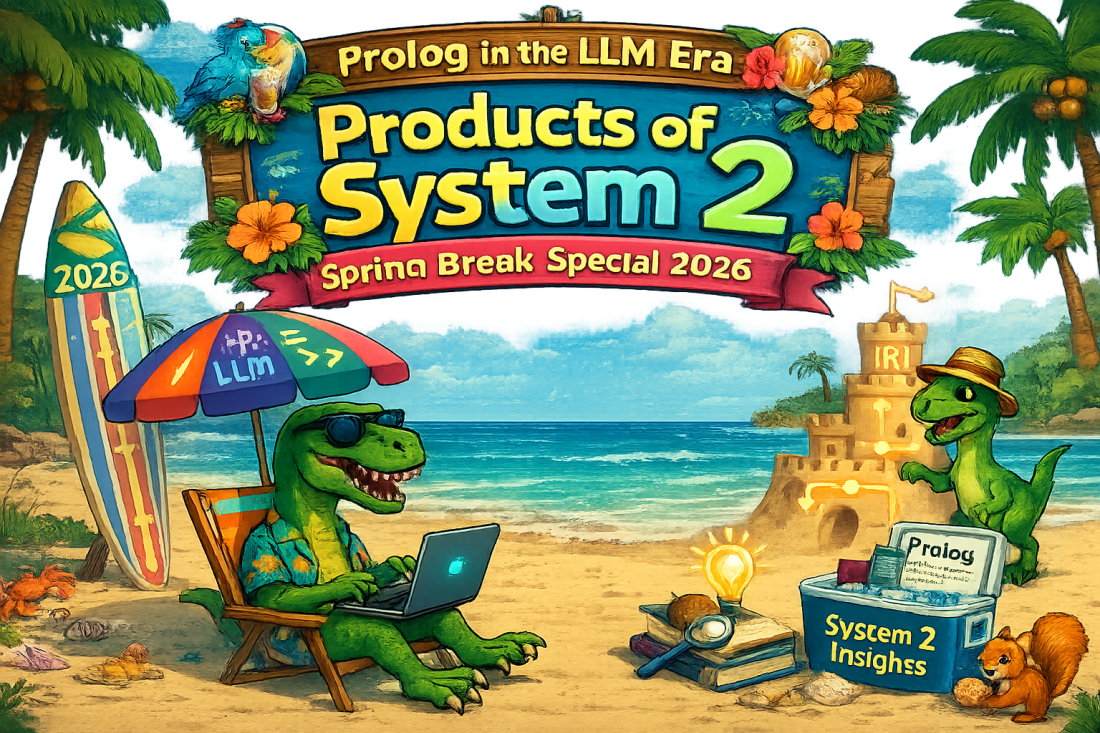
Abstract In The Assemblage of AI architecture, System 2 is modeled after the deliberate reasoning processes described in human cognition. But rather than focusing on psychology, this article examines what System 2 produces inside an AGI system. The outputs are not merely answers to questions but structured artifacts such as stories, plans, procedures, and models. … Continue reading The Products of System 2 – Prolog in the LLM Era – Spring Break 2026 Special
An Interlude Before the Third Act of “The Assemblage of AI”
In the conclusion of my last blog, Chains of Unstable Correlations, I wrote: When you work around experts long enough, you notice that experts sometimes (usually?) forget what isn’t obvious to non-experts. Conversely, people in the field often see things experts overlook because they live inside the operational texture of the system. After a conversation … Continue reading An Interlude Before the Third Act of “The Assemblage of AI”
Chains of Unstable Correlations
Introduction Like it or not, competition is arguably the biggest force affecting how things in our world work, in terms of both evolution and society. Without competition among genes, at the least, life on Earth wouldn't be as it is today. And for better or worse, societal competition at various levels (individual, tribes/cities, countries) wouldn't … Continue reading Chains of Unstable Correlations
Explorer Subgraph—The Dynamic Cartography of Relation Space
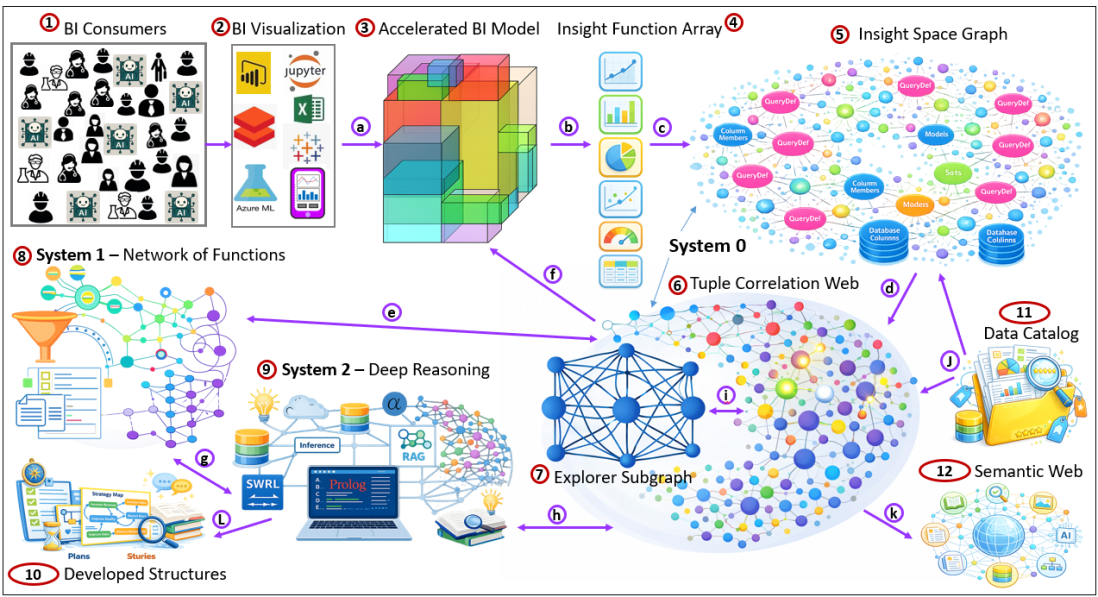
Abstract This blog introduces the Explorer Subgraph, a navigational knowledge structure designed to support System ⅈ (the ⅈ as in the imaginary number). I introduced System ⅈ a few weeks ago in my blog, System ⅈ: The Default Mode Network of AGI. The Explorer Subgraph is a background, always-on layer of intelligence that operates below conscious … Continue reading Explorer Subgraph—The Dynamic Cartography of Relation Space
System ⅈ: The Default Mode Network of AGI
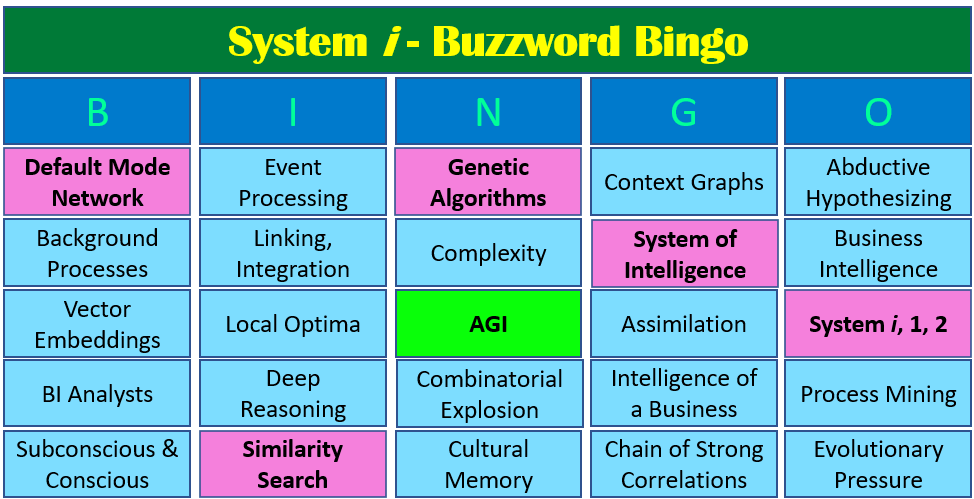
Abstract: TL;DR Preface—The System ⅈ Origin Story For my AI projects back in 2004, SCL and TOSN, the main architectural concept centered on how I imagined our conscious and subconscious work. In my notes, I referred to the conscious as the "single-threaded consciousness". The single-threaded consciousness made sense to me because we have just one … Continue reading System ⅈ: The Default Mode Network of AGI
The Complex Game of Planning
This is my final post for 2025, just in time for your holiday-season reading, ideally from a comfy chair next to the fireplace. It's food for thought for your 2026 New Year resolutions. So toss out that tired old "'Twas the Night Before Christmas" and read this new tale to the kids and grandkids. ✨🎄🔥📚☕❄️🎁 … Continue reading The Complex Game of Planning
From Data through Wisdom: The Case for Process-Aware Intelligence

My new book, Time Molecules, is available!! This is its launch-day blog (June 4, 2025)! Time Molecules is a book about bringing process awareness to business intelligence (BI). Traditional BI flattens reality into snapshots— scalar values, points of information— leaving us staring at dimensionally flattened shadows on a wall. But life unfolds over time, and … Continue reading From Data through Wisdom: The Case for Process-Aware Intelligence
Beyond Ontologies: OODA Loop Knowledge Graph Structures

Introduction: Structuring OODA Loop for Real-World Decision Intelligence Decision-making isn’t just about research—it also involves adapting to change faster than the competition, seizing what can be ephemeral openings for opportunity. The OODA loop—Observe, Orient, Decide, Act—is a well-known model for this, originally developed for military strategy but applicable everywhere from business intelligence to AI-driven automation. … Continue reading Beyond Ontologies: OODA Loop Knowledge Graph Structures
Trophic Cascades of AI
As I mentioned in a previous post, Sample From My Talk - NFA, I will be delivering two sessions at the Data Modeling Zone 2025 (DMZ) in Phoenix. It will be happening from Tuesday, March 4, 2025 through Thursday, March 6, 2025. That post included a preview one of my two sessions, Beyond Ontologies and Taxonomies—focusing on … Continue reading Trophic Cascades of AI
 Soft Coded Logic