KPI-First Probing of the Tuple Correlation Web

Note: From the “deleted scenes” of my book, Enterprise Intelligence, Technics Publications, 2024. This addresses a layered approach to building a Tuple Correlation Web (TCW), which can be massive in its full, enterprise-scoped manifestation. The TCW is primarily an Enterprise Intelligence structure, but it also belongs within the larger idea of my new book, Semantic Webs of … Continue reading KPI-First Probing of the Tuple Correlation Web

Insight Function Array: How the Insight Space Graph Notices, Remembers, and Connects

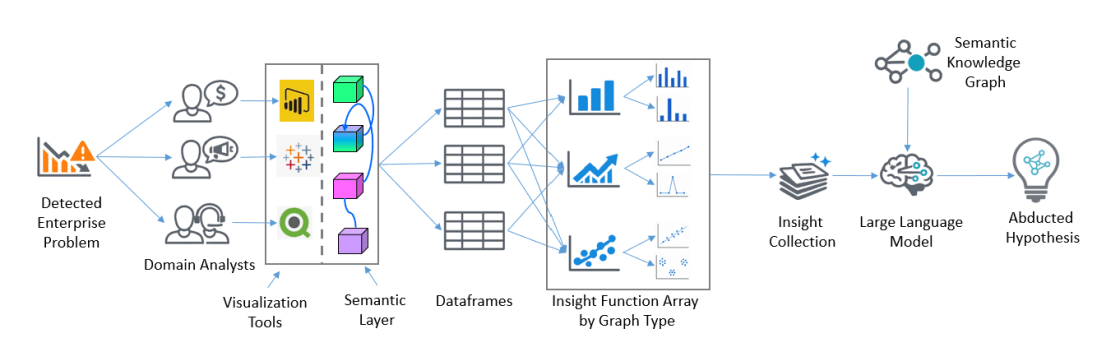
My 2024 book, Enterprise Intelligence, describes the Insight Space Graph (ISG), a graph database that records, maps, and connects the simple insights exposed through the everyday work of Business Intelligence (BI) analysts. Towards the goal of resolving business problems, analysts continually explore enterprise data through tools such as Tableau and Power BI, producing line graphs, … Continue reading Insight Function Array: How the Insight Space Graph Notices, Remembers, and Connects

Chains of Unstable Correlations

Introduction Like it or not, competition is arguably the biggest force affecting how things in our world work, in terms of both evolution and society. Without competition among genes, at the least, life on Earth wouldn't be as it is today. And for better or worse, societal competition at various levels (individual, tribes/cities, countries) wouldn't … Continue reading Chains of Unstable Correlations

The Complex Game of Planning

This is my final post for 2025, just in time for your holiday-season reading, ideally from a comfy chair next to the fireplace. It's food for thought for your 2026 New Year resolutions. So toss out that tired old "'Twas the Night Before Christmas" and read this new tale to the kids and grandkids. ✨🎄🔥📚☕❄️🎁 … Continue reading The Complex Game of Planning

Long Live LLMs! The Central Knowledge System of Analogy

Situation Over the past few months there has been a trend to move from referring to "large language models" (LLM) to just "language models". The reason for that is the recognition that small language models (SLM) have clear advantages under certain situations. So "language model" is inclusive of both. And of course, as soon as … Continue reading Long Live LLMs! The Central Knowledge System of Analogy

Context Engineering and My Two Books

“Context engineering” is emerging as the evolutionary step over prompt engineering. It's the deliberate design of everything an AI system can access before it produces an answer. The goal is to make it work on the right problem, with the right facts, under the right constraints. That is, by mitigating "context drift" as the AI … Continue reading Context Engineering and My Two Books

Stories are the Transactional Unit of Human-Level Intelligence

The transactional unit of meaningful human to human communication is a story. It's the incredibly versatile, somewhat scalable unit by which we teach each other meaningful experiences. Our brains recorded stories well before any hints of our ability to draw and write. We sit around a table or campfire sharing stories, not mere facts. We … Continue reading Stories are the Transactional Unit of Human-Level Intelligence

Outside of the Box AI Reasoning with SVMs

The phrase “thinking outside the box” traces back to a deceptively simple puzzle: nine dots arranged in a 3×3 grid. The challenge is to draw four straight lines through all the dots without lifting your pencil. Most people fail at first because they instinctively keep their lines inside the square boundary implied by the dots. … Continue reading Outside of the Box AI Reasoning with SVMs

Correlation is a Hint Towards Causation

Long ago when scaling database capacity wasn't as easy as upping (or downing) configuration settings through a user-friendly admin Web page (like the "T-shirt size" with Snowflake), highly-skilled DBAs were a luxury at smaller enterprises, and people at work used to go to Happy Hour in droves, a funny thing might happen at pau hana … Continue reading Correlation is a Hint Towards Causation

The Ghost of OLAP Aggregations – Part 1 – Pre-Aggregation

If your entry into the business intelligence (BI) game began after around 2010, it could be difficult to appreciate the value of OLAP cubes (referring mostly to SQL Server Analysis Services MD, ca. 1998-2010), those aggregations, and that MDX query language. In fact, you may have a negative impression of those relics, those "cubes", based … Continue reading The Ghost of OLAP Aggregations – Part 1 – Pre-Aggregation