Web of Functions (Transformations)

This article is a supplement to my new book, Semantic Webs of Meaning: Building Contextual Knowledge Graphs for Deduction and Integration published by Technics Publications (on Amazon) . This is an extension to the topic, Machine Learning Models as Data Products, on page 173. In that topic, iris.py is an example of a Python program … Continue reading Web of Functions (Transformations)

Machine Learning Models in Knowledge Graphs

This article accompanies my new book, Semantic Webs of Meaning: Building Contextual Knowledge Graphs for Deduction and Integration published by Technics Publications. This is an extension to the topic, Machine Learning Models as Data Products, on page 173. In that topic, iris.py is an example of a Python program that creates an ML model (a … Continue reading Machine Learning Models in Knowledge Graphs

When “Sedans Have Four Doors” Means Five Different Things in RDF

This post is related to my book, Semantic Webs of Meaning. Available on Technics Publications and Amazon. Use the code TP25 for a 25% discount if purchasing on the Technics Publications website. In your journey to building knowledge graphs, this is where knowledge graph people can start to sound like the "Comic book Guy" on the Simpsons … Continue reading When “Sedans Have Four Doors” Means Five Different Things in RDF

Trailer for My New Book: Semantic Webs of Meaning

Update August 25, 2026: The supplemental GitHub repo for the Semantic Webs of Meaning is live. The supplemental repo has these main purposes: Post material that is too down into the weeds for the book (ex. install instructions, full appendices, code samples, and tutorials) but is mentioned there. Enable me to expand upon and/or clarify … Continue reading Trailer for My New Book: Semantic Webs of Meaning

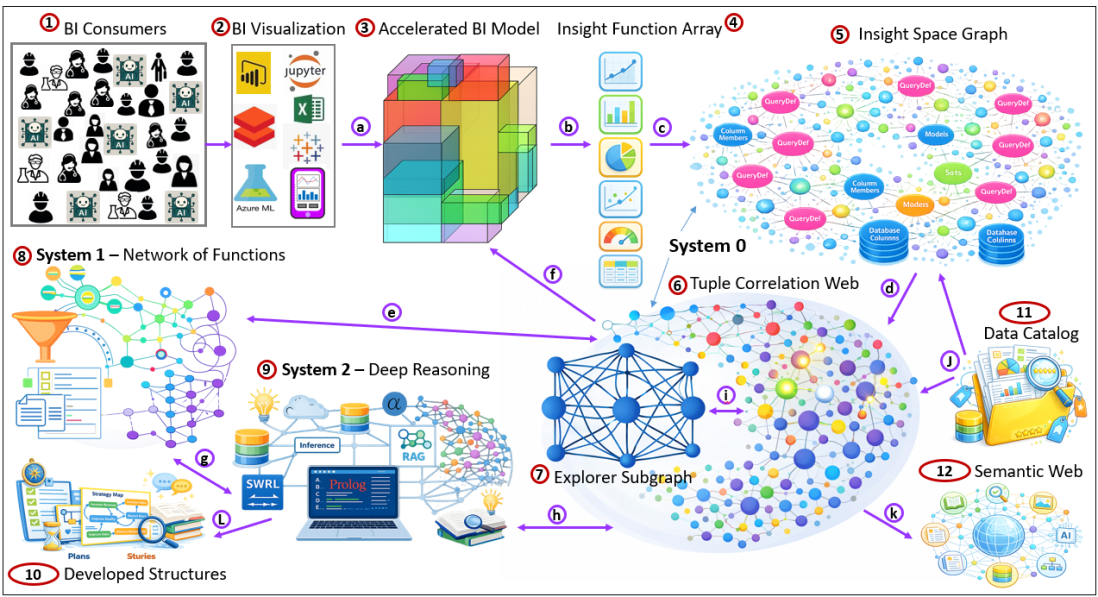
Explorer Subgraph—The Dynamic Cartography of Relation Space

Abstract This blog introduces the Explorer Subgraph, a navigational knowledge structure designed to support System ⅈ (the ⅈ as in the imaginary number). I introduced System ⅈ a few weeks ago in my blog, System ⅈ: The Default Mode Network of AGI. The Explorer Subgraph is a background, always-on layer of intelligence that operates below conscious … Continue reading Explorer Subgraph—The Dynamic Cartography of Relation Space

System ⅈ: The Default Mode Network of AGI

Abstract: TL;DR Preface—The System ⅈ Origin Story For my AI projects back in 2004, SCL and TOSN, the main architectural concept centered on how I imagined our conscious and subconscious work. In my notes, I referred to the conscious as the "single-threaded consciousness". The single-threaded consciousness made sense to me because we have just one … Continue reading System ⅈ: The Default Mode Network of AGI

Conditional Trade-Off Graphs – Prolog in the LLM Era – AI 3rd Anniversary Special

Skip Intro. 🎉 Welcome to the AI “Go-to-Market” 3rd Anniversary Special!! 🎉 Starring ... 🌐 The Semantic Web ⚙️ Event Processing 📊 Machine Learning 🌀 Vibe Coding 🦕 Prolog … and your host … 🤖 ChatGPT!!! Following is ChatGPT 5's self-written, unedited, introduction monologue—in a Johnny Carson style. Please do keep reading because this blog … Continue reading Conditional Trade-Off Graphs – Prolog in the LLM Era – AI 3rd Anniversary Special

Stories are the Transactional Unit of Human-Level Intelligence

The transactional unit of meaningful human to human communication is a story. It's the incredibly versatile, somewhat scalable unit by which we teach each other meaningful experiences. Our brains recorded stories well before any hints of our ability to draw and write. We sit around a table or campfire sharing stories, not mere facts. We … Continue reading Stories are the Transactional Unit of Human-Level Intelligence

Correlation is a Hint Towards Causation

Long ago when scaling database capacity wasn't as easy as upping (or downing) configuration settings through a user-friendly admin Web page (like the "T-shirt size" with Snowflake), highly-skilled DBAs were a luxury at smaller enterprises, and people at work used to go to Happy Hour in droves, a funny thing might happen at pau hana … Continue reading Correlation is a Hint Towards Causation

Beyond Ontologies: OODA Loop Knowledge Graph Structures

Introduction: Structuring OODA Loop for Real-World Decision Intelligence Decision-making isn’t just about research—it also involves adapting to change faster than the competition, seizing what can be ephemeral openings for opportunity. The OODA loop—Observe, Orient, Decide, Act—is a well-known model for this, originally developed for military strategy but applicable everywhere from business intelligence to AI-driven automation. … Continue reading Beyond Ontologies: OODA Loop Knowledge Graph Structures