In the conclusion of my last blog, Chains of Unstable Correlations, I wrote: When you work around experts long enough, you notice that experts sometimes (usually?) forget what isn’t obvious to non-experts. Conversely, people in the field often see things experts overlook because they live inside the operational texture of the system. After a conversation … Continue reading An Interlude Before the Third Act of “The Assemblage of AI”
Tag: nollm
Explorer Subgraph—The Dynamic Cartography of Relation Space
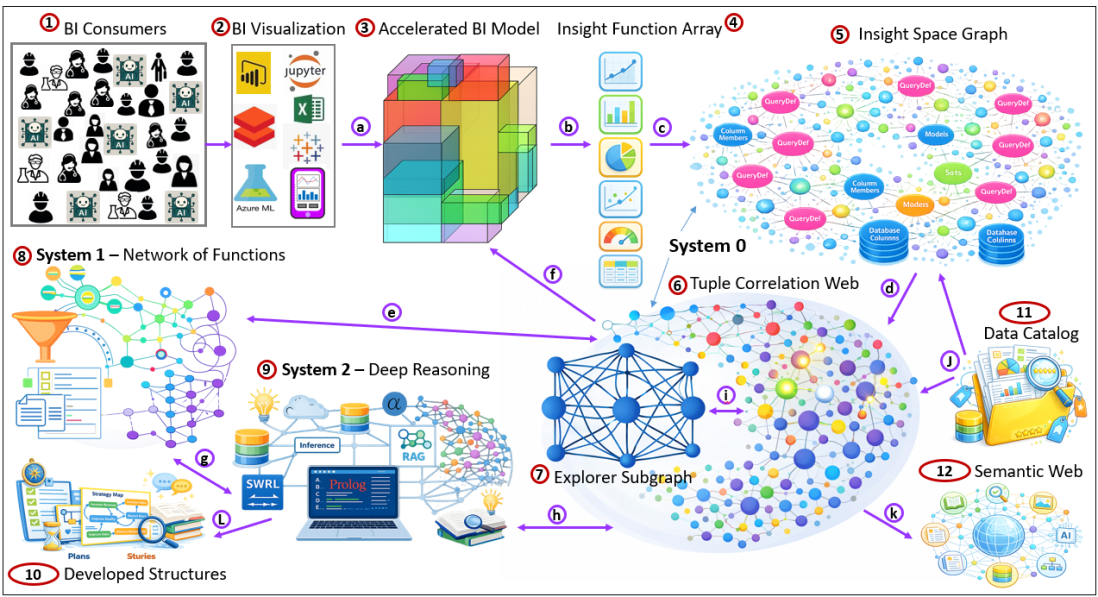
Abstract This blog introduces the Explorer Subgraph, a navigational knowledge structure designed to support System ⅈ (the ⅈ as in the imaginary number). I introduced System ⅈ a few weeks ago in my blog, System ⅈ: The Default Mode Network of AGI. The Explorer Subgraph is a background, always-on layer of intelligence that operates below conscious … Continue reading Explorer Subgraph—The Dynamic Cartography of Relation Space
System ⅈ: The Default Mode Network of AGI
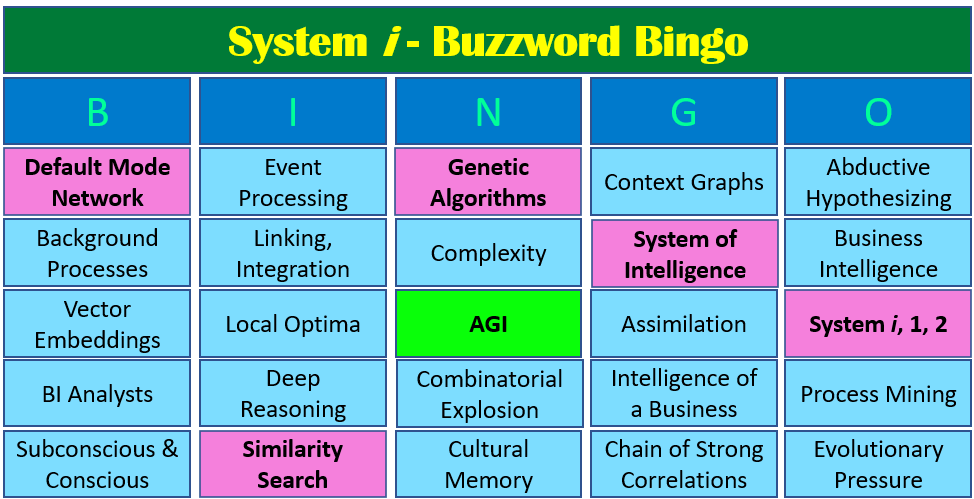
Abstract: TL;DR Preface—The System ⅈ Origin Story For my AI projects back in 2004, SCL and TOSN, the main architectural concept centered on how I imagined our conscious and subconscious work. In my notes, I referred to the conscious as the "single-threaded consciousness". The single-threaded consciousness made sense to me because we have just one … Continue reading System ⅈ: The Default Mode Network of AGI
The Complex Game of Planning
This is my final post for 2025, just in time for your holiday-season reading, ideally from a comfy chair next to the fireplace. It's food for thought for your 2026 New Year resolutions. So toss out that tired old "'Twas the Night Before Christmas" and read this new tale to the kids and grandkids. ✨🎄🔥📚☕❄️🎁 … Continue reading The Complex Game of Planning
Conditional Trade-Off Graphs – Prolog in the LLM Era – AI 3rd Anniversary Special

Skip Intro. 🎉 Welcome to the AI “Go-to-Market” 3rd Anniversary Special!! 🎉 Starring ... 🌐 The Semantic Web ⚙️ Event Processing 📊 Machine Learning 🌀 Vibe Coding 🦕 Prolog … and your host … 🤖 ChatGPT!!! Following is ChatGPT 5's self-written, unedited, introduction monologue—in a Johnny Carson style. Please do keep reading because this blog … Continue reading Conditional Trade-Off Graphs – Prolog in the LLM Era – AI 3rd Anniversary Special
Long Live LLMs! The Central Knowledge System of Analogy

Situation Over the past few months there has been a trend to move from referring to "large language models" (LLM) to just "language models". The reason for that is the recognition that small language models (SLM) have clear advantages under certain situations. So "language model" is inclusive of both. And of course, as soon as … Continue reading Long Live LLMs! The Central Knowledge System of Analogy
Stories are the Transactional Unit of Human-Level Intelligence
The transactional unit of meaningful human to human communication is a story. It's the incredibly versatile, somewhat scalable unit by which we teach each other meaningful experiences. Our brains recorded stories well before any hints of our ability to draw and write. We sit around a table or campfire sharing stories, not mere facts. We … Continue reading Stories are the Transactional Unit of Human-Level Intelligence
Reptile Intelligence: An AI Summer for CEP

Abstract Complex Event Processing (CEP) has long been dismissed as mere real-time infrastructure, yet it embodies the scalable, deterministic substrate that artificial intelligence has overlooked: a high-performance System 1 layer as described in Daniel Kahneman’s Thinking, Fast and Slow. System 1—fast, automatic, intuitive, massively parallel, and effortless—handles the overwhelming flood of sensory (or in enterprise … Continue reading Reptile Intelligence: An AI Summer for CEP
Embedding Machine Learning Models into Knowledge Graphs

Think about the usual depiction of a network of brain neurons. It’s almost always shown as a sprawling, kind of amorphous web, with no real structure or organization—just a big ball of connected neurons (like the Griswold Christmas lights). But this image misses so much of what makes the brain remarkable. Neurons aren’t just randomly … Continue reading Embedding Machine Learning Models into Knowledge Graphs
Playing with Prolog – Prolog’s Role in the LLM Era, Part 3

This blog series explores the synergy between Prolog's deterministic rules and Large Language Models (LLMs). Part 1 and 2 set the stage and discussed using Prolog alongside LLMs and Knowledge Graphs. A practical use case demonstrates how Prolog, aided by LLMs, can make meaningful contributions to AI systems. The series hopes to reignite interest in Prolog.
 Soft Coded Logic