I’m excited to announce that my book, “Enterprise Intelligence” (published by Technics Publications), will be available on June 21, 2024. This book provides what I feel is a pragmatic and sober approach towards integrating today’s level of AI with Business Intelligence (BI) to facilitate and accelerate dynamic, high-performing enterprises.
Note that if you purchase the book from the Technics Publications site, use the coupon code TP25 for a 25% discount off most items (as of June 25, 2024).
My book presents an approach towards the implementation of AI that we should consider within our enterprises whether we achieve AGI/ASI (Artificial General/Super Intelligence) or fall into yet another AI Winter (it should be a mild San Diego-like winter). It advocates for people (we sentient and sapient beings with feelings and goals in life) to remain in the driver’s seat, at least until we’ve lived with this level of AI or greater for a few decades or so. I prescribe augmenting current analytics systems, particularly BI, with AI, as opposed to focusing on AI the central piece of an analytics SaaS.
We don’t know if this LLM-based iteration of AI (since ChatGPT 3.5 burst onto the radar of the general public back in November 2022) will continue on its hockey stick trajectory or if it will flatten into “Part 3 of the s-curve” – the point of diminishing returns. In some ways, it doesn’t matter if AI gets better. It is already good enough to have transformed many domains, such as marketing, coding, and production of context. Today’s LLMs may not produce the greatest work, but as long as I don’t push it beyond a certain creative/artistic/innovative threshold, it certainly can add substantial value.
However, the current quality of LLM work still isn’t to a point where we don’t need to review practically everything it does. As I’ve worked with ChatGPT over the past year and a half, just about every day I’m thinking, “If you want something done right, you might as well do it yourself.”
Whether we achieve AGI/ASI or not within our lifetimes, one thing I do know is that we cannot forfeit our ability for critical/creative thinking. When our physical strength was replaced by animals then machines, it didn’t matter much because we didn’t pride ourselves as the strongest creatures on Earth. In this case, we are the only undisputed critical thinkers (at least on Earth … probably). So this isn’t the same thing as being that “horse and buggy guy”.
Letting the skill of critical/creative thinking atrophy as we continue to drift into AI dependency and complacency–even AI that’s still inferior to even average critical/creative thinkers–albeit with massive reach and unlimited energy-is something we need to seriously analyze. We have no idea what an AGI would be like even if it does seem to “acts” like us. Even the unintended consequences of over-reliance on today’s level of AI just seems fraught with foolishness.
What I propose in the book is constructed from pieces of the analytics frameworks we’ve become familiar with over the past couple of decades. Figure 2 is a very high-level view of how the major pieces fit together, coalescing into a framework for Augmented Enterprise Intelligence.
We can see an Enterprise Knowledge Graph (EKG) is the capstone of the framework. It’s an integration of SME-authored and automatically curated knowledge across and enterprise. We see its three primary inputs of:
- Data Catalog—Linking the two hemispheres of OLAP and OLTP.
- Business Intelligence—A light attempt at a “digital twin” (ISG and TCW) of the
business problems faced by a growing army of enterprise analysts. - Ontologies–The domain-level encodings of knowledge authored by the SMEs of
the business processes.
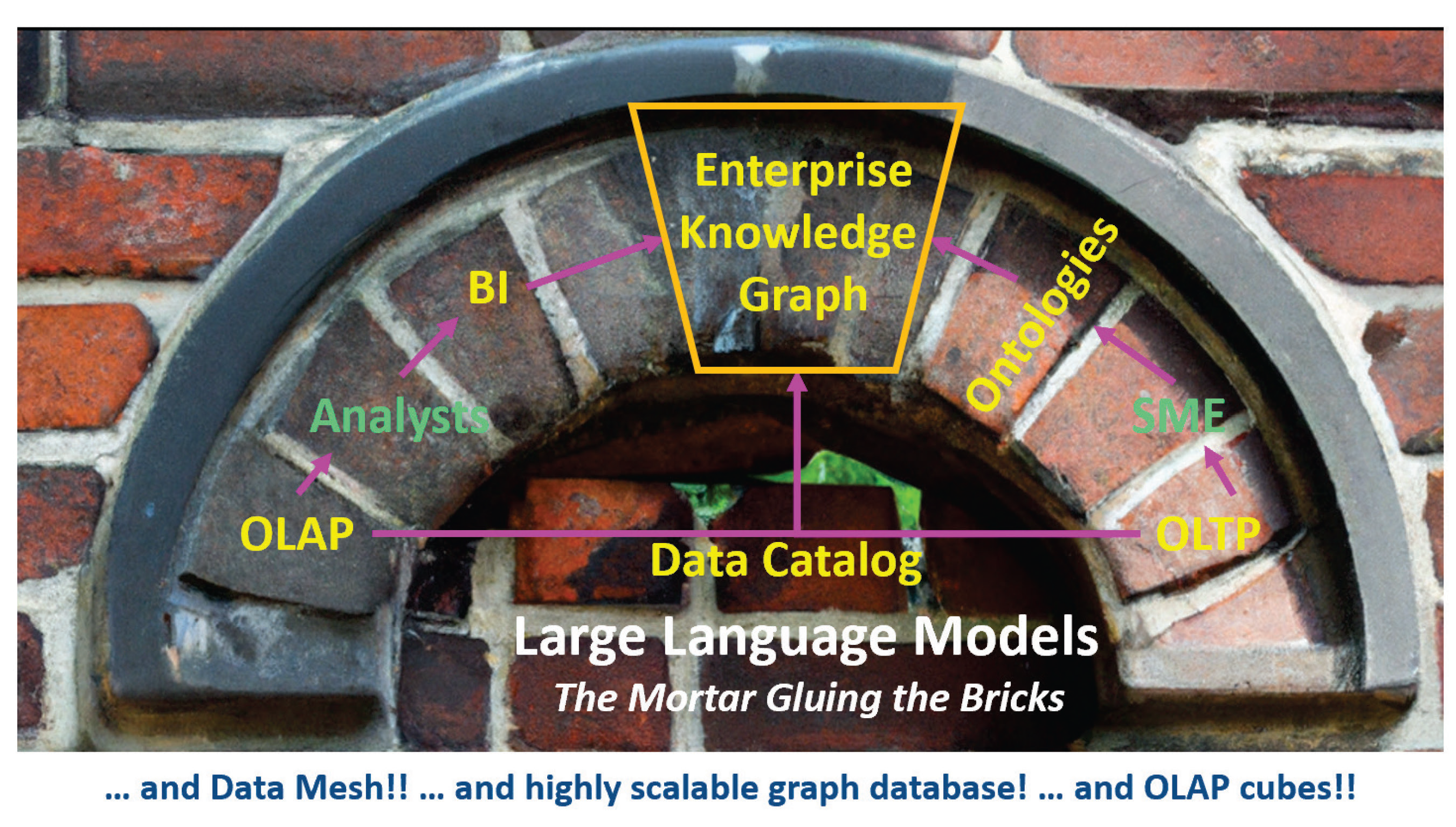
Other notable things in the Figure 2 above:
- LLMs act as the mortar between all the components (the bricks) in a loosely-coupled way.
- Data Mesh is an architectural methodology that enables us to onboard BI systems at a quicker rate.
- The scalability of graph databases today enables KGs of a bigger scale than those we authored in Visio years ago.
- OLAP cubes are necessary constructs when the volume and varietal breadth of analytical data can drastically exceed the feasibly economical capacity of the current hardware.
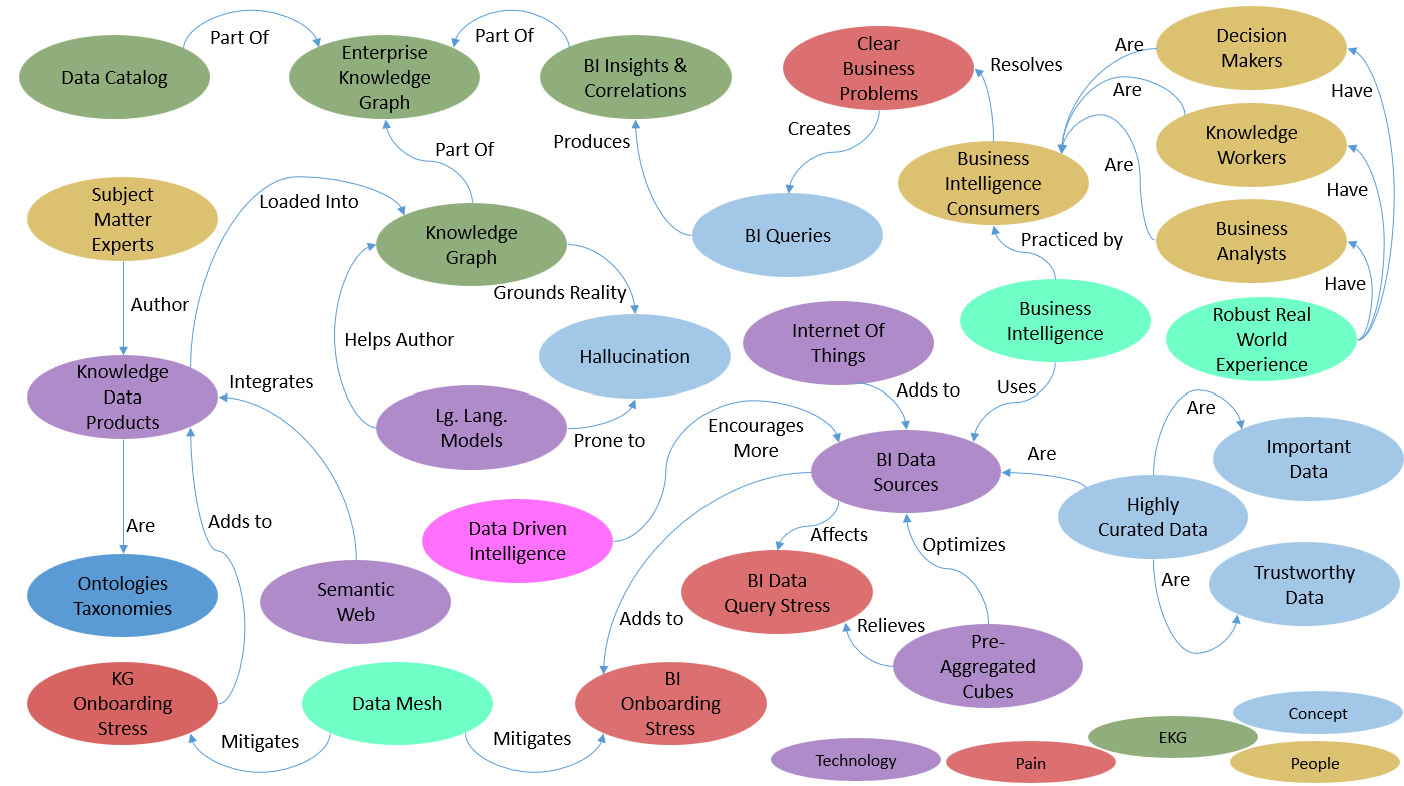
Because knowledge graphs play a big role in the book, it’s fitting to see a KG of how the pieces in the book fit together. Of course, Figure 3 is not as comprehensive as it really should be, but it wouldn’t be readable if it were.
The “Book Cover” Description (as on Amazon)
Harness the Power of BI and AI—Utilize highly curated BI data, an enterprise knowledge graph, and advanced AI to build a resilient and intelligent enterprise capable of making innovative decisions.
In the unprecedently evolving landscape of technology and business, the terms Business Intelligence (BI) and Artificial Intelligence (AI) represent different facets of “intelligence.” However, when combined, they create a powerful synergy that transforms enterprises into dynamic, highly adaptive entities capable of thriving in an ever-changing ecosystem.
This book is the first in a series designed to guide corporations from lumbering entities to becoming agile, high-performing organisms. By integrating BI structures into an Enterprise Knowledge Graph (EKG), businesses can develop a central nervous system more on par with those of living organisms, to enhance decision-making and performance.
The main topics covered include:
- The Sudden Leap Forward: Understand the problem we face with the sudden advent of high-quality large language models (LLMs) and how they bridge the gap between human and machine intelligence.
- The Intelligence of a Business: Explore the desires, fears, and competitive strategies of enterprises, and the need for an expansive field of vision and a central nervous system akin to living organisms.
- Knowledge Graphs and LLMs: Drill into the components of the EKG, including a Knowledge Graph (KG) authored by subject matter experts, a Data Catalog (DC) that organizes metadata, and BI-derived structures like the Insight Space Graph (ISG) and Tuple Correlation Web (TCW).
- Building the Corporate Brain: Learn how to capture the insights and patterns from BI analysts’ activities across the enterprise, creating a single integrated source of insights that functions like a human brain.
- Architecture and Implementation: Gain practical guidance on the architecture of the EKG, BI-charged components, and special patterns for implementation to solve complex business problems.
With the advent of highly capable and accessible AI, the pieces needed to build an integrated enterprise “brain” are now within reach. This book provides the essential knowledge and tools to harness BI and AI, transforming your business into a thriving, intelligent organism ready to navigate the complexities of the modern world.
Humanity is a Distributed System of Brilliance
Humanity (or groups or even individuals) might seem frustratingly foolish at times, still making bad decisions despite all the accumulated knowledge and computers to store and sort out massive information. But fortunately, we’re capable of creatively adjusting as we go along. And it’s essential to remember that we still manage to do a lot of really great things. In all fairness to all of us, it’s all a work in progress. We are a distributed system of eight billion sentient brains, each contributing from unique perspectives into our collective knowledge and wisdom. These brains build on the accumulated wisdom of countless brilliant minds from the past few millennia, creating a tapestry of understanding and innovation.
Each human brain is a marvel of complexity, composed of around 80 billion neurons and trillions of synapses, with possibly many times more factors (e.g. glial cells and those microtubule things Penrose-Hameroff talk about) that might be playing equally crucial roles in the mechanics of our thinking. This intricate network allows us to perceive the world from countless different perspectives, from dimensions of time, place, and infinite contexts.
More importantly, our eight billion brains form a massive socially-structured network of loosely-coupled intelligences linked from person to person through permutations of shared experiences, education, cultures, languages, histories, technologies, and countless other factors. This interconnectedness means that with our slightly different takes on the world, we can collaboratively construct and reconstruct anything from those many angles.
LLMs, on the other hand, are currently built from text written by relatively few of us. Although some works are read by most of us, the vast majority of works are read by few. Similarly, troves of details unique to each of us goes unknown. Additionally, almost all of our writings fail to capture the real richness of all that is in the writer or craftperson’s mind. So, we need to have a mechanism that allows for at least some level of automated input from the masses of knowledgeable folks who haven’t published books, articles, blogs, or even product documentation.
Lastly, although the power of LLMs is to understand unstructured data, structured data, like that of BI systems is easier for people and even AIs to “digest”. Structured data provides a clear and organized format that helps in understanding complex relationships and patterns, reducing the need for discovery of on-the-fly assumptions. This structured approach can enhance the capabilities of LLMs, enabling them to analyze data more accurately and make more informed decisions-just as it does for people.
In my book, “Enterprise Intelligence,” I explore how our collective and incomparably robust human brilliance must continue to drive decisions in the business world—while fully augmenting our analysis in a data-driven manner. By integrating highly curated BI data and advanced AI techniques, we can create dynamic, highly adaptive enterprises capable of making innovative decisions. Just as humanity thrives on its distributed network of unique yet interconnected minds, businesses can leverage BI and AI to navigate and excel in an ever-changing, healthily competitive landscape.
My book demonstrates that while companies may face extinction in the evolutionary process of business, this outcome is preferable to vigorous competition at the individual level, where people suffer or die. Although the end of a business can be difficult for its owners and employees, a healthy churn of startups disrupting larger corporations ensures a dynamic corporate ecosystem. This allows individuals to move on to new opportunities, fostering innovation and growth. By viewing corporations as entities in their own right and using AI (driven by BI) to enable competition at the corporate level, we can create a healthier, more competitive ecosystem that promotes sustainable evolution and benefits society as a whole.

 Soft Coded Logic