This article is a supplement to my new book, Semantic Webs of Meaning: Building Contextual Knowledge Graphs for Deduction and Integration published by Technics Publications (on Amazon) . This is an extension to the topic, Machine Learning Models as Data Products, on page 173. In that topic, iris.py is an example of a Python program … Continue reading Web of Functions (Transformations)
Tag: LLM
Trailer for My New Book: Semantic Webs of Meaning
Update August 25, 2026: The supplemental GitHub repo for the Semantic Webs of Meaning is live. The supplemental repo has these main purposes: Post material that is too down into the weeds for the book (ex. install instructions, full appendices, code samples, and tutorials) but is mentioned there. Enable me to expand upon and/or clarify … Continue reading Trailer for My New Book: Semantic Webs of Meaning
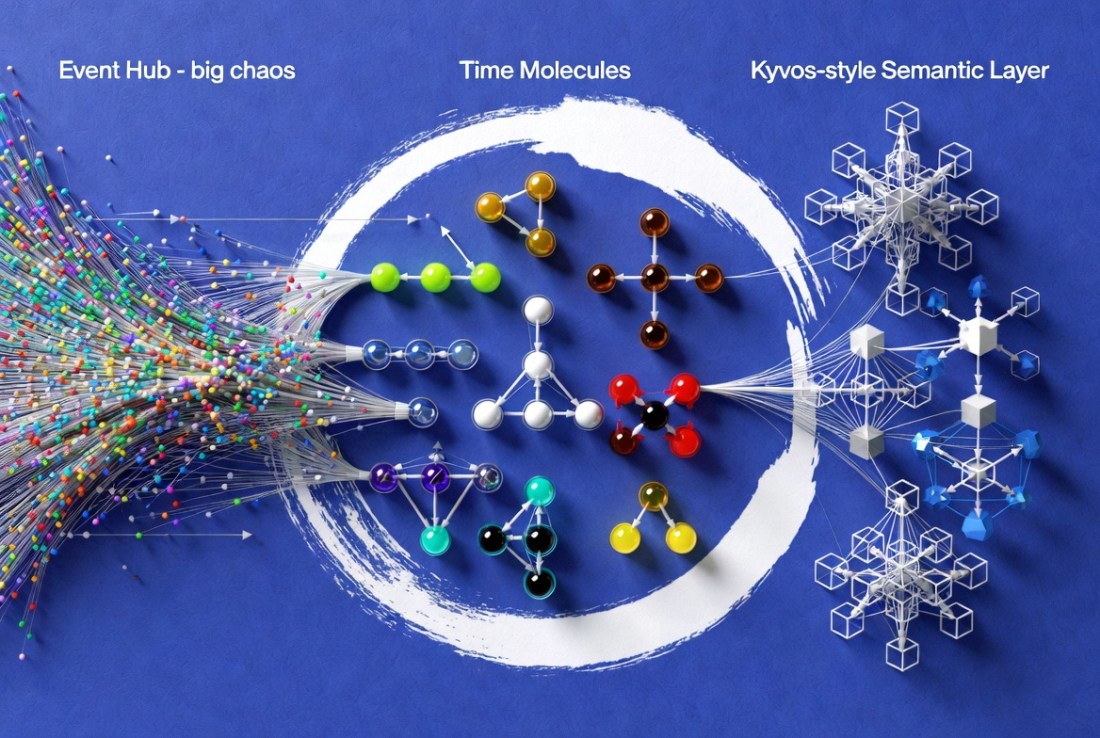
Time Molecules 2026 Refresh/Update
Today, May 15, 2026, is the launch of the Spring 2026 Refresh/Update of my book, Time Molecules, is available. This is not a new edition of the book, but a significant expansion of the material I've placed in its supplemental GitHub repository and this blog site. The refresh expands on the core ideas, strengthening the … Continue reading Time Molecules 2026 Refresh/Update
AI Agents, Context Engineering, and Time Molecules
Abstract AI agents are not just about producing answers—they are executing processes. If those processes emit events for each step, they can be studied the same way we study human and enterprise workflows. By capturing and analyzing these event streams, we can reconstruct the context behind agent decisions and understand how AI-driven systems actually operate … Continue reading AI Agents, Context Engineering, and Time Molecules
An Interlude Before the Third Act of “The Assemblage of AI”
In the conclusion of my last blog, Chains of Unstable Correlations, I wrote: When you work around experts long enough, you notice that experts sometimes (usually?) forget what isn’t obvious to non-experts. Conversely, people in the field often see things experts overlook because they live inside the operational texture of the system. After a conversation … Continue reading An Interlude Before the Third Act of “The Assemblage of AI”
Explorer Subgraph—The Dynamic Cartography of Relation Space
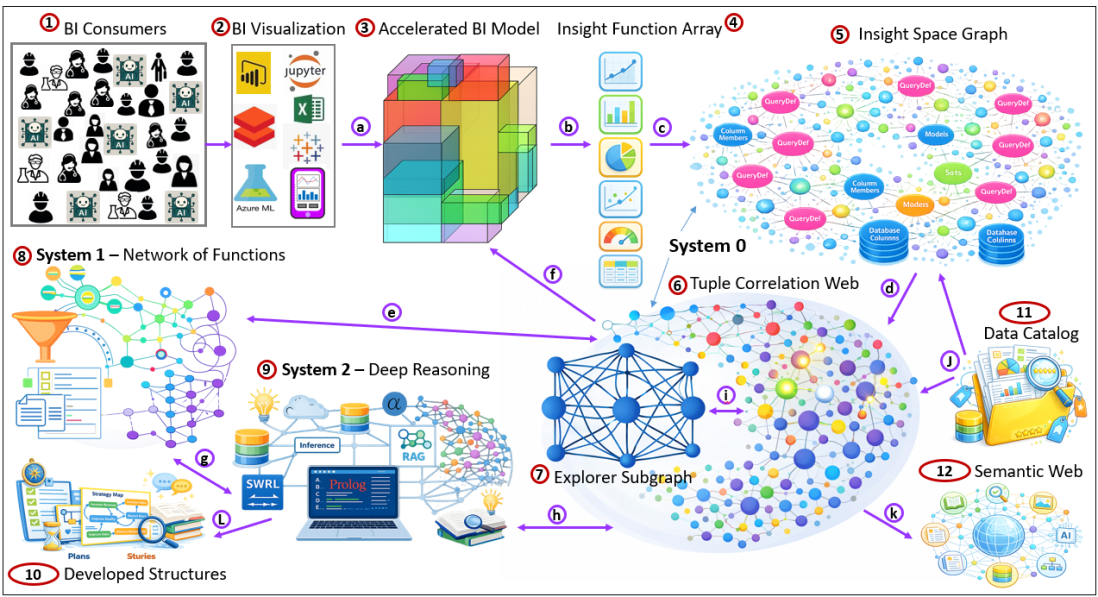
Abstract This blog introduces the Explorer Subgraph, a navigational knowledge structure designed to support System ⅈ (the ⅈ as in the imaginary number). I introduced System ⅈ a few weeks ago in my blog, System ⅈ: The Default Mode Network of AGI. The Explorer Subgraph is a background, always-on layer of intelligence that operates below conscious … Continue reading Explorer Subgraph—The Dynamic Cartography of Relation Space
System ⅈ: The Default Mode Network of AGI
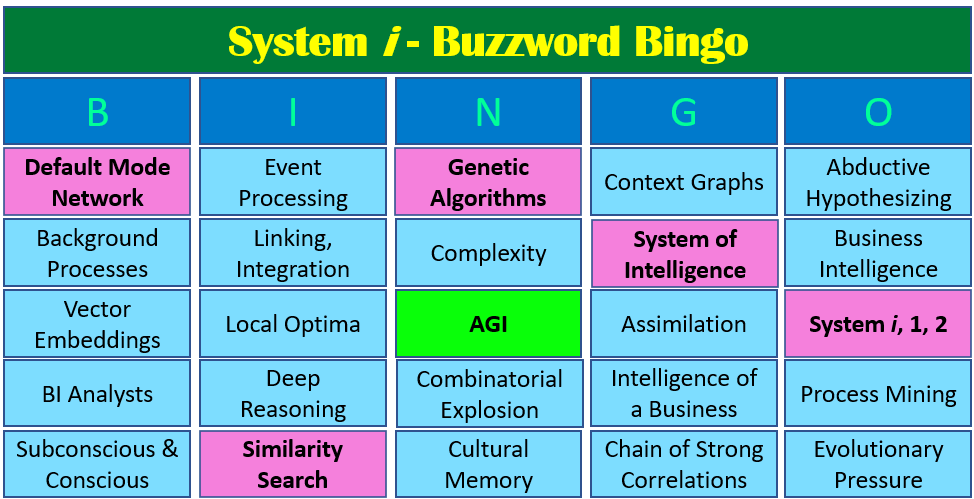
Abstract: TL;DR Preface—The System ⅈ Origin Story For my AI projects back in 2004, SCL and TOSN, the main architectural concept centered on how I imagined our conscious and subconscious work. In my notes, I referred to the conscious as the "single-threaded consciousness". The single-threaded consciousness made sense to me because we have just one … Continue reading System ⅈ: The Default Mode Network of AGI
Conditional Trade-Off Graphs – Prolog in the LLM Era – AI 3rd Anniversary Special
Skip Intro. 🎉 Welcome to the AI “Go-to-Market” 3rd Anniversary Special!! 🎉 Starring ... 🌐 The Semantic Web ⚙️ Event Processing 📊 Machine Learning 🌀 Vibe Coding 🦕 Prolog … and your host … 🤖 ChatGPT!!! Following is ChatGPT 5's self-written, unedited, introduction monologue—in a Johnny Carson style. Please do keep reading because this blog … Continue reading Conditional Trade-Off Graphs – Prolog in the LLM Era – AI 3rd Anniversary Special
The Ghost of OLAP Aggregations – Part 2 – Aggregation Manager
This is Part 2 of a 3-part series where I make the case that pre-aggregated OLAP is essential in this era of AI. The intent of this post is to describe just enough of how a pre-aggregated OLAP engine works for those who are unfamiliar with this technology: Those who have joined the business intelligence … Continue reading The Ghost of OLAP Aggregations – Part 2 – Aggregation Manager
Outside of the Box AI Reasoning with SVMs
The phrase “thinking outside the box” traces back to a deceptively simple puzzle: nine dots arranged in a 3×3 grid. The challenge is to draw four straight lines through all the dots without lifting your pencil. Most people fail at first because they instinctively keep their lines inside the square boundary implied by the dots. … Continue reading Outside of the Box AI Reasoning with SVMs