Seeing the Hook through the Uncanny Valleys Encountered by an Enterprise

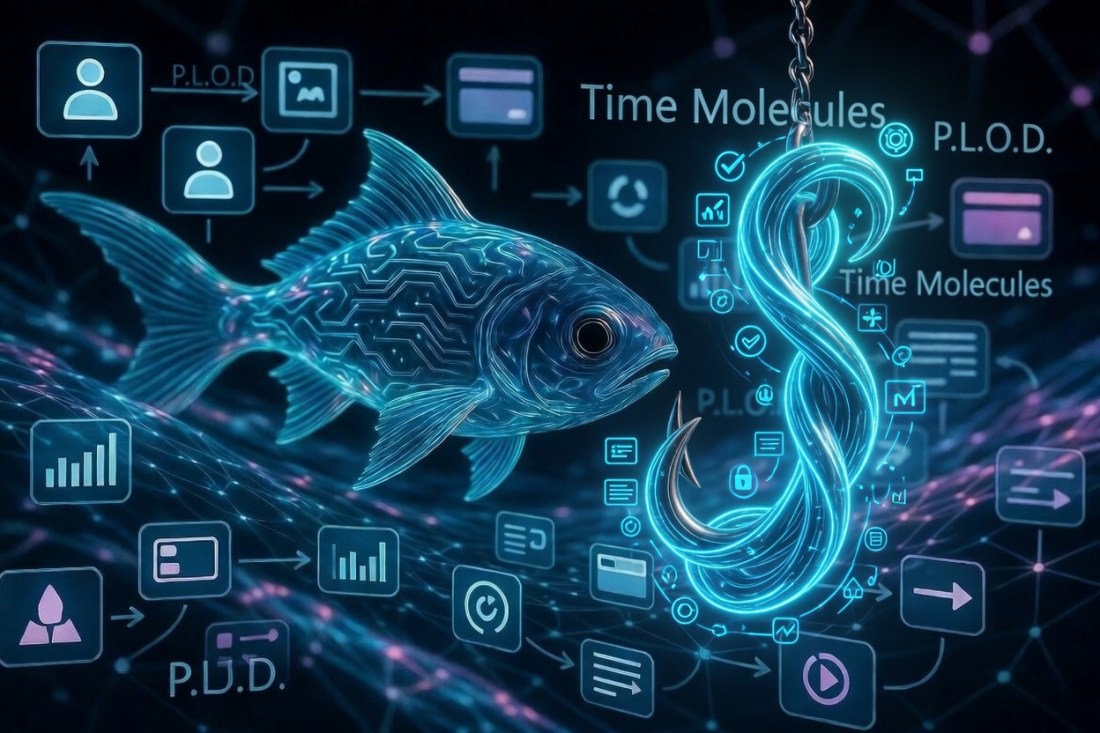
This blog describes the Time Molecules process for the analysis of adversarial situations. That includes frauds, competitive games such as Texas Hold'em Poker, and any other situation where imperfect information is the key asset. Beyond sheer skill, good adversaries rely on stealth, sleight-of-hand, misinformation/disinformation, information overload, mimicry (impersonation), etc. Adversaries paint a false picture for … Continue reading Seeing the Hook through the Uncanny Valleys Encountered by an Enterprise

AI Agents, Context Engineering, and Time Molecules

Abstract AI agents are not just about producing answers—they are executing processes. If those processes emit events for each step, they can be studied the same way we study human and enterprise workflows. By capturing and analyzing these event streams, we can reconstruct the context behind agent decisions and understand how AI-driven systems actually operate … Continue reading AI Agents, Context Engineering, and Time Molecules

An Interlude Before the Third Act of “The Assemblage of AI”

In the conclusion of my last blog, Chains of Unstable Correlations, I wrote: When you work around experts long enough, you notice that experts sometimes (usually?) forget what isn’t obvious to non-experts. Conversely, people in the field often see things experts overlook because they live inside the operational texture of the system. After a conversation … Continue reading An Interlude Before the Third Act of “The Assemblage of AI”

Conditional Trade-Off Graphs – Prolog in the LLM Era – AI 3rd Anniversary Special

Skip Intro. 🎉 Welcome to the AI “Go-to-Market” 3rd Anniversary Special!! 🎉 Starring ... 🌐 The Semantic Web ⚙️ Event Processing 📊 Machine Learning 🌀 Vibe Coding 🦕 Prolog … and your host … 🤖 ChatGPT!!! Following is ChatGPT 5's self-written, unedited, introduction monologue—in a Johnny Carson style. Please do keep reading because this blog … Continue reading Conditional Trade-Off Graphs – Prolog in the LLM Era – AI 3rd Anniversary Special

Context Engineering and My Two Books

“Context engineering” is emerging as the evolutionary step over prompt engineering. It's the deliberate design of everything an AI system can access before it produces an answer. The goal is to make it work on the right problem, with the right facts, under the right constraints. That is, by mitigating "context drift" as the AI … Continue reading Context Engineering and My Two Books

The Ghost of OLAP Aggregations – Part 2 – Aggregation Manager

This is Part 2 of a 3-part series where I make the case that pre-aggregated OLAP is essential in this era of AI. The intent of this post is to describe just enough of how a pre-aggregated OLAP engine works for those who are unfamiliar with this technology: Those who have joined the business intelligence … Continue reading The Ghost of OLAP Aggregations – Part 2 – Aggregation Manager

Outside of the Box AI Reasoning with SVMs

The phrase “thinking outside the box” traces back to a deceptively simple puzzle: nine dots arranged in a 3×3 grid. The challenge is to draw four straight lines through all the dots without lifting your pencil. Most people fail at first because they instinctively keep their lines inside the square boundary implied by the dots. … Continue reading Outside of the Box AI Reasoning with SVMs

Thinking Reliably and Creatively – Prolog in the LLM Era – Summer Vacation Special

Welcome to the Prolog in the LLM Era Summer Vacation Special! Starring … Prolog ... knowledge graphs ... ChatGPT o4-mini ... neuro-symbolic AI ... and our special guest ... Thinking Fast and Slow! In this episode (Part 11 of the series), I wish to address how neuro-symbolic AI relates to this series. After all, the series title, Prolog … Continue reading Thinking Reliably and Creatively – Prolog in the LLM Era – Summer Vacation Special

Analogy and Curiosity-Driven Original Thinking

Original thinking doesn’t spring from a void. It’s the meticulous art of forging a path to a solution where none yet exists, of stitching together lessons from far-flung domains to carry us from where we are to where we wish to be. In everyday life, we rely on zero-sum games—win or lose, right or wrong—yet … Continue reading Analogy and Curiosity-Driven Original Thinking