In the unprecedently evolving landscape of data analytics, turbo-charged by AI in the enterprise mainstream, businesses must craft an “informationally-scalable” infrastructure to keep up with survival of the cleverest. My book, Enterprise Intelligence (Amazon), presents a comprehensive framework that builds on well-socialized Business Intelligence (BI) principles while incorporating modern advancements such as data mesh, knowledge graphs, and Large Language Models (LLMs). This approach not only eases pain points but also addresses governance issues, providing a robust foundation for decision-making in an AI-driven world.
I’ve written a TL;DR of the book, as well as the book description on the Technics Publications and Amazon pages. However, the TL;DR is really a preamble I use when asking ChatGPT for advice. Regarding the book description, as a first-time author, it took me a week to realize the book description is of no use if no one ever finds the book on Amazon.
So, here I offer a book description that is a little more comprehensive than the one on the book (confined to the size of a dust jacket) – but not an entire book in its own right.
We’ve seen the two figures I use in this blog in the earlier Release Date for My Book. However, I explain them in greater detail in this blog.
Note that if you purchase the book from the Technics Publications site, use the coupon code TP25 for a 25% discount off most items (as of June 25, 2024).
The High Level Pieces
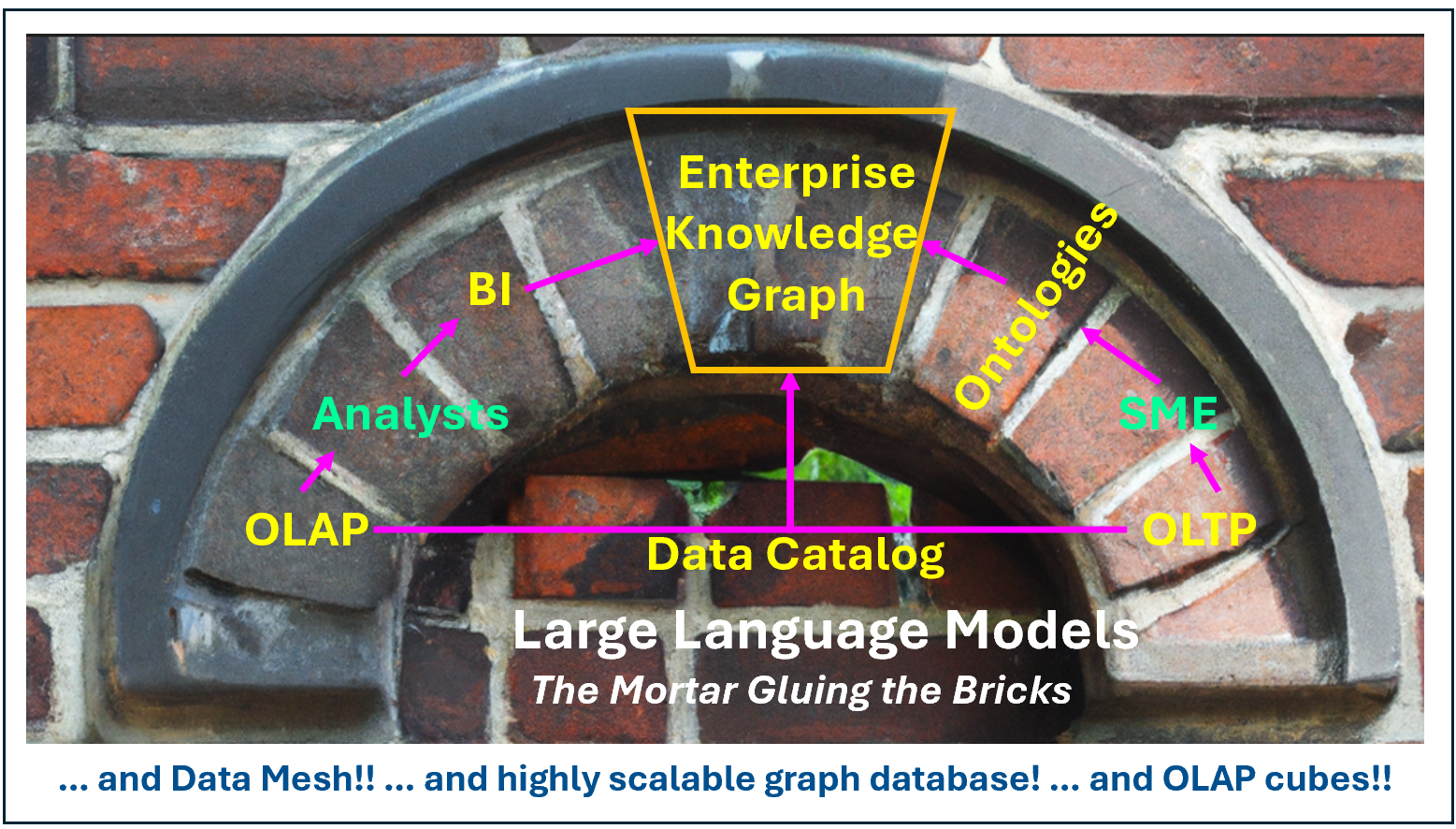
The image below provides a visual representation of the Enterprise Intelligence framework, illustrating how various components fit together to create a cohesive and efficient data ecosystem. Here’s a high-level analysis of how these parts interconnect.
At top-center is the capstone of my book, the Enterprise Knowledge Graph. As a real capstone, it’s the piece that holds the entire structure together. In the context of my book, the EKG is an interconnected framework (a knowledge graph) that organizes and contextualizes enterprise data, combining taxonomy and ontology principles with BI/AI-driven insights.
On the Left: OLAP (Online Analytical Processing)
OLAP systems, represented as the “semantic layer,” are designed for complex queries and analytical tasks. They transform raw data from OLTP systems into a structured format optimized for reporting and analysis. OLAP cubes act as the data warehouse accelerators, providing fast query performance and enabling customer-facing analytics through their pre-aggregated data.
On the Right: OLTP (Online Transaction Processing)
OLTP systems are the backbone of operational data. They handle the daily transactions and operations of the enterprise, generating vast amounts of raw data. This data is crucial for real-time analytics and operational reporting.
Analysts and Domain SMEs (Subject Matter Experts)
Analysts and Domain SMEs (OLAP and OLTP folks, respectively) are the people who interpret and utilize the data. Analysts dive deep into the data, extracting insights and driving business decisions. SMEs, on the other hand, provide the contextual knowledge necessary to understand the data’s relevance and implications. They play a vital role in curating and validating the data used in the Enterprise Knowledge Graph (EKG).
Key Components Feeding into the EKG:
- BI (Business Intelligence): BI tools and processes gather, analyze, and present business data. They produce insights that drive strategic decisions and are integral to the EKG.
- Ontologies: Ontologies provide a structured framework for organizing information. They define the relationships between different data elements, ensuring that the EKG accurately reflects the enterprise’s knowledge and operations.
Central Elements:
- Enterprise Knowledge Graph (EKG): The EKG is the central repository that integrates data from various sources, including BI and ontologies. It acts as a unified model of the enterprise’s knowledge, enabling advanced analytics and informed decision-making.
- Data Catalog: The data catalog ties together data from OLTP and OLAP sources. It ensures that data is well-documented, discoverable, and accessible, facilitating effective data governance and management.
- Large Language Models (LLMs): Positioned as the “mortar gluing the bricks,” LLMs enhance the EKG by providing advanced natural language processing capabilities. The role of LLMs is different from a shiny new toy. It’s ability to “interpret” and translate communication is like a force of coherence. Among many roles, it helps:
- Interpret and generate meaningful insights from the data, supporting various analytical and operational tasks.
- SMEs to encode their domain knowledge into a knowledge graph.
- Help guide BI analysts such as to navigate an enterprise-wide data fabric, suggest visualizations, and data slicing, dicing and drill-throughs.
- Help in tagging and categorizing data in the Data Catalog, ensuring that metadata is comprehensive and up-to-date. (Or assist in master data management.)
Methodology:
- Data Mesh: Data mesh is the methodology that enables better onboarding and management of data. By decentralizing data ownership and treating data as a product, it enhances scalability and governance across the enterprise.
- Semantic Web: The Semantic Web (RDF, OWL, SPARQL) methodology enhances the interconnectedness and semantic understanding across knowledge graphs. By using standardized ontologies and frameworks, it ensures that data from diverse sources is uniformly interpreted and easily integrated, facilitating advanced analytics and AI applications.
Infrastructure:
- Graph Databases: High-scale graph databases, like Neo4j, underpin the EKG. They provide the necessary scalability and performance to handle complex queries and relationships within the EKG.
- OLAP Cubes: OLAP cubes have a history of serving as the customer-facing layer of analytics. With their speed and capabilities, they ensure that end-users can quickly access and analyze data. Tools like Kyvos provide additional semantic layer functionalities, enhancing the analytical experience.
This framework effectively bridges the gap between operational data (OLTP) and analytical data (OLAP), with the EKG at its core. By leveraging the strengths of BI, ontologies, data catalogs, LLMs, and data mesh, it creates a robust, scalable, and efficient data ecosystem. Graph databases provide the necessary infrastructure, while OLAP cubes ensure fast and reliable access to analytics, making this an ideal setup for modern enterprises.
Primary Concepts
The Synergy of BI and Data Mesh
As the spearhead of the framework is the well-established practice of Business Intelligence. BI has long been the cornerstone of data-driven decision-making, leveraging highly curated data to produce insights and correlations that drive business strategies. However, as data volume and complexity increase, traditional BI systems face challenges in scalability and governance.
This is where the data mesh concept comes into play. By decentralizing data ownership and treating data as a product, data mesh significantly mitigates onboarding stress and optimizes data query processes. It integrates seamlessly with BI, enhancing its capabilities by ensuring that data is managed and governed effectively across the enterprise.
Knowledge Graphs and LLMs: A Symbiotic Relationships
Knowledge graphs are another critical component of our framework. They organize and integrate vast amounts of information, creating a structured representation of enterprise knowledge. This not only grounds reality but also mitigates issues of hallucination that can arise with AI.
LLMs, on the other hand, excel in understanding and generating human-like text, making them invaluable in authoring and interpreting data within knowledge graphs. Together, knowledge graphs and LLMs form a powerful pair, enhancing the ability to derive meaningful insights from complex datasets.
If you’re new to knowledge graphs and the Semantic Web, I wrote a page on a baby step towards incorporating the Semantic Web into your BI platform. It was intended to be an appendix in Enterprise Intelligence, but missed the cut.
Hedging Bets on AI Progress
One of the key themes of Enterprise Intelligence is hedging our bets on the progress of AI over the near future. Whether AI development stalls or advances towards Artificial General Intelligence (AGI) or Artificial Superintelligence (ASI), our approach retains advantages. By positioning AI in an assistant role, where it supports and augments BI, we avoid many potential security issues associated with AI autonomy. This ensures that AI is employed as an incredibly valuable tool while minimizing the probability of becoming a liability.
Augmented Enterprise Intelligence
In Enterprise Intelligence, I refer to the architecture as Augmented Enterprise Intelligence (AEI). The idea is that an enterprise’s “knowledge” is augmented by clues derived from the passive analytics activity of the knowledge workers. That’s as opposed to Augmented Reality where technology augments our human senses.
Good Lord!! AEI sounds absolutely horrible! That’s exactly like something an AGI would say!
But it really isn’t when you consider we all somehow need to make a living, and most of us work at some enterprise. Sometimes (I’m being nice) the processes of the enterprise aren’t really communicating all that well with us. The enterprise doesn’t know the countless things the armies of knowledge workers know about what is really going on in the real world. The enterprise only knows what data out of the infinite sources we chose to capture in our databases.
For all of us who work in enterprises, the idea is we people team up into corporations to compete at the level of enterprises. It’s just like the cells of our body. Although each cell in our body is a living creature in itself, they team up at the level of multi-cellular eukaryotes to compete animal to animal. Commerce today is generally not mano a mano–it’s enterprise vs. enterprise. Similarly, we’ve always teamed up into some grouping, whether tribes, countries, associations, clubs.
So, if we could somehow derive some additional information from all knowledge workers-in an unobtrusive way (not adding more admin tasks to their plates)-and we use it to accentuate efficiency of business processes, it just makes things that much easier on us in the course of our workday. Imagine how hard it is for a sports team or military of some sort to accomplish the mission of the group with inferior communication.
From my experience, lack of communication has been blamed for what’s wrong at work more than anything. None of us knows a fraction of what’s going on throughout the enterprise. So all decisions are made on imperfect information. AEI might not make the information perfect, but it can only take it in the right direction.
Understanding the Relationships in Enterprise Intelligence

The intricate relationships depicted in the Enterprise Intelligence framework are designed to create a cohesive and efficient ecosystem for data-driven decision-making. Here is some logic behind these relationships (number-coded to the image above).
- Data Catalog as the Foundation:
- The Data Catalog is an essential component, forming the backbone of our data ecosystem. It is part of the Enterprise Knowledge Graph (EKG) and serves as a centralized repository for metadata, ensuring that all data assets are well-documented and easily accessible. This comprehensive cataloging facilitates better data governance and discoverability.
- Enterprise Knowledge Graph (EKG):
- The EKG, integrating with both Knowledge Graphs and BI Insights & Correlations, serves as a holistic representation of the enterprise’s data and relationships. It ensures that data is interconnected, enabling advanced analytics and insights. The EKG helps ground reality by providing a structured context, mitigating issues of hallucination common with AI models.
- Although the primary “database” for LLM queries are LLMs (such as ChatGPT), the EKG supplements the LLM query process with the EKG’s SME-authored knowledge and insights and relationships from BI activity.
- Subject Matter Experts (SMEs):
- SMEs play a pivotal role in authoring Knowledge Data Products, which are then integrated into the Knowledge Graph. This integration ensures that expert knowledge is encoded into the data structures, enhancing the quality and relevance of insights generated.
- Knowledge Data Products and Semantic Web:
- Knowledge Data Products integrate seamlessly with the Semantic Web, adding to the richness of our data representation. This relationship helps in creating a more interconnected and semantic layer of data, which is crucial for advanced data analytics and AI applications.
- Large Language Models (LLMs):
- LLMs are loaded into the Knowledge Graph and work in tandem to author and interpret data. This symbiotic relationship ensures that AI models are well-grounded in reality and can provide meaningful insights while mitigating risks of hallucination.
- Data Mesh:
- The Data Mesh approach integrates with Knowledge Data Products and the Semantic Web. By decentralizing data ownership and treating data as a product, it mitigates onboarding stress and enhances data governance. This relationship ensures that data is managed efficiently across the enterprise, promoting accountability and scalability.
- BI Insights & Correlations:
- As a part of the EKG, BI Insights & Correlations produce actionable insights that directly address Clear Business Problems. This relationship is critical for transforming raw data into valuable business intelligence, driving informed decision-making.
- The “insights” are memories of what BI consumers across the enterprise have seen in their data visualizations, through their normal BI activity. The correlations are relationships between “things” that have been of interest to BI consumers across the enterprise.
- BI Queries and Data Sources:
- BI Queries are essential for extracting insights from the data. They interact with BI Data Sources, which are the raw inputs for analysis. The Internet of Things (IoT) encourages more data sources, enriching the data landscape and providing a broader base for analysis.
- Highly Curated Data:
- The framework emphasizes the importance of Highly Curated Data, which is crucial for producing Trustworthy Data and Important Data. This curation ensures that the data used in analyses is reliable and valuable for decision-making.
- Pre-Aggregated Cubes:
- Pre-Aggregated Cubes optimize BI query performance and relieve BI Data Query Stress. They are not necessarily, but pre-aggregated OLAP cubes can play a significant role in ensuring that data queries are efficient and responsive, which is vital for timely decision-making.
- BI and its Consumers:
- Business Intelligence practices are central to the framework, used by Business Analysts, Knowledge Workers, and Decision Makers to resolve Clear Business Problems. This relationship underscores the practical application of BI in solving real-world issues.
- Robust Real-World Experience:
- People–that is Business Analysts, Knowledge Workers, and Decision Makers–bring Robust Real-World Experience into the data analysis process. This experience ensures that insights generated are grounded in practical knowledge and applicable to real-world scenarios.
- Today’s LLMs lack the detail experienced in the physical world by people, as well as the unique knowledge and experience.
By understanding these relationships, we can recognize how each component of the Enterprise Intelligence framework interconnects to create a robust, scalable, and efficient ecosystem for data-driven decision-making. This holistic approach not only enhances data governance and analytics but also prepares the enterprise to navigate the complexities of an AI-driven world effectively.
Conclusion
To recap, these are the primary points of this approach towards applying AI in the enterprise:
- BI as the Spearhead: By positioning BI at the forefront, we leverage its strengths in highly curated and well-socialized data, ensuring that human decision-making remains central. This focus on human oversight helps mitigate risks associated with AI making autonomous decisions.
- Integration of Modern Advancements: Incorporating data mesh, knowledge graphs, and LLMs into the BI framework addresses scalability and governance issues. This holistic approach ensures that data management is efficient and effective, providing a strong foundation for decision-making.
- Addressing Governance and Security: With BI as the Spearhead, this framework emphasizes data governance and security long established in BI practices and advanced significantly through the adoption of data mesh.
- Scalable Infrastructure: The use of pre-aggregated OLAP, enterprise-call graph databases and Cloud storage enhances scalability and performance, crucial for handling complex queries and large datasets.
- Human-Centric AI: Positioning AI in an assistant role, where it supports and augments BI, ensures that AI remains a valuable tool without becoming a liability (because it could be either not good enough or too good). This approach hedges against the risks of AI autonomy while leveraging its strengths in constructing knowledge bases.
- Emphasis on Real-World Experience: By integrating the experience of business analysts and SMEs, you ensure that the insights generated are grounded in practical knowledge. This makes the framework more applicable and valuable in real-world scenarios.
This approach offers a sensible and pragmatic middle ground: the reliability and human-centric nature of BI with the scalability and advanced capabilities of modern AI technologies. This creates a robust, secure, and efficient ecosystem for data-driven decision-making, well-suited to navigate the complexities of the AI-driven future.
A Little Note on Data Vault Combined with Data Mesh
I didn’t include the remarkable agility of a Data Vault in my book. It was already too big with the task of describing a few large components, how they tie together, and introducing the BI structures (ISG and TCW).
My old blog, Embedding a Data Vault in a Data Mesh, describes how Data Vault can accentuate the ability to apply Data Mesh principles. When one thing can accentuate the ability of other things, it’s a start of a path to the whole being greater than the sum of its parts.

 Soft Coded Logic