On April 14, 2000 I sat at SeaTac on my way to LA to demo a product I had been working on after work and on weekends for over a year. On CNN playing at my gate, I watched the dot-com bubble bursting with the stock market tumbling down around 10% that day. Picked the wrong day for a pitch.
With a bit of deja vu, Goldman Sach’s published a paper four weeks ago (June 27, 2024), Gen AI: Too Much Spend, Too Little Benefit. The big hype over the past three weeks seems to be how LLMs/AI are over-hyped. It’s not that AI is a fraud by any means, it’s just not yet returning out-sized value that the hype suggests.
My YouTube feed is still dominated by bullish, gold-rushy LLM/AI videos, but AI winter videos are increasingly presented. The clickbait is fresh and compelling, looking more attractive in my fatigue from a year and a half of videos about how some LLM or prompt technique is breaking another record.
The disconcerting thing for me is that my book, Enterprise Intelligence, is an “AI book” (applied AI) released four weeks ago on June 21, 2024, just a week before the Goldman Sachs paper. But I did take a sober approach towards how the LLM/AI of today should be applied in enterprise analytics.
I’m not surprised about LLM/AI entering Gartner’s trough of disillusionment. After 45 years of programming, I’ve been through enough hype cycles to bet my life on the AI winter that would follow ChatGPT 3.5 going viral on the general public in November 2022. Additionally, I spent hundreds of hours testing the limits of GPT during the one-year process of writing the book. Today’s level of AI is still very much a work-in-progress. But used properly, as it is today, it is a fantastic accelerant of productivity.
It was clear from the beginning that if you push GPT beyond or even close to the cutting edge, it faltered beyond what the casual consumer (non-data engineer/scientist) would see. Most of the time for most people even the ChatGPT of November 2022 essentially passed the Turing test. But enterprise decisions involve novel problems for critically-thinking, highly-skilled knowledge workers where anything with reliability less than Six Sigma is almost useless.
Nonetheless, each AI winter (arguably three during my software development years) was followed by an AI summer significantly better than the previous one. For the general public, that easily goes unnoticed–especially since most AI progress over the past decade hasn’t been as abruptly in your face as ChatGPT. This AI Winter will be a mild San Diego winter depicted in the blog image above.
My book is a sober look at how to apply today’s level of LLM/AI capability in an enterprise analytics platform. Specifically, applying AI in human-curated business intelligence (BI) as the spearhead, as the picture towards the top-right of Figure 1 illustrates.
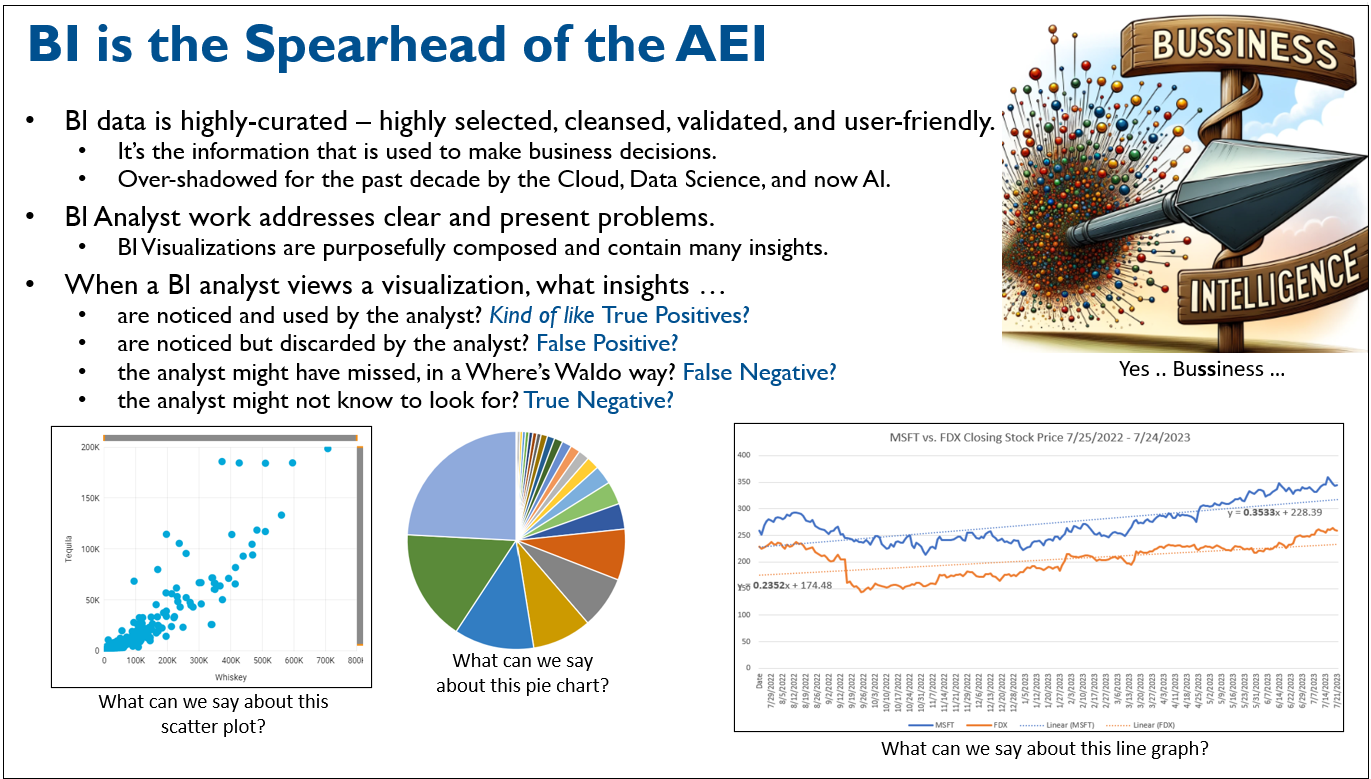
I tried very hard to get DALL-E to draw this picture with BUSSINESS properly spelled. But I lived with it since I could probably master graphic arts and draw it myself quicker, and it will be an enduring icon of shame for OpenAI.
I wrote my book hedging my bet on the achievement of AGI/ASI versus an AI Winter within the timeframe of the next couple of years. If the coin flips to AGI/ASI, the approach I present moves the AI ball forward in a way that moves the ball forward in a way that helps today and as AI improves along the way. It also recognizes that most of the knowledge of the world is in the heads of tens of millions of highly-skilled workers who have never written a book or even a blog or appeared on a YouTube video.
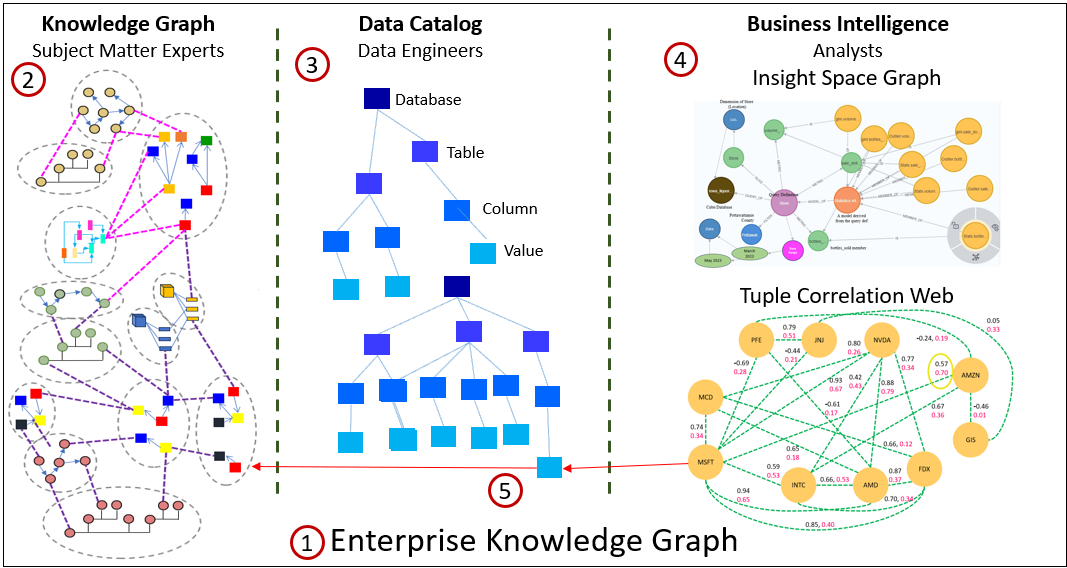
The book prescribes an enterprise knowledge graph composed of a few parts, mostly built with the data mesh methodology, glued together with a very versatile LLM:
- Enterprise Knowledge Graph – The EKG serves as the integrated framework that links together the various components of an enterprise’s data and knowledge infrastructure. It forms the backbone of the system, ensuring seamless connectivity and coherence between different data sources and analytical tools.
- Domain Ontologies – A set of ontologies composed by the subject matter experts (SME) of domains within the Enterprise. Each domain is responsible for providing knowledge of its domain’s entities, structure, and processes.
- Data Catalog – The metadata of all data sources through the enterprise. Items in the domain ontologies map to a data catalog item when possible. LLMs help this process tremendously.
- Business Intelligence – Two structures from BI analyst activity is automatically captured. The BI items are mapped to the Data Catalog as well. These BI components are the primary topics of this book.
- Mappings – The three major components of the EKG link via relationships. For example, the yellow node on the right is MSFT. It links to the MSFT member node of the data catalog, which in turn links to a node in the Domain Ontologies describing “MSFT” a corporation named Microsoft, with primary products Office and Windows.
If the coin flip is AI Winter, the book recognizes that the capabilities of today’s LLMs is of fantastic value when used as a tireless army of interns. It’s wide-scoped versality applied even at the modest levels of today can be profound. And that LLM/AI will at least improve over the years–maybe not crazy improvement, but they will improve just as the Internet continued strong progress after the dot-com crash.
If an AI Winter is coming, think of it as the miracle, the reprieve, you needed to position yourself. I don’t think Generative AI and the road to AGI is over-hyped at all. LLMs just went viral before it was fully-baked. But we should be thankful for that as it gives us time to adjust and prepare for the impending impact on the relevance of our skillsets (and our psyche) when AGI eventually introduces itself to us.
Enterprise Intelligence is neither an AI Bandwagon nor AI Skeptic book. My book is from a BI Architect’s middle-ground point of view – how to combine the best tools into something with the potential to provide value that’s better than the sum of its parts. My book is a culmination of twenty years of hair-pulling experience applying “AI” (at least attempting to) to BI analytics processes.
Notes:
- Enterprise Intelligence: Integrating BI, Data Mesh, Knowledge Graphs and AI, is my long-version book description.
- A short-version description is the TL;DR.
- Enterprise Intelligence is available at Technics Publications and Amazon. If you purchase the book from the Technics Publications site, use the coupon code TP25 for a 25% discount off most items (as of July 10, 2024).
- The Enterprise Intelligence category of this blog site is a list of my blogs related to the book.
Lastly, this Dave Shapiro video released a day after I wrote this blog: “Humans in the Lead” ― AI is accelerating jobs, not taking them (yet) ― Localization and Translation I love the term, “Human in the Lead”, which is very much along the line of AI implemented in the Enterprise with BI as the spearhead. It’s a human-lead “mixture of human experts”–subject matter experts, MBA-like analysts, the DW/BI technical team, and extended teams of knowledge workers with highly specific, unique skillsets and experiences–spearheading analytics efforts with LLM/AI in the role of an army of precocious, tireless interns.

 Soft Coded Logic