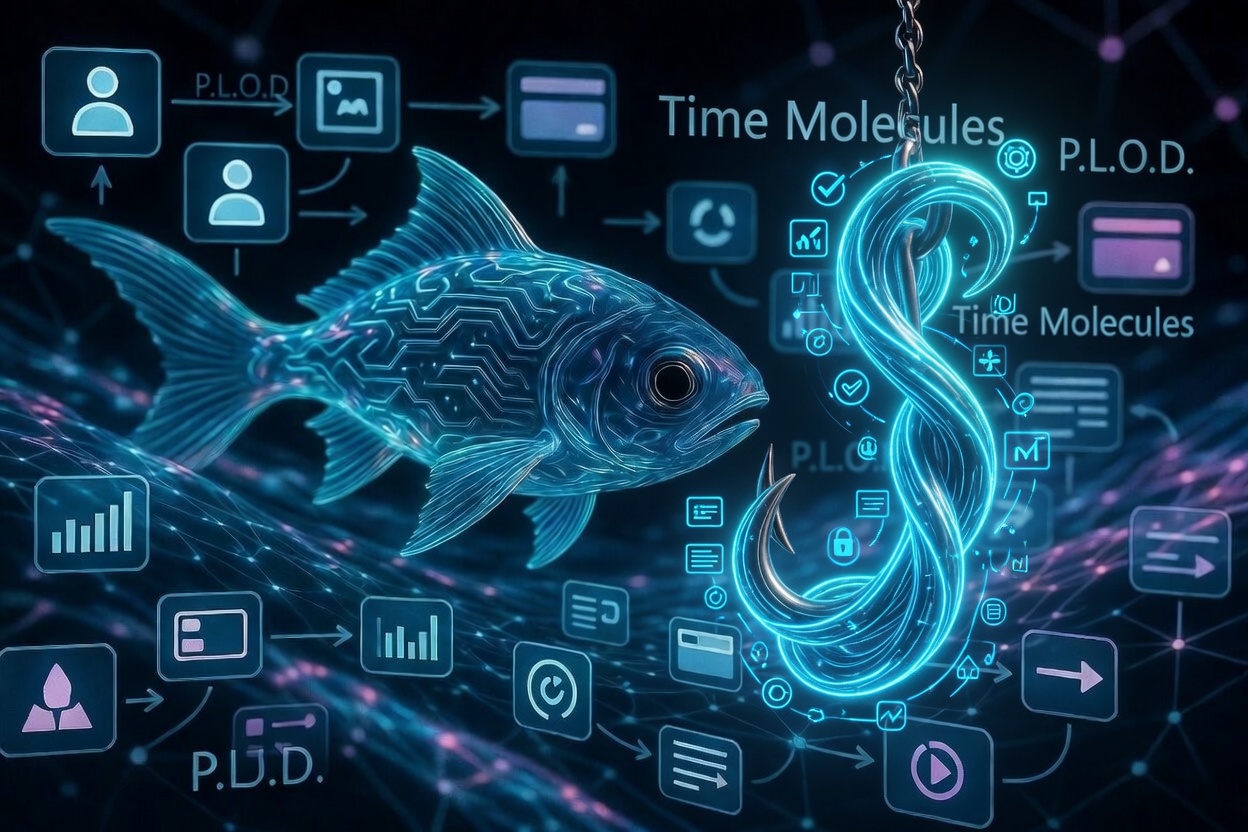
This blog describes the Time Molecules process for the analysis of adversarial situations. That includes frauds, competitive games such as Texas Hold’em Poker, and any other situation where imperfect information is the key asset.
Beyond sheer skill, good adversaries rely on stealth, sleight-of-hand, misinformation/disinformation, information overload, mimicry (impersonation), etc. Adversaries paint a false picture for their opponent to get them to do something. However, an adversary’s attempts are rarely flawless. With a broad enough spectrum of information, a target can theoretically spot subtle flaws—uncanny valleys—which are “true positives” that don’t quite reach probability 1.0.
It lays out how Time Molecules pulls together Probability (conditional probability, machine learning), Logic (Prolog), Ontology (knowledge graphs), and Data (Time Molecules and a Semantic Layer) into a foundation for a level of “enterprise awareness”. I call it P.L.O.D. … hahaha … just my odd sense of humor.
An enterprise AI strategy should be founded upon a modern semantic layer, following by automated machine learning, knowledge graphs. Sorry. I know that doesn’t sound as fun. But LLMs pave a substantially smoother road for the journey from the very start!
At the least, from this blog you’ll gain some ideas of how to integrate these components and how this needs to be looked through a systems thinking lens. On a related note, my books:
- Enterprise Intelligence is about building an enterprise knowledge graph (EKG) on top of the modern semantic layer, such as Kyvos.
- Time Molecules is the time-side of tuple-centric BI OLAP cubes, the current staple of business intelligence.
I’ve written about my first major attempt at something like this in, Conditional Trade-Off Graphs – Prolog in the LLM Era – AI 3rd Anniversary Special and Prolog in the LLM Era – Part 1
Our world is event-driven, and our intelligence enables us to anticipate the consequences. If there’s anything AI could do to better serve us, it’s to be smarter about anticipating consequences in a strategically valuable manner so we might worry less about all the things all the time that could happen. It can be my “trusted worrier”, so to speak.
At the risk of getting “cancelled”, the starting point of theme of this blog is this:
Although the motives between hackers/scammers and everyone else might be of polar qualities, we still use information in the same way when it comes to competitive/adversarial situations. We collect data and clues to identify points that lend themselves to manipulation which leads to a path to our desired outcomes.
Pros and Cons vs a Checklist
Many recognition algorithms apply a similarity score, a checklist of qualities, a one-dimensional structure. It could be more robust as a weighted checklist. But the problem with a weighted checklist is there are many ways to calculate a high, medium or low score. The combination does matter. For example, you can have a good BMI by being tall and of average weight for your height, or you could be shorter and very thin for your height.
Fish do not simply bite a hook because it resembles food. That sounds obvious, but it is a deeper idea than it first appears. A fish may recognize the worm, the movement, the color, the possibility of food. But at the same time, it may recognize something else—the odd gleam of metal, an unnatural bend, a stiffness in the movement, a smell that does not belong, a shape that does not fit any safe pattern.
The fish is not necessarily computing a single score.
It is not saying: 87 percent worm, 13 percent hook, therefore bite.
It may be recognizing two things at once. Both are true positives (the current cliche of “two things can be true at once”):
- I see food.
- I also see something wrong.
And the recognition of “something wrong” can override the recognition of food, depending on its level of hunger.
That is the heart of the problem enterprises now face with fraud, cyberattacks, scams, operational anomalies, supply-chain surprises, customer churn, bad advice, and other rare but damaging events. The bad thing rarely arrives wearing a name tag. It arrives dressed in the clothes of a normal event.
A login looks like a login. A payment looks like a payment. A vendor invoice looks like a vendor invoice. A customer support request looks like a customer support request. A sales opportunity looks like a sales opportunity. A file download looks like a file download.
But something is off. The action is a little too fast. The device is unfamiliar. The language is nearly right but not quite. The path through the process is legal, but strange. The event is not impossible. It is just not normal in the right way.
That is the enterprise uncanny valley. It’s an arms race of fooling each other towards some gain or avoidance of risk—whether it’s the level of “fish” intelligence (robust, multi-variate), as opposed to the higher level of “reptile intelligence” (iterative), then finally “human-level” intelligence (iterative recognition decoupled from a versatile selection of actions). See, Levels of Intelligence – Prolog’s Role in the LLM Era, Part 6 and Reptile Intelligence: An AI Summer for CEP.
The Enterprise Uncanny Valley
We usually think of the uncanny valley in terms of human-like robots or synthetic faces. Something is almost right, and because it is almost right, the small wrongness becomes disturbing. But the same principle applies to processes.
A scam email is not alarming because one or more features are blatantly wrong. It is alarming because many features are right. It mimics a trusted institution, a familiar workflow, a known person, a normal transaction, or a reasonable request. The scammer’s job is camouflage. The defender’s job is not merely classification. The defender’s job is to notice what the camouflage failed to hide.
That’s why this is not just a machine-learning (ML) scoring problem. Scores from ML models usually consider a few input features, run it through a computation trained by an algorithm, and outputs a score. That score is only based on the parameter values. Granted those parameters were chosen because they are more “predictive” of an output than other potential parameters. This isn’t a bad thing, in fact it’s desirable. We don’t want to make the model rigid, tied to what is in the training data, which probably won’t reflect the world as it changes.
Because such ML “scores” consider only the most predictive parameters. A score can be useful, but a single score is often a compression of the very clues we need to preserve. In rare-event detection, the little things matter. Rare events are often perfect storms of many small factors. No one factor screams. But several tiny oddities, recognized together, change the meaning of the event.
This is closer to adversarial systems such as Texas Hold’em Poker the eternal struggle between predator and prey than to a checklist. In both systems, players rely on projecting as little information or deceitful information to their opponents as possible. A skilled poker player does not recognize a bluff by walking through a fixed list:
Eye movement? Check. Breathing? Check. Chip handling? Check. Therefore bluff.
That kind of checklist can be gamed. A good bluffer learns the checklist. What gives them away is often something they did not know they were supposed to hide.
The same is true in fraud and cybersecurity. Attackers learn the obvious rules. They learn the scoring models. They learn the controls. So the frontier moves to the tiny signals they did not anticipate: timing, sequence, context, semantic mismatch, unusual property combinations, process path irregularity, environmental conditions, history, and what should have happened next but did not.
That is why an intelligent enterprise needs many senses. In my blog, Thousands of Senses, the central point is that intelligence does not come from merely five broad senses, or even a few dozen inputs, but from access to a long tail of granular signals that can be selectively activated by context. The blog makes the enterprise analogy directly: IoT devices, AI agents, application logs, transactions, customer behavior, operational events, and other streams become sensory organs for the business. The issue is not simply “more data,” but more kinds of signals, available when the situation requires them. (Soft Coded Logic)
That is the missing layer between ordinary CEP and process-aware intelligence.
Why Ordinary CEP is not Enough
Complex Event Processing (CEP) in itself is already a powerful idea. Events stream through a system. Rules detect patterns. Windows aggregate activity. Alerts fire when known conditions appear. That is important. It is the fast reflex layer.
But the problem with camouflage is that the known condition is often avoided. The scammer or attacker is deliberately trying not to match the obvious rule. The fish is designed to look like food. The phishing email is designed to look like business. The fraudulent transaction is designed to look like normal behavior. So the CEP layer needs help.
The event should still go to the regular CEP engine. We still need fast rule evaluation, windowing, thresholds, and immediate reactions. But beside that fast lane, there should be a deeper process-intelligence lane that asks:
What process is this event part of? What usually comes next? What has this kind of event led to before? What good outcomes is it associated with? What bad outcomes is it associated with? Which properties make this instance different? Which knowledge graph concepts does this event touch? Which paths from this event lead toward risk, fraud, failure, churn, delay, escalation, or opportunity?
That deeper lane is where Time Molecules fits. Time Molecules can act as the system that says: this is not just an event. This is an event inside a case (a cycle) of a process, with case-level properties, event-level properties, semantic meaning, process history, and probable futures.
That changes the nature of detection. Instead of asking, “Is this event bad?” we can ask:
What is this event becoming?
Events are not Isolated Facts
Events that happen in the world are the result of upstream events and precede a number of downstream events, some bigger than others, perhaps all seemingly inconsequential, some perhaps disaterous. It order to analyze the effect:
- Knowledge graphs (where events types are included as part of the ontology of the KG) can link the event to other phenomenon, particularly goals and risks we wish to avoid. To be clear, by “event”, I don’t mean each of the individual events that happen, for example, Eugene purchased a pack of honeyberry seeds on 3/10/2026. But the name of events such as arrive, depart, earthquake, sent text, woke up, ate lunch, etc.
- Prolog scripts can estimate the probability of risks based on contemporary events. Note that Bayesian Conditional Probabilities act as a lighter, faster detection of probability (like System 1), where we could corroborate with deeper deductive capability of Prolog.
Let’s look at an example. A login event is not just a login event.
It belongs to a case of a cycle of potential fraud. The case might be a session, a customer journey, an account lifecycle, an order, a shipment, an insurance claim, a support incident, a loan application, a patient encounter, or a security investigation.
The login also has event properties:
device, IP range, geolocation, authentication method, browser fingerprint, time of day, failed attempts, velocity, requested resource, user agent, MFA behavior, previous event, next event.
The case has properties too:
customer type, account age, risk tier, geography, normal activity pattern, open tickets, recent changes, known relationships, employee role, vendor status, current business context.
Now add Time Molecules. The event can be linked to one or more Markov model segments. That means the system can ask:
In cases like this, when this event happens, what usually happens next?
That alone is powerful. But the key to success in an adversarial world is to correctly predict the next several steps. If a customer normally browses, compares, adds to cart, reviews shipping, and pays, but this case jumps from account recovery to stored payment update to high-value purchase to address change, the individual events may all be legal. But the path has the wrong shape.
This is process awareness. The suspicious thing is not necessarily the event. It is the event in sequence.
The event can also be linked to Bayesian conditional probabilities:
Given these properties, what is the probability of a chargeback? Given this event and this case context, what is the probability of account takeover? Given this sequence, what is the probability that the next event is escalation? Given this delay, what is the probability that the case fails its SLA? Given this supplier behavior, what is the probability of a shipment exception?
Expanding the Ontology of Events with a Knowledge Graph
The event registered in Time Molecules has an Internationalized Resource Indicator (IRI). The properties of individual events may have IRIs. The database, table, column, source system, event type, and property definitions can all be grounded semantically. The event is not just the string "PasswordResetRequested" or "InvoiceSubmitted". It is tied to an enterprise concept. That concept may be related to other concepts: authentication, credential recovery, identity risk, payment method, vendor trust, delivery exception, regulated data, privileged access, medical device, financial instrument, or customer distress.
This is where Time Molecules, Bayesian probabilities, Markov models, and the knowledge graph begin to form a process.
The Markov model tells us what tends to happen next. The Bayesian layer tells us what conditions change the odds. The knowledge graph tells us what this event and its properties mean. The CEP layer gives us the immediate reflex. The deeper Time Molecules layer gives us process memory.
Recognition is not One Score
“Just one number, please.” That’s what my customer usually says when I respond with more than a single answer. Why do I respond with more than just one number? Because “it depends”. A common enterprise pattern is to turn everything into a score:
fraud score risk score churn score lead score health score anomaly score
Scores are useful. But a score is not the same as recognition.
Recognition can be simultaneous and contradictory.
A fish can recognize food and danger. A poker player can recognize confidence, fear, and a huge opportunity. A fraud system can recognize a valid customer and an account takeover pattern. A security system can recognize a normal employee and a compromised device. A supply-chain system can recognize a normal purchase order and a pattern that precedes disruption. The point is not to collapse those recognitions too early.
The enterprise should preserve the independent recognitions:
This looks like a normal payment. This also looks like a mule-account pattern. This looks like a real employee login. This also looks like impossible travel. This looks like an ordinary vendor invoice. This also looks like a vendor-bank-change scam. This looks like a hungry fish seeing food. This also looks like a fish seeing the .
Then the question becomes:
Which recognition should dominate right now?
That answer is contextual.
A starving fish may bite despite uncertainty. A cautious fish may not. A novice may freeze in the presence of danger. A trained martial artist, surgeon, firefighter, or security analyst may act because experience lowers the cost of action. Not because danger is absent, but because skill changes the threshold.
Enterprises work the same way because every decision is really a matter of “it depends” to some degree.
Ontology of Risk, Motivation, and Tactics
A bank may tolerate friction for a high-risk wire transfer but not for a low-value coffee purchase. A hospital may allow a risky override in an emergency but not during routine administration. A cybersecurity system may challenge a user more aggressively during an active incident than during normal operations. An airline may tolerate unusual rebooking patterns during a storm but not on an ordinary Tuesday.
So the threshold to react should not be static. It should be:
- Context-aware. depend on circumstance, experience, current threat level, user history, process state, business cost, and the skill or authority of the actor. That is much richer than a fixed score.
- Cognizant of motivation, appetite. If we know the motivation of an adversary, we might apply experience from prior situations—what was involved, the process, our solution. However, a good adversary will guard their motivation, in fact, emit a false motivation.
The 2nd point suggests the timeless saying, “Fool me once, shame on you. Fool me twice, shame on me.” I’m suggesting a kind of ontology (beyond what is formally called ontology) that maps out risks, motivations (objectives, goals), tactics, strategy maps, and all the parts it involves. Each element should be a well-known IRI, which connects it to the greater “rest of the world” knowledge graph. Additionally, most objectives and goals are in a hierarchy, a taxonomy, as we see in balanced scorecards, where sub-objectives roll into objectives, etc.
Even if we’re not certain about the motivation of an adversary, we can systematically zero in on the real goal by filtering on the state of attributes of candidate motivations we’ve mapped in the ORMT. We should always be skeptical about an adversary’s motivations because fooling us about their motivation is fundamental. That’s why games and tests are inadequate towards building intelligence. We know the goal of the game, and methods for achieving the goal are bounded by well-defined rules.
To recap, the idea is a systematic, ontology-driven process for inferring motivations (or other goals) from observed events:
- Observe current events and incorporate recently occurred events into the analysis.
- Attempt to link these events (considering their frequency, typicality, or anomaly relative to normal patterns) to candidate items in the ORMT. This step typically surfaces multiple possible motivations/goals, along with a high rate of false positives.
- For each candidate linked from the ORMT, evaluate the current state of its defining attributes. This prunes the candidate set by eliminating those inconsistent with the observed evidence, thereby reducing false positives. Not every attribute needs to be present for initial retention. However, be aware that a sophisticated (“master”) adversary may deliberately create false negatives by masking or suppressing expected indicators.
- For each of the remaining viable goals/motivations (our active HA—the alternative hypotheses still under consideration), actively monitor for the specific attributes predicted by the ORMT that have not yet been observed. The subsequent appearance of these missing attributes supplies confirmatory evidence, allowing us to strengthen support for the true motivation while further falsifying alternatives. This ongoing evidence-gathering and confirmation step is what distinguishes and validates our HA against H0 (the null hypothesis, representing the baseline or benign explanation).
Related Work: A Place to Start
As an FYI, there is already useful work in this general area, especially in cybersecurity and insider-threat research.
- MITRE ATT&CK is probably the best starting point for tactics and techniques. It is not really an RDF/OWL ontology in the classic Semantic Web sense, but it behaves like a practical knowledge base of adversary behavior: tactics describe the “why,” techniques describe the “how,” and procedures describe concrete examples.
- STIX ((Structured Threat Information eXpression) is useful for representing cyber threat intelligence. It is especially good at describing threat actors, campaigns, attack patterns, indicators, observed data, malware, tools, vulnerabilities, and relationships among them. STIX is closer to a graph-shaped exchange model than a pure ontology, but it can be mapped into a knowledge graph.
- UCO, the Unified Cyber Ontology, is closer to a true RDF/OWL-style ontology. It is useful when the goal is semantic integration across cyber evidence, threat intelligence, incidents, assets, vulnerabilities, and related data. Because it is ontology-oriented, it is a better candidate when the goal is to link cyber concepts into a broader enterprise knowledge graph.
There is also work on insider-threat ontologies, which is useful because it moves beyond technical events into behavioral, organizational, motivational, and risk indicators. This matters because many enterprise risks are not visible from the event alone. The meaning comes from the actor, context, motivation, process state, and possible consequence.
So this is not a blank field. Existing work gives us starting points. ATT&CK is strongest for tactics and techniques, STIX for threat-intelligence exchange, UCO for RDF/OWL-style semantic integration, and insider-threat ontologies for motivation and behavioral risk.
What I am adding here is the connection to “process memory”—using Time Molecules to ask not only what an event is, but what the process may be becoming, as well as incorporating probability (ML models, Bayesian probabilities) and logic (Prolog). So that we can continue to plod along 🙂
The Architecture: Fast CEP plus Deeper Time Molecules Reads
The architecture I propose is to give CEP a deeper nervous system. CEP is like Kahneman’s System 1 and Time Molecules is like System 2.
The event still enters the streaming platform. The fast CEP layer evaluates immediate rules:
Is this on a deny list? Did the count exceed a window threshold? Did this exact forbidden sequence occur? Is this event malformed? Does this match a known attack or fraud pattern?
That layer is fast and deterministic.
But in parallel, the event is sent to a Time Molecules process-intelligence service. This service performs deeper reads, depending on urgency and available time.
The first level is “what comes next?”
This is the easiest and probably the most immediately useful. Given the event, the case properties, and the event properties, find the models that match this context. Then look up matching segments in ModelEvents. If the current event is Event1A, retrieve the likely EventB values, probabilities, counts, and elapsed-time statistics.
That gives the system a process-aware forecast:
From here, cases like this usually go to these next events. These next events are good. These next events are bad. This case is currently moving toward something we want. This case is currently moving toward something we want to avoid.
The second level is semantic expansion through the knowledge graph.
The event’s IRI points to a semantic node. From that node, the system can traverse associations: parent concepts, related risks, expected effects, known bad outcomes, known good outcomes, compliance implications, process ownership, data lineage, source systems, and controls.
This can be cached. Most event types do not change their semantic neighborhood every second. The path from PasswordResetRequested to AccountTakeoverRisk or from VendorBankAccountChanged to PaymentFraudRisk can be precomputed or memoized.
The third level is property-level semantic search.
This is deeper and more expensive, but it is where many “ glint” signals live. The event type may be normal, but a property may be odd. The amount, location, device, timing, text, chemical reading, temperature, delay, confidence level, source column, or unit of measure may carry the warning.
At this level, the system is not only asking:
What does this event mean?
It is asking:
What do these properties mean in this situation?
That is where a knowledge graph grounded in source metadata becomes valuable. The system can move from a raw property to its enterprise meaning: not just col_237, but shipping temperature, privileged role, beneficiary account, dosage change, machine vibration, customer distress phrase, or unusual address distance.
This is how “thousands of senses” becomes practical.
Not every event needs every sense. But the system needs the ability to pull in the right sense when the moment demands it.
See: The Products of System 2 – Prolog in the LLM Era – Spring Break 2026 Special
The Query Pattern to Time Molecules
At the database level, the core procedure should be simple in concept:
Accept an event, case properties, and event properties. Find all models that match those properties. Find matching
ModelEventsrows where the current event isEvent1A. Return likely next events, probabilities, supporting counts, elapsed-time measures, and semantic links.
In plain English, the stored procedure says:
“Given what just happened, and given the kind of case this is, show me what usually happens next in comparable cases.”
That procedure becomes a bridge between CEP and Time Molecules.
The stored procedure signature is:
EXEC GetNextEventsForObservedEvent
	@EventA = 'arrive',
	@CasePropertiesJson='{"EmployeeID":1,"LocationID":1}',
	@EventPropertiesJson=NULL,
	@TopN = 20
The exact implementation can evolve, but the responsibility should stay focused.
It should not try to do everything. It should not become the whole fraud engine, security engine, recommendation engine, or operations engine. Its job is to answer the process question:
In comparable historical process contexts, what tends to follow this event?
The result set should be designed for both machines and humans:
| Output | Meaning |
|---|---|
ModelID | The matching process model |
EventA | The observed/current event |
EventB | A likely next event |
Probability | Probability of EventB after EventA in that model |
EventCount | Support behind the probability |
AvgElapsedTime | Typical time between events |
StdDevElapsedTime | Variability in timing |
OutcomeClass | Optional semantic classification: good, bad, neutral, unknown |
EventB_IRI | Knowledge graph link for the predicted event |
ModelDescription | Human-readable explanation of the model |
ReasonContext | Which case/event properties caused this model to match |
That last field matters. If the system says, “this looks risky,” the analyst should be able to see why this model was selected.
Was it because of geography? Customer segment? Device type? Case type? Transaction amount? Event set? Time window? Source system? Security role? Product category?
This preserves explainability without pretending that the entire decision can be reduced to a single reason.
The Relevance
A customer does not need another dashboard that says something is red.
They need a system that can say:
This event is normal in isolation, but abnormal in this process context. This path often leads to a bad outcome. These properties are the ones that made this case comparable to prior bad cases. The next expected event did not occur. A different event occurred instead. The semantic meaning of that detour is important. We should slow down, ask for verification, route to review, or trigger a compensating process.
That is a much more practical vision than “AI will detect fraud.”
It is also more credible. The system is not claiming something magical. It is using observed event history, process models, conditional probabilities, semantic metadata, and knowledge graph associations to support better recognition.
That is exactly what enterprises are missing. Most enterprise systems know transactions. Some know entities. Fewer know processes. Almost none know the semantic meaning of process deviations in real time.
That is the gap Time Molecules can fill.
The Hook, the Bluff, and the Process
The fish does not need a philosophy of fishing to avoid the hook. It only needs enough sensory richness to recognize that something about the worm is wrong.
The poker player does not need a formal theory of deception to call a bluff. They need enough experience to recognize that something in the performance does not fit the situation.
An enterprise does not need to wait for artificial general intelligence to defend itself better. It needs richer event streams, process memory, semantic grounding, and a way to preserve the little off-details instead of flattening them prematurely into a score.
That is the Time Molecules process idea.
A CEP system sees the event. A Time Molecules system remembers what events like this become. A knowledge graph understands what the event means. Bayesian probabilities adjust the odds based on context. The enterprise reacts only when the recognition of danger outweighs the recognition of normalcy, under the circumstances of the moment.
That is not just event processing, but process-aware recognition. In an environment where attackers, scammers, competitors, and even ordinary operational failures all arrive camouflaged as normal business, seeing the hook is the difference between intelligence and reaction.
Also see:
- hypothetical_example_of_time_molecules_forecase_rare_events.md for a discussion on applications focused on rare events.
PLOD Runthrough
Let’s go through a sample runthrough of the PLOD mechanism–the service process at a restaurant. For simplicity, let’s assume a slight level of dystopia. For example, cards in the wallet/purses/nametags of people can be readily read through RFID sensors. Events, such as detecting a person, is sent to a high-scale event processing system.
Let’s also assume that the host at the front desk is a human but not necessarily experienced with dealing with customers, so he gets some AI assistance from a trusty AI Agent we’ll name Hudson.
We assume there is a high-scale event processing system that detects the arrival of a customer at one of our restaurants. His face is readily recognized by cameras monitoring the door. The system receives a json packet containing the customer’s loyalty ID number (1), among other things.
It’s rather busy, so the host is unable to greet the customer as soon as he walks in with his party. A good piece of information is to obtain a general idea of how patient this customer is. Keep in mind that the process to follow is invisible to the host.
Query Time Molecules
A query is submitted to Time Molecules, one of the two “Ds” in PLOD (the other is the Semantic Layer):
EXEC GetNextEventsForObservedEvent
	@EventA = 'arrive',
	@CasePropertiesJson='{"CustomerID":1,"LocationID":1}',
	@EventPropertiesJson=NULL,
	@TopN = 20
That stored procedure finds models (Markov models) with the event, arrive, for CustomerID:1 at LocationID:1. For each model, the predicted next step is returned, along with some statistics and metadata.
This as an abbreviation of the results returned from the command:
| ModelID | StartDateTime | EndDateTime | EventSet | EventA | EventB | Prob | Rows | EventA_Description | EventB_Description |
|---|---|---|---|---|---|---|---|---|---|
| 5 | 1900-01-01 00:00:00.000 | 2050-12-31 00:00:00.000 | restaurantguest | arrive | greeted | 1 | 2 | User arrives at location | User was greeted |
| 6 | 1900-01-01 00:00:00.000 | 2050-12-31 00:00:00.000 | restaurantguest | arrive | greeted | 1 | 1 | User arrives at location | User was greeted |
If the host at the front desk were looking at the output and were experienced, he would infer that he might want to place some priority on this customer who is known to leave. But what about other customers already there who are prone to leave or are powerfully mighty YouTube influencers?
So, the AI continues to analyze to support the host no matter his level of customer service savvy. Next question for the AI is what do we know about customers who arrive and depart? Fortunately, subject-matter-experts have authored a knowledge graph that knows about such things.
Adding the Knowledge Graph Check
The previous step asks Time Molecules a process question:
Given that the customer arrived, what usually happens next?
In this restaurant example, the next event might be greeted, but it might also be something worse: the customer may leave before ordering.
The Time Molecules result can tell us that this path exists:
arrive -> departed before ordering
That is already useful information, but by itself, the Markov model only tells us the process path and its probability. The knowledge graph lets the AI agent ask a second question:
If this customer is moving toward
departed before ordering, what does that event mean, and why might it happen?
The full Turtle file for this example is here:
restaurant_knowledge_graph.ttl
This is the important handoff:
- CEP sees an event such as
arrive. - Time Molecules checks comparable historical process paths.
- The model says that
departed before orderingis one possible next event. - The AI agent then checks the knowledge graph.
- The knowledge graph returns the semantic meaning, possible risk reasons, affected business concepts, and expected event that was skipped.
In other words, the Time Molecule says:
This path sometimes goes from arrive to departed before ordering.
The knowledge graph says:
Departed before ordering is an abandonment event.It prevents the expected ordered event.It affects revenue opportunity, customer satisfaction, and waiting experience.Possible reasons include excessive wait time, unpleasant greeting, crowding,unappealing specials, host unavailable, or a confusing seating process.
That is a very small graph lookup, but it tells the AI agent a lot.
Salient TTL Segment
The full TTL contains more context, but the core idea is carried by a few triples.
First, DepartedBeforeOrdering is modeled as a kind of exception/abandonment event:
tm:DepartureBeforeOrderingEvent
    a owl:Class ;
    rdfs:subClassOf tm:AbandonmentEvent ;
    rdfs:subClassOf tm:RestaurantEvent ;
    rdfs:label "Departure before ordering event" ;
    rdfs:comment "A restaurant event where the customer leaves before placing an order." .
Then the actual restaurant event is connected to the expected event it interrupts, the business concepts it affects, and the possible risk reasons:
rest:DepartedBeforeOrdering
    a tm:DepartureBeforeOrderingEvent ;
    rdfs:label "departed before ordering" ;
    skos:prefLabel "departed before ordering" ;
    rdfs:comment "The customer leaves the restaurant before placing an order." ;
    tm:negativeOutcome true ;
    tm:preventsExpectedEvent rest:Ordered ;
    tm:affects rest:RevenueOpportunity ;
    tm:affects rest:CustomerSatisfaction ;
    tm:affects rest:WaitingExperience ;
    tm:hasRiskReason rest:ExcessiveWaitTime ;
    tm:hasRiskReason rest:UnpleasantGreeting ;
    tm:hasRiskReason rest:TooCrowded ;
    tm:hasRiskReason rest:UnappealingSpecials ;
    tm:hasRiskReason rest:HostUnavailable ;
    tm:hasRiskReason rest:ConfusingSeatingProcess .
The risk reasons are themselves semantic concepts:
rest:ExcessiveWaitTime
    a tm:RiskReason ;
    a skos:Concept ;
    skos:prefLabel "Excessive wait time" ;
    skos:definition "The customer waits longer than expected or longer than they are willing to tolerate." ;
    tm:increasesRiskOf rest:DepartedBeforeOrdering ;
    skos:broader rest:WaitingExperience .

rest:UnpleasantGreeting
    a tm:RiskReason ;
    a skos:Concept ;
    skos:prefLabel "Unpleasant greeting" ;
    skos:definition "The customer is acknowledged in a way that feels rude, indifferent, rushed, or unwelcoming." ;
    tm:increasesRiskOf rest:DepartedBeforeOrdering ;
    skos:broader rest:ServiceEngagement .

rest:TooCrowded
    a tm:RiskReason ;
    a skos:Concept ;
    skos:prefLabel "Too crowded" ;
    skos:definition "The restaurant appears too full, noisy, cramped, or uncomfortable for the customer." ;
    tm:increasesRiskOf rest:DepartedBeforeOrdering ;
    skos:broader rest:RestaurantEnvironment .
The process links show that the bad path is a possible continuation from both arrive and greeted:
rest:Arrive
    tm:usuallyFollowedBy rest:Greeted ;
    tm:usuallyFollowedBy rest:DepartedBeforeOrdering .

rest:Greeted
    tm:usuallyFollowedBy rest:Ordered ;
    tm:usuallyFollowedBy rest:DepartedBeforeOrdering .
That is the bridge between process mining and the semantic network. The process model tells the agent that this path can happen. The KG tells the agent what that path means.
SPARQL: Ask the KG Why the Customer Might Leave
After Time Molecules returns a possible next event such as DepartedBeforeOrdering, the AI agent can call the knowledge graph with a SPARQL query like this:
PREFIX tm:   <https://timemolecules.com/ontology/>
PREFIX rest: <https://timemolecules.com/example/restaurant/>
PREFIX rdfs: <http://www.w3.org/2000/01/rdf-schema#>
PREFIX skos: <http://www.w3.org/2004/02/skos/core#>

SELECT
    ?riskEvent
    ?riskEventLabel
    ?preventedEventLabel
    ?affectedConceptLabel
    ?riskReasonLabel
    ?riskReasonDefinition
    ?broaderConceptLabel
WHERE {
    VALUES ?riskEvent { rest:DepartedBeforeOrdering }

    ?riskEvent rdfs:label ?riskEventLabel .

    OPTIONAL {
        ?riskEvent tm:preventsExpectedEvent ?preventedEvent .
        ?preventedEvent rdfs:label|skos:prefLabel ?preventedEventLabel .
    }

    OPTIONAL {
        ?riskEvent tm:affects ?affectedConcept .
        ?affectedConcept skos:prefLabel ?affectedConceptLabel .
    }

    OPTIONAL {
        ?riskEvent tm:hasRiskReason ?riskReason .
        ?riskReason skos:prefLabel ?riskReasonLabel .
        OPTIONAL { ?riskReason skos:definition ?riskReasonDefinition . }
        OPTIONAL {
            ?riskReason skos:broader ?broaderConcept .
            ?broaderConcept skos:prefLabel ?broaderConceptLabel .
        }
    }
}
ORDER BY ?riskReasonLabel ?affectedConceptLabel
The result gives the AI agent something like this:
| Risk event | Prevented event | Affected concept | Risk reason | Broader concept |
|---|---|---|---|---|
| departed before ordering | ordered | revenue opportunity | excessive wait time | waiting experience |
| departed before ordering | ordered | customer satisfaction | unpleasant greeting | service engagement |
| departed before ordering | ordered | waiting experience | too crowded | restaurant environment |
| departed before ordering | ordered | waiting experience | unappealing specials | menu appeal |
| departed before ordering | ordered | customer satisfaction | host unavailable | service engagement |
| departed before ordering | ordered | customer satisfaction | confusing seating process | service engagement |
The exact row shape depends on the SPARQL engine and whether it expands the optional combinations, but the meaning is:
The customer did not merely leave.The customer abandoned the restaurant process before the order commitment event.That abandonment affects revenue, satisfaction, and waiting experience.The likely semantic reasons belong to waiting, greeting, environment, menu appeal,and seating-process confusion.
SPARQL: Start from the Observed Event
The AI agent can also start from the event it just observed. For example, if CEP observes arrive, the agent can ask:
What risky events are semantically connected to likely next events from
arrive?
PREFIX tm:   <https://timemolecules.com/ontology/>
PREFIX rest: <https://timemolecules.com/example/restaurant/>
PREFIX rdfs: <http://www.w3.org/2000/01/rdf-schema#>
PREFIX skos: <http://www.w3.org/2004/02/skos/core#>

SELECT
    ?observedEventLabel
    ?nextEventLabel
    ?riskReasonLabel
    ?riskReasonDefinition
    ?affectedConceptLabel
WHERE {
    VALUES ?observedEvent { rest:Arrive }

    ?observedEvent rdfs:label|skos:prefLabel ?observedEventLabel .
    ?observedEvent tm:usuallyFollowedBy ?nextEvent .
    ?nextEvent rdfs:label|skos:prefLabel ?nextEventLabel .

    OPTIONAL {
        ?nextEvent tm:hasRiskReason ?riskReason .
        ?riskReason skos:prefLabel ?riskReasonLabel .
        OPTIONAL { ?riskReason skos:definition ?riskReasonDefinition . }
    }

    OPTIONAL {
        ?nextEvent tm:affects ?affectedConcept .
        ?affectedConcept skos:prefLabel ?affectedConceptLabel .
    }
}
ORDER BY ?nextEventLabel ?riskReasonLabel
This query is intentionally simple. It is not trying to replace the Time Molecules model–that’s not its forte. The model should still provide the probabilities, counts, and elapsed-time statistics. The knowledge graph provides semantic expansion.
A combined agent response could look like this:
Time Molecules found that after arrive, the customer usually moves to greeted,but there is also a lower-probability path to departed before ordering.The knowledge graph classifies departed before ordering as an abandonment event.It prevents the expected ordered event and affects revenue opportunity, customersatisfaction, and waiting experience.Possible reasons include excessive wait time, unpleasant greeting, crowding,unappealing specials, unavailable host, or confusing seating process.
The Value Add
This is the “hook”, figuratively and metaphorically. A conventional process query can say:
arrive -> departed before ordering
A Time Molecules query can say:
arrive -> departed before orderingprobability = 0.06average elapsed time = 240 secondsstandard deviation = 95 seconds
The knowledge graph adds:
departed before ordering is an abandonment eventit prevents orderedit affects revenue opportunityit affects customer satisfactionit affects waiting experienceit has risk reasons
That turns a next-event prediction into an explanation surface.
The agent does not need a huge reasoning system to get value. With one additional KG call, it can move from:
What is likely to happen next?
to:
Why does this next event matter, what expected event was skipped, and what business concepts might explain or be affected by it?
That is the larger Time Molecules point. The Markov model supplies process memory. The knowledge graph supplies meaning. Together, they let an AI agent produce a more useful interpretation than either one could produce alone.
Verbose Calculation of Risks
The KG tells the agent what kinds of risks exist.
Prolog–normally playing the “L” in PLOD, but also the “P” in this case–an then calculate:
Given this specific customer, in this specific situation, which risks are currently active?
The knowledge graph gives the AI agent the semantic map:
DepartedBeforeOrdering has risk reason ExcessiveWaitTime has risk reason UnpleasantGreeting has risk reason TooCrowded has risk reason UnappealingSpecials has risk reason HostUnavailable has risk reason ConfusingSeatingProcess
But the knowledge graph does not, by itself, decide whether those risks apply to this specific customer right now.
In this tutorial, Prolog is used as the reasoning (logic) layer. The rules can be authored from machine learning models, decision trees, scorecards, analyst rules, or other model outputs. The point is not that Prolog replaces machine learning. The point is that machine learning can produce usable risk logic, and that logic can be packaged into rules the AI agent can execute, inspect, and explain.
A machine learning model might discover patterns like this:
Customers with low patience, during high crowding, after a slow greeting,are much more likely to leave before ordering.
That pattern can be translated into Prolog as a rule:
risk(Customer, excessive_wait_time, high) :-
    customer_patience(Customer, low),
    current_crowd_level(high),
    wait_time_seconds(Customer, Wait),
    Wait > 180.
Now the AI agent can combine three things:
| Layer | Role |
|---|---|
| Time Molecules | What usually happens next in the process |
| Knowledge Graph | What the next event means semantically |
| Prolog | Which risks apply to this specific customer right now |
The result is not just:
arrive -> departed before ordering
It becomes:
This customer is at elevated risk of departing before ordering because the current wait is long, the restaurant is crowded, and this customer profile has low tolerance for delay.
Example Prolog Risk Package
The Prolog file can be treated as a generated or authored risk package. It may be created by analysts, exported from machine learning models, or assembled from several Prolog fragments.
For example, here are three Prolog, that are separately created and maintained, but will merge into one.
This first part is created from realtime information. This facial recognition camera (again, for the sake of explanation, please put aside the dystopian connotations), looks up the perform and returns information calculated from semantic layers (ex. Kyvos Insights) formatted as Prolog. These “facts” are merged with the subsequent Prologs:
%%%%%%%%%%%%%%%%%%%%%%%%%%%%%%%%%%%%%%%%%%%%%%%%%%%%%%%%%%%%
% Customer qualities
%%%%%%%%%%%%%%%%%%%%%%%%%%%%%%%%%%%%%%%%%%%%%%%%%%%%%%%%%%%%

customer_patience(customer_123, low).
customer_price_sensitivity(customer_123, medium).
customer_visit_intent(customer_123, quick_meal).
customer_loyalty_level(customer_123, new_customer).
This Prolog reflects the current conditions in the restaurant, particurlarly the lobby. Many of these facts could be inferred from cameras using “computer vision” models trained to recognize characteristics:
%%%%%%%%%%%%%%%%%%%%%%%%%%%%%%%%%%%%%%%%%%%%%%%%%%%%%%%%%%%%
% Contemporary restaurant features
%%%%%%%%%%%%%%%%%%%%%%%%%%%%%%%%%%%%%%%%%%%%%%%%%%%%%%%%%%%%

current_crowd_level(high).
current_noise_level(high).
current_host_availability(low).
current_specials_appeal(low).
current_menu_visibility(medium).

wait_time_seconds(customer_123, 240).
greeting_quality(customer_123, neutral).
seating_process_clarity(low).
These are the risks Prolog. This Prolog probably needs to be authored primarily by humans. However, the humans can be assisted by LLMs and BI:
%%%%%%%%%%%%%%%%%%%%%%%%%%%%%%%%%%%%%%%%%%%%%%%%%%%%%%%%%%%%
% Restaurant premature departure risk rules
%
% These rules calculate risk reasons for a specific customer
% in the current restaurant situation.
%%%%%%%%%%%%%%%%%%%%%%%%%%%%%%%%%%%%%%%%%%%%%%%%%%%%%%%%%%%%

risk(Customer, excessive_wait_time, high) :-
    customer_patience(Customer, low),
    wait_time_seconds(Customer, Wait),
    Wait > 180.

risk(Customer, excessive_wait_time, medium) :-
    customer_patience(Customer, medium),
    wait_time_seconds(Customer, Wait),
    Wait > 240.

risk(Customer, too_crowded, high) :-
    current_crowd_level(high),
    current_noise_level(high),
    customer_visit_intent(Customer, quick_meal).

risk(Customer, host_unavailable, high) :-
    current_host_availability(low),
    wait_time_seconds(Customer, Wait),
    Wait > 120.

risk(Customer, unpleasant_greeting, medium) :-
    greeting_quality(Customer, poor).

risk(Customer, confusing_seating_process, medium) :-
    seating_process_clarity(low),
    customer_loyalty_level(Customer, new_customer).

risk(Customer, unappealing_specials, medium) :-
    current_specials_appeal(low),
    customer_price_sensitivity(Customer, medium).

%%%%%%%%%%%%%%%%%%%%%%%%%%%%%%%%%%%%%%%%%%%%%%%%%%%%%%%%%%%%
% Rollup rule
%%%%%%%%%%%%%%%%%%%%%%%%%%%%%%%%%%%%%%%%%%%%%%%%%%%%%%%%%%%%

departure_before_ordering_risk(Customer, high) :-
    risk(Customer, excessive_wait_time, high).

departure_before_ordering_risk(Customer, high) :-
    risk(Customer, too_crowded, high),
    risk(Customer, host_unavailable, high).

departure_before_ordering_risk(Customer, medium) :-
    risk(Customer, confusing_seating_process, medium).

departure_before_ordering_risk(Customer, medium) :-
    risk(Customer, unappealing_specials, medium).

%%%%%%%%%%%%%%%%%%%%%%%%%%%%%%%%%%%%%%%%%%%%%%%%%%%%%%%%%%%%
% Explanation rule
%%%%%%%%%%%%%%%%%%%%%%%%%%%%%%%%%%%%%%%%%%%%%%%%%%%%%%%%%%%%

departure_reason(Customer, Reason, Level) :-
    risk(Customer, Reason, Level).
The three Prolog above are merged. A simple Prolog query would be:
departure_reason(customer_123, Reason, Level).
Possible result:
Reason = excessive_wait_time,Level = highReason = too_crowded,Level = highReason = host_unavailable,Level = highReason = confusing_seating_process,Level = mediumReason = unappealing_specials,Level = medium
The AI agent can then join these Prolog results back to the knowledge graph.
The Prolog result says:
excessive_wait_time is hightoo_crowded is highhost_unavailable is high
The knowledge graph says:
excessive wait time is broader than waiting experiencetoo crowded is broader than restaurant environmenthost unavailable is broader than service engagement
So the agent can explain the result in business language:
The customer is at high risk of leaving before ordering. The strongest active risks are excessive wait time, crowding, and host unavailability. Semantically, these risks point to problems in waiting experience, restaurant environment, and service engagement.
Who Authored the Prolog
The Prolog rules do not have to be hand-written from scratch. They can be authored from machine learning outputs. For example, a decision tree might produce a branch like this:
IF wait_time_seconds > 180AND customer_patience = lowTHEN excessive_wait_time_risk = high
That can be converted to:
risk(Customer, excessive_wait_time, high) :-
    customer_patience(Customer, low),
    wait_time_seconds(Customer, Wait),
    Wait > 180.
A second model might produce:
IF crowd_level = highAND visit_intent = quick_mealTHEN too_crowded_risk = high
Which becomes:
risk(Customer, too_crowded, high) :-
    current_crowd_level(high),
    customer_visit_intent(Customer, quick_meal).
This is a kind of neuro-symbolic handoff. Machine learning discovers useful risk patterns. Prolog packages those patterns into explicit, inspectable rules. The knowledge graph gives those risks semantic meaning. Time Molecules places the risk inside the actual process path.
Agent Flow
The agent flow now looks like this:
1. CEP observes: customer_123 arrived2. Time Molecules asks: What usually happens after arrive?3. Time Molecules returns: arrive -> greeted arrive -> departed before ordering4. The AI agent asks the KG: What is DepartedBeforeOrdering?5. The KG returns: It is an abandonment event. It prevents Ordered. It affects RevenueOpportunity, CustomerSatisfaction, and WaitingExperience. It has risk reasons such as ExcessiveWaitTime, TooCrowded, HostUnavailable, etc.6. The AI agent asks Prolog: Which of those risks are active for customer_123 right now?7. Prolog returns: ExcessiveWaitTime = high TooCrowded = high HostUnavailable = high ConfusingSeatingProcess = medium8. The agent responds: This customer is at high risk of leaving before ordering because the wait is already long, the restaurant is crowded, and the host is unavailable. These risks affect waiting experience, service engagement, and revenue opportunity.
How Does Prolog Fits Here
Prolog is useful here because this part of the problem is not merely statistical. It is conditional, explainable, and composable. It is the “L” in PLOD, Logic.
Note: Prolog is deductive reasoning. Its inferences are based on Boolean-based rules built from subject-predicate-object facts. Its power is the in the logical expressiveness of rules known/discovered by subject-matter-experts, machine learning models, or LLMs. Once discovered they can be encoded and queried in a logically robust manner.
However, Prolog’s queries (which look like Prolog itself) could be thought of as rules.
The agent is asking a question requiring a sophisticated answer, requiring a level of inference:
What is the probability that the customer leaves?
It is asking:
- Why might this specific customer leave?
- Which risk reasons are active?
- Which features caused those risks?
- Which business concepts are affected?
- What expected event is being missed?
Those are rule-shaped questions.
The rule may have originated in machine learning, but once it is expressed as Prolog, it becomes something the agent can inspect and use.
That gives the system a useful separation of concerns:
| Component | Question Answered |
|---|---|
| CEP | What just happened? |
| Time Molecules | What usually happens next? |
| Knowledge Graph | What does that event mean? |
| Prolog | Which risks apply to this case right now? |
| LLM / AI Agent | How should this be explained or acted upon? |
The knowledge graph gives the agent the menu of possible explanations. Prolog determines which explanations apply to the current case.
So the KG might say:
DepartedBeforeOrdering can be caused by excessive wait time, unpleasant greeting,crowding, unappealing specials, host unavailability, or confusing seating.
But Prolog can say:
For this customer, right now, the active risks are excessive wait time,crowding, and host unavailability.
That provides enough information for a human or AI agent to make their priotization decisions.
The Time Molecule detects the process path. The KG gives the path meaning. Prolog calculates which risks are active. The AI agent turns the combined result into a useful explanation.
See: Knowledge Graphs vs Prolog – Prolog’s Role in the LLM Era, Part 7
Tying Back to the Data of the Semantic Layer
Time Molecules also facilitates a tie back to the database (BI data source, Semantic Layer, data warehouse, or event storage such as Azure CosmosDB) from which the events creating the Markov models were imported. This is the other “D” in PLOD.
The following table is actually part of the result of the stored procedure, GetNextEventsForObservedEvent, way back in Query Time Molecules:
| ModelID | EventA | EventA_Source_ServerName | EventA_Source_DatabaseName | EventA_SourceColumn_TableName | EventA_SourceColumn_ColumnName | EventB | EventB_Source_ServerName | EventB_Source_DatabaseName | EventB_SourceColumn_TableName | EventB_SourceColumn_ColumnName |
|---|---|---|---|---|---|---|---|---|---|---|
| 5 | arrive | BI001 | Restaurant | Events | Event | greeted | BI001 | Restaurant | Events | Event |
| 6 | arrive | BI001 | Restaurant | Events | Event | greeted | BI001 | Restaurant | Events | Event |
That table displays metadata to the source of the events, particularly the name of the event (arrive, greeted).
For example, suppose the database, BI001.Restaurant, is a modern, highly-performant Semantic Layer such as Kyvos Insights. Assuming we have access to that Semantic layer, we could connect to it and richly obtain further data towards facilitating high-qualty decisions. That’s all the wonderful traditional BI information we’ve come to love over the decaades, such as Time series of the customer’s recent profitability.
All Together Now …
Tying Time Molecules back to the BI semantic layer (or your data warehouse, event store, or modern semantic engine like Kyvos Insights) is far more than a convenient metadata lookup. It is the final piece that transforms the entire system from sophisticated pattern recognition into genuine process intelligence.The Markov models give you the statistical shape of the process—the DNA of what usually happens next. The knowledge graph gives every event and property real meaning. Prolog lets you reason about active risks and implications. But it is the semantic layer—the rich, business-aware data model—that supplies the living context that makes any deviation actually matter.Suddenly you are no longer just detecting that “this sequence is statistically unusual.” You are understanding:
- This customer belongs to the top 3% lifetime-value segment, has shown high sensitivity to wait times in the past, and the current greet-to-seated delay is already 2.8× their personal baseline.
- This vendor payment path deviates from their established pattern, their accounts-receivable aging has deteriorated sharply in the last 60 days, and the new beneficiary account matches a known high-risk pattern in the ontology.
- This user is executing a rare but technically allowed sequence of privileged actions—right after a negative performance review, while accessing sensitive customer data at unusual hours, on a device that has never been seen before.
The semantic layer dynamically enriches every observed event with customer/value/risk dimensions, historical behavioral baselines, segment information, external signals, and any other relevant business context. Time Molecules moves from asking “Is this sequence rare?” to asking “Given who this is, what they normally do, and what is at stake, how concerning is this deviation right now?”
This is where the full power of PLOD. reveals itself:
- Probability (Markov + timing) supplies the expected process memory.
- Logic (Prolog + Bayesian) reasons about implications and risk.
- Ontology (knowledge graph) grounds everything in shared enterprise meaning.
- Data (semantic layer) supplies the rich, multidimensional business reality.
Together they create something that feels remarkably close to experienced human intuition—the same way a seasoned poker player doesn’t just see the cards, but reads the player, the betting pattern, the table dynamics, and the entire history all at once.
The link back to the semantic layer is not a boring integration detail. It is the point where Time Molecules stops being an observer of processes and becomes a genuine co-pilot for high-stakes operational decisions. New risks, regulations, or business concepts can be added to the ontology without retraining models. The entire stack stays explainable, adaptable, and deeply grounded in what the business actually cares about.
That is how you finally escape the enterprise uncanny valley—not by throwing more scores at the problem, but by giving the system the same rich, multi-layered awareness that lets a fish see the hook … and actually understand why it should swim away.
Integrating a Lot of Moving Parts
Yes, we’re pulling a lot together. But it’s integration of components fragmented across a landscape that creates a powerful entity, whether it’s a person or other creature, or a successful enterprise.
My other book, Enterprise Intelligence, is all about integration of components into a system. Please see, Enterprise Intelligence: Integrating BI, Data Mesh, Knowledge Graphs, Knowledge Workers, and LLMs
Knowledge Graphs, Semantic Layers, Prolog, all involve a lot of engineering—a lot of human-in-the-loop—which is oddly frowned upon in many AI circles at the time of writing (You don’t want a human keeping tabs on things?). That’s bad for AI vendors, but good for us individuals who must keep exercising our creative capability. But my books and most of my blogs are centered around automation of these structures, which is only feasible with the advent of easy-to-access and relatively inexpensive LLMs (and other non-LLM ML models).
I know all too well that LLMs fall well short working with us as a peer partner (for now and at least the ones available to little folks like me), but it is rather good at performing relatively familiar tasks that are substantially time-consuming. Currently, LLMs ironically lack the precision of a machine and the deep creativity of the most creative humans. This approach leverages its current sweet spot—tireless, incredibly smart assistant—although I need to triple-check whatever work it provides. This art of working with LLMs, combining human and machine intelligence, is just getting started—a pidgin for now, a creole later.


