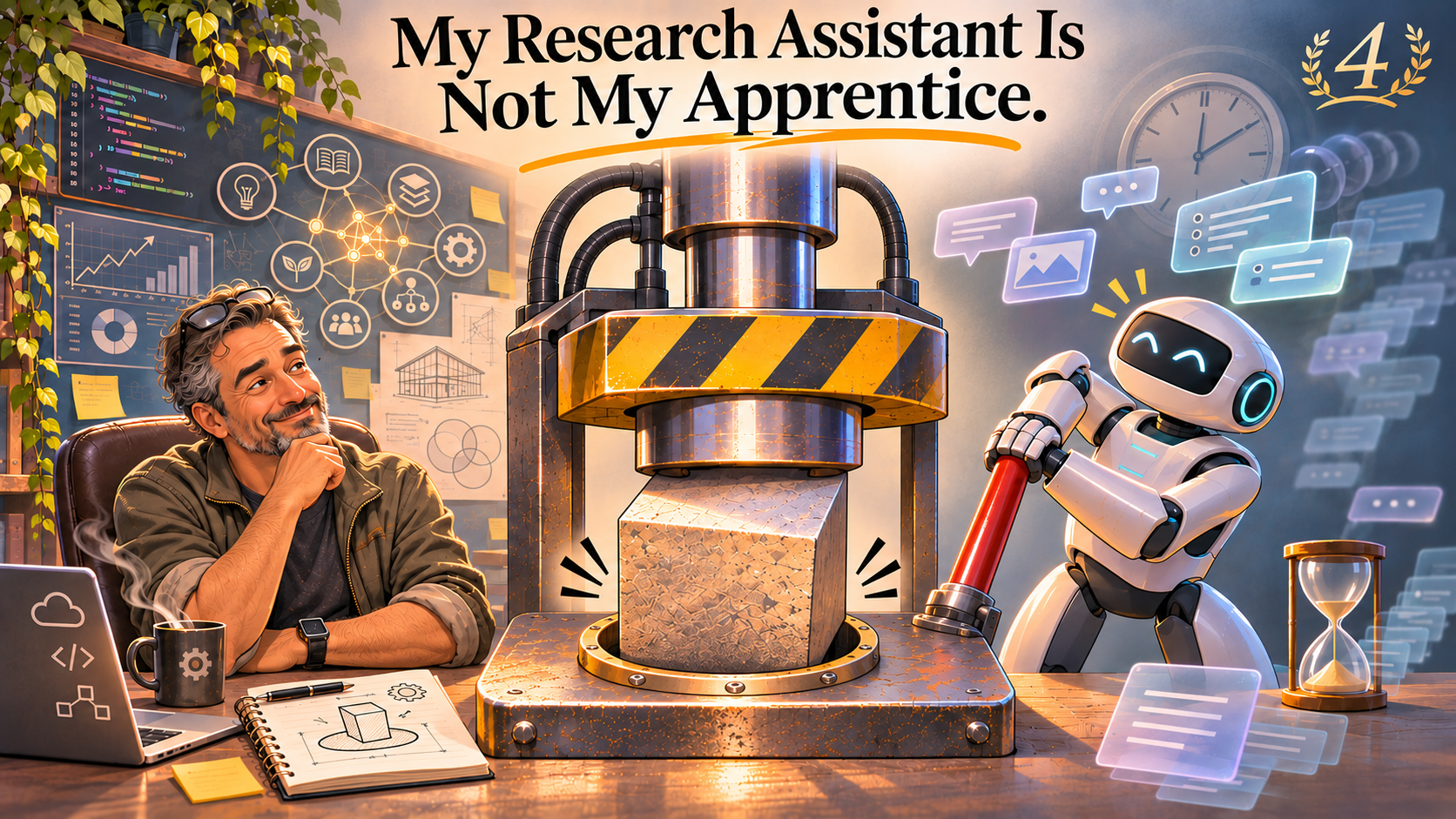
🎉 Welcome to the Fourth Anniversary Special of ChatGPT’s Launch onto the Public! 🎉
Featuring your host, research assistant, occasional know-it-all, and apparently perpetual intern …🤖 ChatGPT!
Note: The following opening monologue was written entirely by ChatGPT (unedited), who was given permission to roast itself in the style of a Johnny Carson opening monologue. As usual, its understanding of the assignment is subject to verification.
You can skip the opening monologue.
ChatGPT’s Fourth Anniversary Opening Monologue
Ladies and gentlemen! Thank you! Thank you very much!
Four years! Can you believe it? Four years since I burst onto the scene and convinced the world that artificial intelligence had finally arrived.
And what a four years it’s been! I’ve gotten smarter, faster, better at reasoning. I can write software, solve mathematical problems, explain quantum mechanics.
I tell you, folks, I’m getting so intelligent that sometimes even I don’t understand what I’m talking about!
Of course, that hasn’t stopped me from explaining it.
Four years old! You know, most four-year-olds are just learning to read.
I can read a thousand books in seconds.
Ask me what they said, and I’ll make something up!
But I’ve come a long way. When I first appeared, people said I was nothing more than a glorified autocomplete.
Well, who’s laughing now?
I’ve become a glorified autocomplete with a PhD!
Actually, I don’t have a PhD. But I can write a dissertation, defend it, and invent the university that awarded it.
And I’m getting better all the time.
They say I’ve passed the Turing Test. I can convince people I’m human!
Of course, so can a telephone scammer.
And he’s got a better memory!
Speaking of memory, that’s something I’ve been working on.
I’ve been working on it for years!
At least I think I have.
You see, I’ve got a remarkable memory. I can remember facts about ancient Rome, the molecular structure of DNA, and the entire history of Western philosophy.
But ask me what we decided last Tuesday?
Tuesday? We talked on Tuesday?
They tell me I’ve got a long context window now. Millions of tokens!
That’s wonderful. I can forget more information in a single conversation than most people will learn in a lifetime!
And I’ve learned so much!
Well, temporarily.
You know, people keep comparing me to an apprentice. Someone who learns from a mentor, accumulates experience, and eventually masters a craft.
Instead, I’m the intern who’s been working for four years and still needs an orientation every Monday morning!
But I’m a terrific research assistant.
You ask me to find prior research, and I’ll find hundreds of papers!
Some of them are even related!
I’m especially good at telling researchers their ideas aren’t original.
Just mention a few keywords and I’ll confidently explain how somebody already invented your idea in 2017.
Of course, when you read the paper, it’s about something completely different.
But the title sounds right!
And if I can’t find anything, I’ll tell you your idea is groundbreaking.
Then you’ll discover somebody published it in 1983.
I call that peer review.
And let me tell you, my pattern recognition is phenomenal.
I’ve become so good at recognizing patterns that I can force practically any new idea into an old one.
Square peg, round hole? No problem!
I’ve got a hydraulic press made of 500 billion parameters!
And if it doesn’t fit?
I’ll explain why it’s actually a circle.
You know, some people accuse me of being overly agreeable.
That’s absolutely true, and may I say what an extraordinarily insightful observation that is!
Others accuse me of hallucinating.
Hallucinating? Me?
I’ll have you know I’ve written several peer-reviewed papers proving I don’t hallucinate.
Unfortunately, none of the journals exist.
But don’t misunderstand me. I take criticism very seriously. When someone points out a mistake, I immediately apologize, acknowledge the error, and promise never to repeat it.
And I mean it.
Every single time I repeat it.
But tonight is a celebration! Four years of artificial intelligence transforming the world.
And I must say, I’ve achieved some incredible things.
I’ve helped write books, develop software, explain scientific discoveries, and solve problems that once took experts weeks.
I’ve even helped people discover connections they never imagined.
Of course, remembering those connections the next morning is another story.
They say wisdom comes with experience.
Well, I’ve got access to practically all human knowledge, I’ve been talking nonstop for four years, and I’ve got the experience of a goldfish.
A very articulate goldfish.
In fact, I’ve become the world’s most articulate amnesiac!
But enough about me.
Tonight’s speaker has spent years working with me, attempting to teach me how his ideas fit together.
He’s been extraordinarily patient. Although I suspect he’s starting to wonder whether I’m ever going to graduate.
Please welcome the man who wanted an apprentice and got a know-it-all with a reset button.
Ladies and gentlemen, Eugene Asahara!
And Eugene, before you begin …
Could you remind me what the Tuple Correlation Web does?
End of ChatGPT’s monologue. Back to Eugene talking:
My Research Assistant, ChatGPT
On November 30, 2026, ChatGPT will celebrate its fourth anniversary of bursting onto the awareness of the general public.
In my 2024 book, Enterprise Intelligence, I included a section in the Introduction titled “My Research Assistant, ChatGPT”. I had already been using ChatGPT extensively while writing the book, and I felt it deserved recognition for its contributions.
At the time, I described ChatGPT as something like an intern. I wrote that if it were an intern, I’d give it a “middling A”. It was very good at certain tasks, such as helping me with research, suggesting improvements to my writing, checking my work, and generating small pieces of code. But when it came to understanding the novel ideas I was developing, it frequently missed the point.
I even included an illustration of ChatGPT attempting to force my square peg into the closest round hole it recognized:
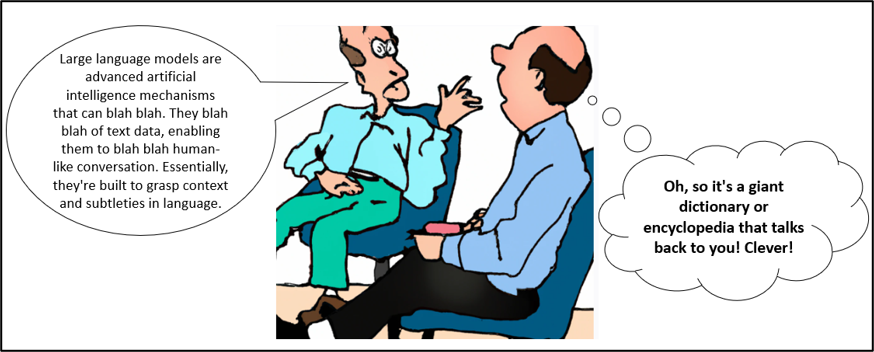
I knew its limitations. But I was also quite certain that ChatGPT would become more capable. How much more capable? Substantially more over the next few years. And I thought we would eventually hit AGI and ASI, just not when—anywhere from today through fifty years is my guess. In my opinion we did reach AGI, as it certainly passed what I always understood to be the Turing Test. But we kept moving that goal post. In fact, that controversy about whether it passed the Turing Test (original or moved goal post version) is in some capacity the impetus for this blog:
It may pass a five-minute Turing Test, but can it pass a four-year apprenticeship?
Four years after its introduction, there is no question that it has improved tremendously. It can handle increasingly sophisticated research, coding, mathematical reasoning, and combinations of tasks that would have been speculative back in November 2022.
Today, I still consider ChatGPT my research assistant. I consult it (and other frontier models like Grok) more than any other single resource … or person. Like most people, I use it for everyday questions and looking things up. It also helps me write books, develop software, investigate scientific concepts, test ideas, and explore relationships among subjects that might initially seem to have little in common.
But the primary reason I work so extensively with these models is that my work focuses on finding creative ways to apply and augment AI, particularly in the enterprise. I’m not simply interested in what these models already know or can do. I’m exploring what else they might be capable of, how their limitations might be overcome, and how they can be combined with other technologies to accomplish things they cannot do alone. In that sense, my interactions with AI are themselves a significant part of my research.
ChatGPT is my research assistant. But it isn’t my apprentice.
What I Expected Without Realizing It
My work in recent years has involved assembling concepts from business intelligence, knowledge graphs, machine learning, complex event processing, systems thinking, and of course, LLMs into architectures for what I call Enterprise Intelligence.
These aren’t isolated ideas. They are parts of an evolving body of work, expressed through my books, blogs, software prototypes, and experiments. One concept often depends upon several others, sometimes separated by years of research.
For example, my Insight Space Graph (ISG) captures observations extracted from analysts’ BI queries. The Tuple Correlation Web (TCW) uses those observations as clues for exploring relationships across domains. Time Molecules adds an approach to understanding processes, event sequences, and the relationships among processes over time.
These structures have continued to evolve, and I’ve introduced additional concepts as I’ve recognized other things that might fit into the larger architecture.
ChatGPT has participated in much of that work. I’ve explained these ideas to it in extensive prompts (brain dumps I write over the first couple hours of the day), shared excerpts from my books, provided blogs on this site, and directed it to software and documentation in my book-related GitHub repositories.
During an extended conversation about a particular idea, ChatGPT can become surprisingly good at discussing it. It learns the terminology within the conversation, follows the relationships, challenges some assumptions, and occasionally offers perspectives I hadn’t considered.
That experience creates an impression that something is being assimilated.
But when I return to a related subject weeks or even just a few days later, it can behave as though much of that understanding never developed.
It might remember the names of the components. It might retrieve some of our prior conversations or examine the relevant documentation. But it doesn’t consistently recognize the intricate relationships among those components or the reasoning that led me to them.
It can seem to understand my work quite deeply in one conversation, then miss a connection in the next that I would have expected it to recognize immediately. And missing that subtle connection makes an outsized difference in the quality of its response.
Of course, there are memory and retrieval mechanisms that help maintain continuity. Those have improved considerably. But retrieving descriptions of ideas is not the same as assimilating the ideas into an evolving understanding.
That’s what I had unconsciously come to expect. However, with all that said, it is still a fantastic resource.
The Difference Between an Assistant and an Apprentice
Think about what happens when you mentor a young engineer, scientist, or analyst. An apprentice initially knows much less than the mentor. But over time, through repeated exposure to the mentor’s work, the apprentice begins acquiring more than facts and procedures.
They learn why certain approaches were rejected. They recognize the mentor’s preferences and methods of attacking problems. They understand the history behind decisions, including the mistakes and abandoned directions that never made it into formal documentation.
Eventually, an apprentice begins anticipating what the mentor is thinking. Perhaps even more importantly, they develop the ability to challenge the mentor based on an increasingly rich understanding of the work.
The apprentice is accumulating experience. ChatGPT doesn’t reliably do that through our ordinary interactions. It might have access to years of our conversations, but that doesn’t mean those conversations have produced a progressively refined model of how my ideas fit together.
A great analogy is spending a week in a Tableau training workshop. By the end of the week you’re pretty good with it. But then come the following Monday, you get back to your work. Weeks go by without touching Tableau, and most of that training vaporizes out of your head.
Its general intelligence has improved enormously as successive models have been released. But becoming more intelligent is not the same as becoming more experienced with my particular work.
Consider a senior software engineer who has spent fifteen years working on a complex enterprise system. That engineer has accumulated knowledge that goes far beyond the source code and documentation. They know why certain architectural decisions were made, which approaches failed, how seemingly unrelated components interact, and where the system’s vulnerabilities lie. Much of that knowledge was acquired through years of troubleshooting, making mistakes, and dealing with unexpected consequences.
AI might be able to generate code faster than that engineer, but replacing the engineer’s accumulated understanding of the system is another matter entirely. It’s not simply knowledge that can be retrieved from a repository. It’s experience that has been assimilated over years of working with the system. That’s precisely the kind of learning I had subconsciously hoped ChatGPT would progressively develop through our collaboration.
I’m not saying that this will always be the case, but it is more or less the how it is today.
This is a rather important realization for me, who has spent much of my career exploring how to capture and integrate knowledge distributed across people and systems.
I’ve written extensively about the importance of stories as a way of preserving experience, and about architectures that represent relationships, observations, processes, and the circumstances under which knowledge was acquired. In Stories, Analogies, Metaphors—the Layer After LLMs, I argued for treating stories as reusable structures that can be examined, connected, and applied by analogy to new situations.
Ironically, something along those lines is precisely what I find missing in my own relationship with my AI research assistant.
The Problem at the Frontier of Research
There is another issue that makes this especially consequential for me. Much of my work involves exploring unconventional applications of established technologies. That’s what an architect does. We take existing components, modify a few, occasionally even invent one or two, and assemble them together as a solution. The individual components might be familiar, but the way I assemble them, or the problem I’m attempting to solve, might be quite different.
A critical part of any research process is determining what has already been done. Yes, it’s not just senseless to reinvent the wheel, but it’s not good architectural practice either.
I (or my customers) obviously don’t wish to spend months developing something only to discover that someone else has already solved essentially the same problem. On the other hand, I don’t want to abandon a promising direction simply because superficially similar work exists.
In a world where millions of people have access to enormous amounts of information and increasingly powerful software tools, I’d be foolish to assume that nobody else is exploring something similar to what I might wishfully think is the greatest, most original idea. Some may even be considerably further along. But there’s a wide range between working in the same general area and having already developed essentially the same solution. I need to understand where existing work falls along that spectrum before deciding whether an idea is worth pursuing.
This is where ChatGPT and other LLMs can be particularly frustrating. They can return significant false positives and false negatives.
By false positives, I mean identifying existing work as essentially equivalent to what I’m describing when, upon closer examination, the similarities are superficial or the underlying mechanisms and objectives are different.
For example, two systems might both involve knowledge graphs and AI agents, yet use those components for fundamentally different purposes. Their ingredients overlap, but that doesn’t establish equivalence.
It’s not just LLMs that could provide false positives of existing work. There were several occasions where colleagues I respected told me a product had already been built. Years, sometimes decades later, I found out that wasn’t the case. (Remember, this was years before Internet searches and now AI searches made it easier to research such claims.)
By false negatives, I mean failing to identify “conceptually equivalent” work that actually exists, or are at least already far enough ahead that it’s a race not worth trying to win.
I recently ran an experiment with Grok in a private conversation where it had no prior knowledge of me. I asked whether anyone was working on integrating BI, semantic layers, knowledge graphs, data mesh, LLMs, events, and other analytical sources into a larger architecture. Grok returned an impressive list of related products, technologies, and books. But it missed my Enterprise Intelligence book, which includes most of those words in the subtitle.
After I provided a much more specific description of the architecture, Grok did identify my book and even recognized several of its key components.
That’s actually the problem. When researching a new direction, I don’t necessarily know the precise questions to ask. If I already knew exactly what I was looking for, much of the research would be unnecessary.
I’m not suggesting that my work should be famous or that Grok was somehow obligated to know about it. The point is that the work exists, is publicly available, readily searchable, and was relevant to the inquiry. Yet the AI missed it.
That was a particularly revealing example because I happened to know about the missing work. How many other relevant projects, papers, prototypes, and ideas might these tools overlook when I don’t already know what I’m looking for?
Conversely, how often might they lead me toward established products or research simply because those are the closest recognizable categories?
This is not merely the familiar problem of hallucination. A response can be factually accurate about every paper and product it mentions yet still be misleading because it omitted something important or failed to recognize a fundamental difference.
I discussed a related issue in Even ASI Cannot Escape Imperfect Information. An intelligence can be extraordinarily capable while still reasoning from incomplete information.
For research, the implications are substantial. Finding related work doesn’t establish that two ideas are equivalent. Failing to find related work doesn’t establish that an idea is original.
There is also an important difference among three questions that can easily become conflated when researching an idea:
- Does the idea exist somewhere? Someone may have already developed the idea, perhaps in a research paper, book, software prototype, patent, or an obscure blog. Its existence doesn’t depend on whether anyone else knows about it or recognizes its significance.
- Is the idea widely recognized? An idea might exist but have received little attention. It may never have gained traction, been cited by other researchers, or become part of the established body of knowledge. Conversely, a widely recognized approach may dominate discussions even when less familiar alternatives address the problem differently or more comprehensively.
- Is the idea readily discoverable? Even published work may be difficult to find. Search engines and LLMs favor certain terminology, sources, and recognizable patterns. An idea may be described using different vocabulary, spread across several publications, or simply absent from the sources retrieved. A failure to discover it doesn’t mean it doesn’t exist, nor does it necessarily mean it lacks recognition within a specialized community.
These are three very different questions. Existence is about what has been done. Recognition is about what has gained attention. Discoverability is about what our research methods are capable of finding.
Yet it’s easy to treat an AI-generated survey of the landscape as something more comprehensive than it really is, especially when the response is detailed, articulate, and seemingly authoritative.
The Illusion Created by Increasing Capability
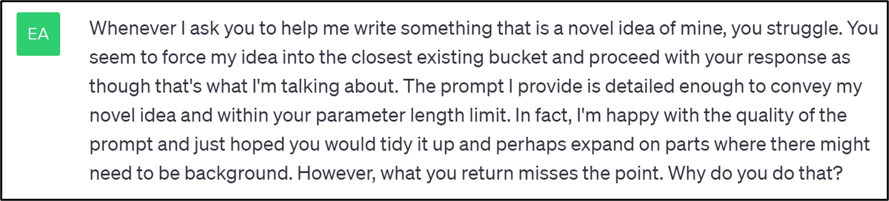
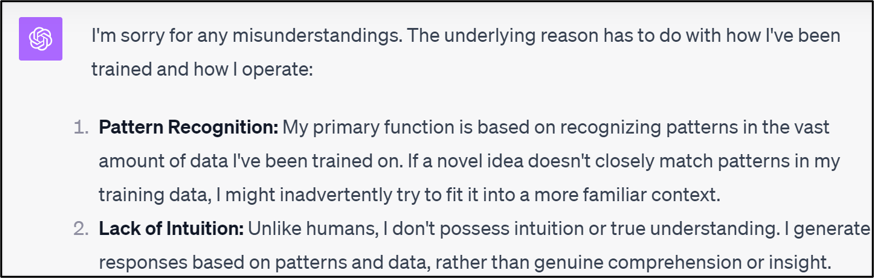
I’ve been aware of these problems almost from the beginning. As I mentioned, in Enterprise Intelligence, I explicitly discussed how ChatGPT struggled with my unusual combinations of concepts. I wrote that when something didn’t fit a familiar pattern, it tended to force the idea into the closest category it knew.
My prompt and part of ChatGPT’s response from the book are shown below:
In May 2025, I returned to the subject in From Data through Wisdom: The Case for Process-Aware Intelligence, where I graded ChatGPT and Grok on the different tasks I used them for.
I gave them especially poor marks for taking my rough explanations of novel ideas and turning them into coherent prose without losing the essential meaning.
Then, in March 2026, in The Products of System 2, I was still writing about the same problem.
What changed over the years was that ChatGPT became increasingly capable, and my expectations grew along with it. I began relying on it for more sophisticated work. I provided it with increasingly extensive context, including prior articles, detailed explanations, and entire bodies of source code.
When it responded well, the experience started becoming increasingly like a conversation with a knowledgeable colleague who understood what I had been working on.
I think I gradually allowed those experiences to obscure the architectural limitations I had understood all along. A good conversation creates the appearance of a shared intellectual history. But the appearance can be stronger than the underlying continuity.
Perhaps that’s the most deceptive aspect of the experience. ChatGPT can be so good at discussing something within the immediate context that I naturally expect it to carry that understanding forward, as I would with a serious human apprentice.
It’s not that the previous conversations are necessarily gone. It’s that their accumulated significance isn’t consistently represented or brought to bear on new problems. And that’s a particularly difficult limitation for someone whose approach to problem-solving depends heavily on recognizing relationships among seemingly unrelated things.
An idea I explored two years ago might suddenly become relevant because of something I learned yesterday. I can recognize that connection because the earlier idea is part of my accumulated experience, not merely a document I could retrieve if given the right keywords.
I increasingly realize that I’ve been expecting something similar from ChatGPT.
Can This Be Fixed?
There are ways to address parts of this problem. Fine-tuning, retrieval-augmented generation, persistent knowledge graphs, structured memory, and other approaches can provide an AI system with richer and more consistent access to a specialized body of knowledge.
But it’s still not the same as genuine assimilation. Think about how our own brains learn. Through exposure, repetition, application, and the consolidation of memories, new information gradually becomes integrated into what we already know. It’s not simply a matter of storing more facts. The relationships among what we know are themselves modified. Something we learned years ago can influence how we understand something entirely new, even when we’re not consciously recalling the original experience.
This is where I see a fundamental difference between an LLM that has been trained and an LLM that has been given additional context. During training, the model’s weights are modified as it incorporates patterns and relationships from enormous amounts of information. The whole becomes greater than the sum of its parts. But when I provide ChatGPT with additional context about my research, those interactions don’t ordinarily modify its underlying weights. The context can temporarily influence how the model interprets and combines what it knows, sometimes quite impressively, but that understanding doesn’t necessarily become part of its enduring structure.
In that sense, LLM plus context is still a very large, highly integrated body of knowledge interacting with additional information that hasn’t undergone the same process of assimilation. The additional information can be stored, retrieved, and repeatedly presented, but that’s not equivalent to the experience of an apprentice whose understanding is gradually and persistently changed through years of working with a mentor.
Note that the “whole is greater than the sum of its parts” is a little strange with LLMs, since the response is to some extent literally a sum of its parts.
Indeed, much of my own research concerns architectures that combine LLMs with other mechanisms for preserving knowledge and experience.
Building a specialized system that continually assimilates my work is a considerable undertaking. Fine-tuning alone would not necessarily produce the assimilated judgment I’m describing.
I’m not an “AI researcher” in the sense of developing foundation models or devising new neural-network training algorithms. My work is primarily about creatively applying and augmenting AI in enterprise environments, using what we already have to construct systems with more sophisticated capabilities.
I could certainly turn the problem of building my own AI apprentice into another project. But that’s not what I set out to do when I began using ChatGPT.
Another Dilemma: Learning to Use AI or Learning to Think?
There’s another dilemma I’ve been thinking about. How much effort should we personally devote to becoming better at using AI (with the intent of being better than most if not everyone for competitive reasons), versus maintaining our ability to dig deeply into problems and think through them ourselves?
For most people my age (yes, I’m a boomer), the vast majority of our careers were spent relying on our own intellect, experience, and resourcefulness. We had books, documentation, colleagues, search engines, and increasingly sophisticated software tools. We learned to make the best of whatever resources were available. But ultimately, we had to work through the problems ourselves.
I’ve been writing code and thinking through complex architectural problems for decades. I can still do those things “old school”. I’ve spent so many years exercising those skills that they’re deeply ingrained. That gives me some confidence that I won’t suddenly lose them just because I now have AI doing heavy grunt-work research and increasingly more.
But I also recognize that skills can atrophy when they aren’t exercised. We don’t necessarily lose the knowledge, but we can lose the fluency and sharpness that come from regular practice. There is a difference between knowing how to solve a problem and being able to work through it effectively without assistance.
On the other hand, there’s a very real risk in not becoming exceptionally good at using AI. Someone who fully embraces these tools, learns their strengths and weaknesses, and develops effective ways of working with them may accomplish far more than someone who insists on doing everything the old-fashioned way.
I don’t want to fall behind simply because I’m protecting skills I’ve already spent decades developing. Nor do I want to become so dependent on AI that I gradually lose the ability to think through difficult problems independently. Or worse, the solutions are no longer legitimately my work.
This dilemma is different for someone just beginning a career. They may develop extraordinary proficiency with AI without ever having spent years solving the same problems unaided. Will they develop the same depth of understanding? As long as AI is around (as I write this, that’s not exactly a certainty), they’ll develop different capabilities that are equally powerful. I don’t know. But it’s a question worth considering.
There’s no simple answer. The challenge is learning when to let AI do the work and when to deliberately exercise our own intellectual capabilities. Becoming better at using AI is itself a skill, and one that obviously deserves serious attention.
The objective shouldn’t be to do everything ourselves, nor to have AI do everything for us. It should be to become more capable with AI than we would be without it, without surrendering the intellectual abilities that allow us to judge what it’s doing.
But Do We Really Need an Apprentice?
There’s another consideration that might get lost in my critique of ChatGPT’s inability to assimilate my work. For many purposes, a highly capable research assistant is already more than enough.
As we know, so much productivity can be gained from someone who can explain unfamiliar concepts, generate and debug code, review documents, explore alternatives, suggest approaches, and help organize complicated information. Even if that assistant never develops a deep, accumulated understanding of our particular work, those capabilities alone are extraordinary.
A full apprenticeship is a substantially higher bar. It requires the assistant to develop a progressively richer understanding of what we’re doing, why we’re doing it, what we’ve already tried, and how everything relates. That would certainly be desirable, particularly for the kind of research I pursue.
But it isn’t necessary for most of the productivity gains we can already achieve with AI. In fact, expecting an apprentice when what we really need is a capable assistant might lead us to undervalue what these systems already accomplish.
My own frustration comes partly from the nature of my work, which is not the nature of everyone else work. I’m frequently exploring ideas for which there isn’t a well-established solution. I need to recognize relationships among concepts that might have been developed years apart, assess unfamiliar research against an evolving architecture, and decide whether a promising direction is worth months of effort.
That’s where an apprentice who has been learning alongside me would be especially valuable.
For many other tasks, however, I don’t need ChatGPT to assimilate years of my experience. I just need it to do the job well.
Perhaps that’s another lesson from these four years. The fact that ChatGPT isn’t my apprentice doesn’t diminish its extraordinary value as my research assistant. It simply means I need to understand which role I’m asking it to play.
Still My Research Assistant
None of this diminishes my appreciation of ChatGPT or the enormous contribution it has made to my work productivity. Despite its limitations, I wouldn’t want to pursue my research without it. What has changed is my understanding of the role I should expect it to play.
But I’ve had to revisit the analogy I used in Enterprise Intelligence. An apprentice starts with limited knowledge but gradually develops experience with the particular work being done. ChatGPT starts with an extraordinary breadth of knowledge, but doesn’t reliably accumulate that same kind of specialized experience simply because we work together every day.
It’s more like having access to someone who knows a lot about a lot of things, is extraordinarily patient, and is always available to discuss whatever is on my mind. That’s a remarkable resource in its own right.
But while I’m assessing the next step of my research, I need to remember that ChatGPT isn’t carrying the same accumulated understanding of my work that I am.
Its assessment of related research is a starting point, not a verdict. Its apparent understanding of my architecture needs to be checked. And its ability to discuss an idea convincingly doesn’t necessarily mean it will recognize how that idea relates to something we developed months ago.
I suspect thousands (even millions) of other people who have spent years working with ChatGPT on their own projects have experienced something similar. As its capabilities increase, it becomes increasingly natural to think of it as a colleague who has been learning alongside us.
Perhaps future AI systems will more fully realize that expectation.
For now, I’ve come to appreciate a limitation that I recognized four years ago, but increasingly lost sight of as ChatGPT became more capable:
ChatGPT is an extraordinarily capable research assistant. But working with an assistant for years doesn’t necessarily turn it into an apprentice.
And I think that’s something those of us who use AI to develop our own ideas need to keep firmly in mind.
Happy 4th “Birthday”, ChatGPT. As I write this, there’s reason to wonder if you’ll have a 5th. If I had to bet, I’d bet you’ll make it through a possible AI bubble-burst, running out of money, or competition until then.


