I learned today that Patrick Stewart passed away a couple of days ago, on Oct 28. So this blog also serves as a tribute to the actor who played one of my favorite characters.
TL;DR: of the Blog: Human intelligence does more than accumulate facts. We package experience into stories, compress stories into references and metaphors, and use analogy to map pieces of old stories onto new situations. LLMs already produce impressive stories and analogies, but largely as an emergent capability of an extraordinarily rich statistical model trained at the token level. I am suggesting a more purposeful layer around and above the LLM: stories treated as first-class objects that can be dereferenced into characters, situations, relationships, sequences, causes, outcomes and lessons; represented in several complementary ways; searched for structural similarities; mapped against a current problem; and recombined into candidate solutions.
Star Trek: The Next Generation’s “Darmok” provides a useful metaphor for both the power and the risk of that architecture: a civilization can become extraordinarily effective at communicating through compressed story references, yet brittle when the listener does not share the same story library. The goal for AI should be to gain the leverage of stories, metaphor and analogy without allowing the more flexible less abstracted machinery beneath them to atrophy.
Important: Darmok is the metaphor here, not the subject. The subject is a possible architecture for intelligence beyond the LLM: treating stories, metaphor, analogy, and curiosity as purposeful capabilities built above and around the extraordinarily powerful statistical machinery we already have.
TL;DR of Darmok: Captain Picard meets the Tamarians, whose individual words can be translated but whose sentences remain incomprehensible because they communicate largely through references to stories from their shared culture. “Darmok and Jalad at Tanagra” means nothing to Picard because he does not know who Darmok and Jalad were or what happened at Tanagra. The Tamarian captain, Dathon, therefore creates a shared experience with Picard from which understanding can grow. By the end, that new experience has itself become a story—and therefore a new reference: “Picard and Dathon at El-Adrel“. The episode is ultimately about meaning being reconstructed from shared experience rather than carried completely by the words themselves.
Good short YouTube video: Darmok, under 8 minutes
Darmok and Jalad at Tanagra
In the Star Trek: The Next Generation episode Darmok, Captain Picard encounters the Tamarians, a people whose words can be translated but still cannot be understood. They communicate largely by invoking people, places, and situations from stories shared throughout their culture.
- “Shaka, when the walls fell.”
- “Darmok and Jalad at Tanagra.”
- “Temba, his arms wide.”
- “Sokath, his eyes uncovered.”
The words themselves are understandable. What Picard lacks are the references. Who was Darmok? Who was Jalad? What happened at Tanagra? What relationship among those characters and events is the speaker asking him to recognize?
Once Picard begins learning the stories behind the references, the language begins to make sense.
I’m talking about this episode because it ties together something I have been writing about from several directions: stories, references, metaphor, analogy, and curiosity may be much more fundamental to intelligence than we usually give them credit for.
I have gone as far as calling stories the transactional unit of human-level intelligence. I increasingly think that idea points toward a layer of AI that comes after the LLM—not replacing LLMs, but building around them.
I actually didn’t like this episode when I saw it in its first run back in 1991. It’s because I knew they still needed to learn the stories. It was also so blatantly obvious that we speak in metaphors to some extent. We learn from history, literature, other peoples’ experiences. I thought Captain Picard was linguistically anthropocentric or human-centric in his assumptions about language. You’d think that’s very obvious in the 24th century.
Looking back, though, I think there was another problem hidden inside my objection. The Tamarians still had to learn those stories somehow. And once the stories became compressed into references, they seemed strangely unable to unpack them again. Humans use metaphors and references constantly too, but if someone does not understand one, we can descend into the story, explain the individual events and relationships, or abandon the metaphor altogether and describe the situation more literally.
We Already Speak Tamarian
The Tamarian language seems bizarre until we notice how often we already do something similar. American conversation is full of references to movies, television, sports, history, literature, music, advertising, politics, and shared cultural events. We all love a great reference. Someone mentions the Soup Nazi from Seinfeld, Clark Griswold’s tangled ball of Christmas lights, the rise of Chauncey Gardner in Being There, David and Goliath, or the boy who cried wolf. If you know the story, very little needs to be said.
There also might be less widespread sources—from a notorious family or office event—whereby only family or co-workers will understand. For example, “Uncle Willie and the lemons”.
Speaking of Seinfeld, a friend and I were recently discussing how it’s almost a “social reference library”. It’s surprising how many stories we can refer to as metaphor. For example, we could start a TikTok “trend” of Tamarian-style metaphors:
- George with the whale — a lie forces someone to become what he only pretended to be.
- George doing the opposite— abandoning your habitual judgment because it has repeatedly failed.
- George at the fire — self-preservation revealing character when social obligation disappears.
- Jerry lost in the parking garage — a badly designed environment turning an ordinary task into an ordeal.
- Kramer at the dealership — deliberately pushing past an assumed boundary to discover the real one.
- George with the eclair — rationalization making an obviously unacceptable act seem defensible.
- Elaine, dancing at the office party — the gulf between self-perception and everyone else’s perception.
- Jerry before the Soup Nazi — willingly submitting to an unreasonable system because the reward is worth it.
- George as Vandelay— a fabricated story becoming more elaborate until reality exposes it.
- George double-dipping— a tiny act exposing incompatible assumptions about unwritten social rules.
A reference might point to an entire story, but it can also point to just one character, scene, setting, relationship, decision, or outcome within it. Those elements carry meaning because of their position in the larger story.
Think about everything packed into even a simple story:
| Story Element | What It Carries | Iconic Example |
|---|---|---|
| Characters | Actors with different roles, capabilities, motivations, perspectives, and relationships | David and Goliath — the underdog and the overwhelming opponent |
| Settings | The environment and constraints within which events can occur | The Death Star trench in Star Wars — a constrained setting that shapes the entire attack |
| Scenes | Particular states or situations at a point in the unfolding story | Clark Griswold waiting for his Christmas bonus — a single scene that captures expectation, frustration, and impending disappointment |
| Sequences | How one scene or state leads to another through time | The tortoise and the hare — overconfidence, pause, persistence, reversal, outcome |
| Conflicts | Competing goals, pressures, constraints, or forces | Captain Ahab and Moby Dick — obsession set against an uncontrollable force |
| Causes and consequences | What produced an event and what changed because of it | The boy who cried wolf — repeated false alarms destroy credibility, producing the later consequence |
| Successes and failures | Which actions worked, which did not, and under what conditions | Apollo 13 — repeated failed assumptions and improvised solutions under severe constraints |
| Lessons | Patterns or knowledge that can be carried forward into another situation | The Good Samaritan — moral responsibility extends beyond expected social boundaries |
A tiny reference can dereference that much larger structure in another person’s mind.
The Bible and texts from pretty much all religious traditions are packed with this mechanism. Many stories may just seem like tales of great godly feats but are really about a payoff of a great human lesson. There are long narratives, short parables, poetry, proverbs, metaphor, and memorable characters. “David and Goliath” escaped the original story centuries ago and became a general pattern for a small challenger confronting a powerful opponent. The Good Samaritan became a character type. The Prodigal Son became another. Psalms encode experience through poetry, while Proverbs compress lessons even further.
You do not have to retell those stories every time you use them. Once they become shared cultural knowledge, the reference becomes a pointer to the story. That is remarkably close to what the Tamarians are doing.
Much of Language Is Fossilized Metaphor
The Tamarian language seems less exotic the longer we think about how our own language works. We do not merely make occasional metaphors. A tremendous amount of ordinary vocabulary grew through metaphorical extension: something concrete that humans could see, touch, feel, or do became a way of describing something more abstract. Eventually the transferred meaning became so familiar that we stopped noticing the metaphor.
| Word | Concrete Meaning | Metaphorical Extension |
|---|---|---|
| grasp | Physically hold something | Understand an idea |
| point | A particular physical location | The central idea of an argument |
| root | Part of a plant beneath the ground | An underlying cause |
| branch | Part of a tree | A division of an organization or field |
| head | Part of the body | Leader, top, or front |
| foot | Part of the body | Bottom or base |
| bright | Giving off or reflecting light | Intelligent or perceptive |
| heavy | Having substantial physical weight | Serious, intense, or difficult |
| warm | Relatively high temperature | Friendly or emotionally receptive |
| cold | Relatively low temperature | Emotionally distant |
| fall | Physical downward movement | Decline, defeat, or collapse |
| rise | Physical upward movement | Increase, advancement, or rebellion |
Linguists sometimes call these dead metaphors. The metaphor has become so conventional that speakers no longer experience it as figurative language. That suggests a stronger statement:
Much of ordinary language is fossilized metaphor. Words that now seem literal often began as transfers from physical experience, spatial relationships, bodily action, or older stories.
The progression can look something like:
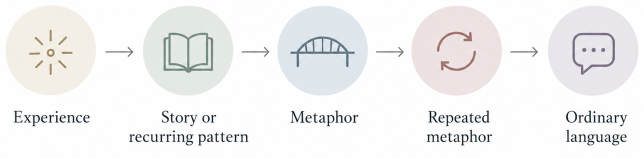
So Darmok may not portray an utterly alien form of communication at all. The Tamarians simply leave visible something that our own language often hides.
The “X of Y” Shortcut
We do something similar when we describe an unfamiliar place by naming a familiar one.
Waimea Canyon on Kauaʻi, for example, is commonly called “the Grand Canyon of the Pacific”. The expression does not provide measurements, geology, climate, vegetation, or a map. Instead, it asks the listener to retrieve an existing mental model of the Grand Canyon and transfer some of its salient characteristics to Waimea Canyon.
This pattern is everywhere:
| Place | Familiar Reference | What the Metaphor Is Asking Us to Transfer |
|---|---|---|
| Nashville, Tennessee | The Athens of the South | Athens as a reference for education, arts, learning, and culture; Nashville even built a full-scale Parthenon replica. |
| Ouray, Colorado | The Switzerland of America | Alpine mountains, steep valleys, dramatic scenery, and a compact mountain settlement. |
| Atlanta, Georgia | Hollywood of the South | A large film-production ecosystem analogous to Hollywood’s role in film and television. |
| Bengaluru, India | The Silicon Valley of India | A dense technology ecosystem of software companies, technical talent, entrepreneurship, and investment. |
But there is an important dependency hiding inside every one of these expressions. Calling Waimea Canyon “the Grand Canyon of the Pacific” may tell someone quite a bit if that person consumed its richness of properties, standing at the rim of the Grand Canyon. They can retrieve the scale, depth, exposed walls, distances, colors, and feeling of looking across an enormous canyon landscape.
For someone who has never seen the Grand Canyon—and perhaps knows little more than its name—the metaphor carries much less information. The same applies to “Athens of the South”. If Athens means little more than “a city in Greece”, much of the intended meaning disappears. “Silicon Valley of India” becomes shallow if Silicon Valley itself is only a name.
That is the Darmok problem again: A metaphor cannot transfer knowledge that the receiver does not already possess. “Darmok and Jalad at Tanagra” is meaningless to Picard because he does not know about Darmok, Jalad, or Tanagra.
“The Grand Canyon of the Pacific” has the same dependency, only hidden beneath a reference familiar enough that we rarely notice it. Metaphor therefore does not transport the whole meaning. It sends an address and relies upon the receiving mind to reconstruct the rest.
But Can the Tamarians Get Back Down?
That raises another question about the Tamarians. Their problem may not be that they operate at too high a level of abstraction. Stories and metaphors are powerful precisely because they compress so much experience into something small enough to carry around. The strange part is that when Picard does not possess the story behind the reference, they seem to have tremendous difficulty moving back down into something more literal.
In terms of the DIKUW progression I talk about quite a bit—Data, Information, Knowledge, Understanding, Wisdom—I imagine something analogous to an enterprise with excellent ML models and a rich knowledge graph, but whose OLAP or semantic layer has atrophied and whose ability to work directly from raw observations has atrophied even further. The higher-level structures may still work extremely well. The problem is that increasingly sophisticated abstractions have become the normal way the system operates, while the finer-grained mechanisms from which something genuinely new can be assembled are used less and less.
Those lower levels probably would not be completely gone. Tamarian engineers, scientists, doctors, historians, and perhaps children learning the culture would still need some way to deal with particulars. But perhaps those capabilities became specialized while everyday Tamarian thought and communication became increasingly dependent upon the accumulated higher-level library.
That could make them remarkably efficient within a culturally homogeneous community whose members share much of the same story library, but terribly brittle in an interstellar civilization populated by many sentient species. Humans evolved in a changing and diverse world in which nobody knows more than a fraction of what everyone else knows.
We continually encounter people with different histories, professions, cultures, experiences, and stories, while genuinely new situations keep appearing. When a shared reference fails, we can unpack it, explain the underlying events and relationships in more literal language, or assemble a new explanation from smaller pieces. The Tamarians did not necessarily climb too high. They may have optimized so heavily for their accumulated higher-level representations that the lower-level flexibility needed outside that shared library atrophied.
Stories Are Packages of Experience
A story is therefore much more than text. It packages players, relationships, motivations, context, sequences of events, changes in state, causes, consequences, successes, failures, and often a lesson. Importantly, the story can remain one particular instance while the lesson carried by that instance reaches far beyond it. David and Goliath happened once within the story, but the pattern it represents can be applied to situations that have nothing to do with ancient warfare.
That may help explain why humans have carried stories for thousands of years. Before databases, textbooks, or even writing, stories were a remarkably durable way to serialize experience so another brain could reconstruct it.
In Stories are the Transactional Unit of Human-Level Intelligence, I argued that stories are densely linked units of knowledge. Scenes can themselves be stories. Characters participate in many stories. Motifs recur across them. One story reminds us of another.
The result is not a filing cabinet of isolated narratives. It is closer to a densely connected story space. References provide shortcuts through that space.
Systems Tell Stories Too
There is another meaning of “story” that is especially important to what I have been building. A story does not have to be a novel, movie, parable, or anecdote. A system unfolding through time tells a story too:
- A customer enters a store, examines something, asks a question, buys it, returns it, contacts support, and eventually becomes either a loyal customer or an ex-customer.
- A patient enters a hospital, is examined, tested, diagnosed, treated, monitored, and discharged.
- An AI agent receives a task, retrieves context, calls tools, encounters an exception, revises its approach, and eventually succeeds or fails.
Each is one actual path through a system.
That is essentially what I was trying to capture with Time Molecules. Traditional BI is very good at describing things and their characteristics. Time Molecules instead asks what happens through time. Events are organized into cases, with each case representing one cycle or instance of a process.
Put another way:
A case is to a system something like a story is to a world: one particular way events actually unfolded.
The system represents the space of possibilities. The case is one realized journey through it.
That also means different runs through the same system produce different stories. A normal order proceeds smoothly. Another encounters an inventory problem. Another is delayed. Another is canceled. The cast may differ, the timing differs, branches are taken or avoided, and the ending may change.
In AI Agents, Context Engineering, and Time Molecules, I described this very directly: every cycle of a process tells a story. Looking only at the final result throws away much of the intelligence contained in how that result came about.
When we collect many similar cases, another interesting thing happens. The stories begin to rhyme (a metaphor). A Markov model can summarize those recurring stories—the common transitions, alternative paths, loops, exceptions, probabilities, and timing. It is not one story. It is a probabilistic abstraction of many related stories.
There are therefore two very different kinds of generalization involved here. A Markov model generalizes across many instances: it summarizes the recurring transitions, alternatives, probabilities, loops, and timing found in a population of cases. A story used as metaphor or analogy generally does something different. It remains one instance—David and Goliath, Apollo 13, my kahili ginger plant—but that particular instance can carry a lesson, pattern, or piece of wisdom whose applicability is much broader than the event itself. The story is not an average of many cases. It becomes an exemplar whose richer structure can be dereferenced and mapped onto something new.
That framing became much more explicit in the Time Molecules 2026 Refresh: event sequences such as customer journeys, hospital visits, machine workflows, support incidents, and agent runs become first-class analytical objects, while Markov models compress large populations of those stories into analyzable abstractions.
This is important for analogy. In Analogy and Curiosity-Driven Original Thinking, I described Time Molecules as a process library. The idea was not to store only processes that obviously belong to one enterprise or industry. It was to preserve processes across very different domains because a process from one domain might become the analogy that helps solve a novel problem somewhere else.
That gives stories another role. They are not only how humans communicate experience. They can also become units of process memory.
Parsing Stories into Analogy Candidates
In my earlier discussion in Stories are the Transactional Unit of Human-Level Intelligence, I explored a fairly prescriptive way of turning stories into machine-readable structures. I used SBAR—Situation, Background, Assessment, Recommendation—as an intermediate structure and then encoded the resulting story as an RDF knowledge graph. The idea was to move from messy narrative, to manageable pieces, to an explicit structure that could be linked to other knowledge.
One example I used there was the story of trying for twenty-two years to get a kahili ginger plant to bloom in Boise. The narrative contains people, a plant, places, changing environmental conditions, repeated attempts, failures, interventions, observations, and eventually an outcome. In a sense, the story can first be dereferenced into that richer web of experience, then decomposed into structures a machine can work with. I used the LLM to pull some of that structure out of the free-form story and express it through SBAR and RDF. That is the kind of decomposition I have in mind here—not reducing a story to a checklist, but exposing some of its actors, situations, events, relationships, causes, outcomes, and lessons so they can be compared with pieces of other stories.
The table below suggests another complementary way to parse stories, this time specifically for analogy.
| Story Element | What We Might Extract |
|---|---|
| Characters | Roles, motivations, capabilities and relationships |
| Settings | Environmental conditions, resources and constraints |
| Scenes | Important states or situations |
| Sequences | Transitions among those states |
| Conflicts | Competing goals, pressures or forces |
| Causes and consequences | What appears to lead to what |
| Successes and failures | Actions, conditions and outcomes |
| Lessons | Patterns that might transfer elsewhere |
These are manageable—but still related—reductions of a much richer story. They inevitably lose information, but they give us pieces that machines can compare.
Parsing a story into smaller parts is only the first step. If we want machines to search, compare, and reason over those parts, they need representations that preserve different aspects of the story.
There probably should not be one universal representation. The same scene, character relationship, conflict, or sequence could be encoded several ways because each representation preserves something different.
| Representation Family | Examples | What It Preserves | Role in Analogy |
|---|---|---|---|
| Narrative / semantic representation | Text, embeddings, vector stores | Meaning, context, tone, fuzzy similarity, conceptual resemblance | Finds candidate stories or fragments that seem semantically related even when the wording and domain differ |
| Graph representation | RDF, knowledge graphs, property graphs, causal graphs | Entities, roles, relationships, dependencies, causes, provenance | Exposes structural correspondences: who maps to whom, what relationship maps to what, and where the analogy breaks |
| Temporal / process representation | Time Molecules, event sequences, Markov models | Order, transitions, timing, branches, loops, recurring paths, probabilities | Finds stories that unfold similarly and generalizes across many related trajectories |
| Structured / symbolic representation | Schemas, rules, constraints, attributes, goals, conditions | Explicit properties, requirements, limits, actions, outcomes | Tests whether an analogy is actually applicable under the conditions of the current situation |
These representations are complementary rather than mutually exclusive.
A story does not need to have one canonical encoding. Different representations preserve different aspects of the same experience.
- Narrative text and vectors preserve the semantic richness of the story and make fuzzy retrieval possible. A vector search might discover that a supply-chain problem resembles an ecological process even though they share almost no vocabulary.
- Graphs preserve explicit structure: actors, roles, relationships, dependencies, causes, and other connections. Once a candidate analogy is found, a graph can help determine exactly which portions correspond and which do not.
- Time Molecules and Markov models preserve how the story unfolds through time. Individual event sequences retain particular cases, while Markov models generalize across many related or “rhyming” stories.
- Structured and symbolic representations preserve explicit constraints, conditions, goals, and rules. They can help test whether a seemingly good analogy survives contact with the actual circumstances of the current problem.
None of these needs to win. The same story can be represented in several forms at once, and each provides a different lens through which an analogy can be discovered, tested, and eventually reused.
The same story fragment can therefore have several representations at once. That matters because analogy does not require two stories to match in every way. We may discover similarity in a vector space, confirm an important relationship in a graph, find a matching sequence in a process model, and reject another portion because the causal structure is different.
The representations give us different ways of finding and examining candidate correspondences. They do not, by themselves, solve the new problem.
The important part is that we do not need to match only whole stories to whole problems.
A current problem might resemble one story in its characters, another in its sequence, another in its conflict, and yet another in the way an apparently successful action produced an unexpected consequence.
That gives us something more specific than: This problem is like David and Goliath.
It might instead become:
- The competitive relationship resembles David and Goliath.
- The sequence resembles the boy who cried wolf.
- And the solution to one particular bottleneck resembles something seen in an ant colony.
Those are sub-metaphors—smaller structural correspondences drawn from different stories. And that is where the hard part begins.
Metaphor Points, Analogy Maps
This also helps clarify the relationship between metaphor and analogy. A metaphor can say, in effect: This is like that.
For example, Microsoft vs. IBM around the early 1980s was “David and Goliath”. No elaborate explanation is necessary. The listener begins reconstructing the pattern.
Analogy goes further by asking how the structures correspond.
- Who is David here?
- Who is Goliath?
- What corresponds to the sling?
- Which advantage held by the apparently weaker player changes the balance?
- And perhaps most importantly:
- Where does this analogy stop working?
In Analogy and Curiosity-Driven Original Thinking, I argued that novel solutions can emerge when we recognize similar relational structures in very different domains. A process from ecology, geology, manufacturing, warfare, medicine, or cooking might provide the seed of a solution somewhere seemingly unrelated.
The old story does not supply the answer. It provides a candidate structure from which an answer can grow.
Curiosity Searches the Story Space
But how do we find the right story? That is the role of curiosity.
Something does not fit our current explanation. We feel there is a hole somewhere. We remember something vaguely similar. We follow it. Maybe it fails. That reference reminds us of another one. We wander into another domain entirely.
That wandering is not necessarily wasted motion. Curiosity is probing the story space for another structure that might fit.
An experienced person has more than facts accumulated in memory. The person has thousands of stories: projects that succeeded, projects that failed, people who reacted unexpectedly, bugs that turned out to have strange causes, books, jokes, movies, mistakes, conversations, historical episodes, things a teacher once said.
Experience expands the library from which analogy can draw.
The First Library Was Nature
But our library did not begin with human stories.
Long before humans could deliberately invent anything, evolution had been generating working solutions through enormous amounts of trial and error under the unforgiving constraints of the physical world. Eyes, limbs, camouflage, signaling, cooperation, competition, distributed systems, repair, adaptation, branching structures, swarms—nature was already filled with mechanisms that had survived some test of reality.
In System ⅈ: The Default Mode Network of AGI, I called nature our first library. Human inventiveness did not begin from a blank page. We observed patterns that evolution had taken hundreds of millions of years to stumble upon and reused them through analogy.
That process changed dramatically once humans could preserve solutions outside biology. Stories, tools, procedures, diagrams, mathematics, science, engineering, and eventually vast digital archives allowed one successful idea to become the starting point for another. Culture became a second solution library—and eventually the much faster-growing source of most new analogies.
So there is an important acceleration here. Evolution slowly discovered workable patterns through immense stretches of trial and error. Humans then observed and abstracted those patterns, culture preserved the abstractions, and analogy allowed us to recombine them into new solutions.
Evolution had the luxury of immense time and countless failed experiments. Human ingenuity developed a shortcut: we can reuse the results instead of starting the search over from scratch.
That is one reason I argued in Long Live LLMs! The Central Knowledge System of Analogy that LLMs remain extraordinarily important. Their huge semantic breadth gives them access to an immense range of possible connections.
But finding a possible analogy and living through a story are not quite the same thing.
From Metaphor to Solution
Finding analogies is not the same as solving the problem. Retrieval may actually become the easier part. LLMs, vectors, knowledge graphs, and process libraries can provide enormous numbers of possible analogies. The difficult work is deciding which portions are salient.
For each candidate analogy we need to ask:
| Analogy Check | What We’re Testing |
|---|---|
| What corresponds? | Identify the actors, roles, relationships, events, states, or mechanisms that map between the old story and the current situation. |
| What does not correspond? | Find the places where the analogy breaks rather than forcing the stories to match. |
| Which relationships are important to the outcome? | Separate the structural relationships that helped produce the result from surface similarities. |
| Which details are incidental? | Discard attributes that belong to the original story but have little bearing on why events unfolded as they did. |
| What current constraints invalidate part of the analogy? | Test whether differences in environment, resources, timing, scale, incentives, technology, or other conditions make part of the old solution unusable. |
| Can pieces of several analogies be combined? | Treat an analogy as a source of components rather than a complete answer; combine salient pieces from multiple stories into a new candidate solution. |
The resulting solution may therefore never have existed as a complete story anywhere in the library. It is constructed from pieces of prior stories.
A scene from one story contributes an approach to a bottleneck. A character relationship from another suggests how two participants might interact. A process from nature suggests a mechanism. A historical failure warns against a particular path. A completely different story supplies the missing final step.
The analogies are seeds, not answers.
This is close to what I meant in Analogy and Curiosity-Driven Original Thinking when I described analogy as the beginning of a solution rather than the solution itself. A process we have encountered before gives us something to start with. From there, we mutate it to fit a novel situation.
So an architecture for analogy might look something like starting with our current situation we’re experiencing, then:
- parse into story elements
- retrieve matching stories and story fragments
- map corresponding roles, states, relationships and sequences
- identify the salient transferable pieces
- combine pieces from one or more analogies
- construct a candidate solution
- act
- look again
The final step is essential. The analogy was only a hypothesis about how the current story might unfold. But, reality gets the last word.
Tying Up the Analogy Arc
Looking back, I can now see this thread developing across several things I wrote without originally planning them as a series. Many of the concepts brought together here are not “household words” with an established literature a reader can simply be expected to know. The references below show where I developed the individual pieces of this argument before they converged in this article.
| Published | Blog | Part of the Arc |
|---|---|---|
| March 14, 2025 | Sneak Peek at My New Book—Time Molecules | Moves from static things toward systems unfolding through sequences of events. Cases capture particular trajectories through processes. |
| June 27, 2025 | Analogy and Curiosity-Driven Original Thinking | Explicitly describes Time Molecules as a process library. Curiosity searches widely; analogy maps relational structures from familiar processes onto novel problems. |
| October 10, 2025 | Stories are the Transactional Unit of Human-Level Intelligence | Stories package context, players, sequence, interaction, outcomes, and lessons into reusable units of experience. |
| November 3, 2025 | Long Live LLMs! The Central Knowledge System of Analogy | LLMs provide extraordinary breadth for discovering possible relationships among far-flung pieces of accumulated human knowledge. |
| February 17, 2026 | An Interlude Before the Third Act of “The Assemblage of AI” | Makes the evolutionary library explicit: evolution generates solutions, humans observe them as examples, and culture becomes the expanding library for future analogy. |
| March 4, 2026 | The Products of System 2 | Stories, plans, strategies, procedures and designs become durable products of deliberate intelligence. It explicitly connects story to analogy. |
| May 15, 2026 | Time Molecules 2026 Refresh/Update | Makes the story interpretation of Time Molecules explicit: event sequences are stories and Markov models are abstractions of many “rhyming” stories. |
| September 28, 2026 | Symbols Travel, Meaning Is Rebuilt | Meaning itself does not travel intact. Symbols and references travel, while the receiving mind reconstructs meaning from its accumulated context. |
| |September 30, 2026 | Reaching from the Realm of Information into the Realm of Knowledge | Uses DIKUW to connect data, semantic-layer information, explicit knowledge, understanding and wisdom, while emphasizing that movement upward does not eliminate the levels below. Higher levels continue to depend upon and feed back into them. |
| October 28, 2026 | Updating Decision Data Points: Why a Fast Semantic Layer Is Part of the Intelligence Loop | Adds re-observation: remembered stories and observations cannot simply be trusted indefinitely because the world continues changing. |
Seen together, the progression looks something like:

Curiosity searches across the library. Time Molecules provides one way of making actual process stories and their generalized patterns machine-accessible. And re-observation asks whether the story we believe we are currently in is still the story actually unfolding.
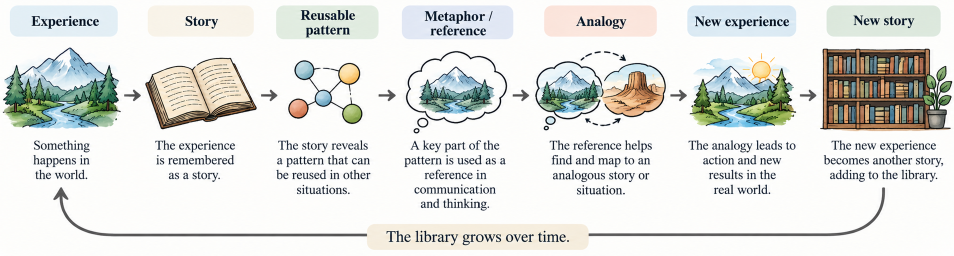
Picard and Dathon at El-Adrel
The ending of Darmok may be the most interesting part of all this. At the beginning, Picard cannot understand “Darmok and Jalad at Tanagra” because he does not possess the underlying story. Then Picard and Dathon live through a story of their own.
By the end, that experience has itself become a Tamarian reference: Picard and Dathon at El-Adrel.
A new event has become a story. The story has acquired characters, a setting, actions, an outcome, and meaning. And now that story can become a reference used to understand some future situation.
The library has grown:
After LLMs
LLMs are extraordinarily good and fundamentally useful at portions of this process. They can roam an enormous space of human knowledge, recognize relationships among seemingly unrelated things, propose analogies, identify corresponding roles, and tell us about stories we have never encountered.
There is something interesting about how we got there. Most, if not virtually all, of the material used to train LLMs was already produced by human intelligence: stories, histories, explanations, arguments, procedures, designs, discoveries, failures, instructions, code, and countless other artifacts. But LLM training breaks the textual representation of that accumulated material down into tokens and builds an extraordinarily powerful statistical model from relationships among those tokens.
Retrieval-augmented generation (RAG) adds an interesting capability to that architecture. The trained LLM does not retain its source corpus as a library of documents it can simply reopen. What it learned has been distributed through the statistical model. RAG gives it a way, at inference time, to reach back toward source-level material—documents, records, cases, or other external evidence—and bring those particulars back into context. It is not literally retrieving the model’s original training data, but in this sense RAG provides a path back toward the kind of “source” material from which the statistical model was built.
That has worked far better than many people expected. But I do not think that token-level statistical machinery, however powerful, is the end of the architecture. The argument of this article is that another layer can be built above and around it: stories treated as reusable units of experience, metaphor as compressed reference, analogy as structural transfer between stories, and curiosity as a way of searching that story space. The LLM provides a remarkably broad substrate beneath that layer, but the higher layer can organize and reuse experience in ways that are more explicit than next-token prediction alone.
To be clear, LLMs already produce remarkably good metaphors and analogies. But that capability is largely an emergent by-product of the statistically rich model created through token-level training, not the result of deliberately constructing an analogy mechanism. The model was not explicitly designed to:
- Dereference stories into actors, situations, sequences, relationships, causes and outcomes.
- Retrieve structurally corresponding stories.
- Map those pieces onto a new situation.
- Identify where the mapping fails. Deliberately recombine pieces from several stories into a candidate solution.
It can often approximate some of those operations remarkably well. What I am proposing is to make them purposeful parts of the architecture, with the LLM remaining an extraordinarily powerful substrate beneath them.
Seen this way, the Tamarians become an interesting warning from the opposite direction. Perhaps their civilization became extraordinarily good at something like this upper story-and-metaphor layer. Their accumulated stories became such effective cognitive shorthand that they increasingly communicated and perhaps even thought through those high-level structures. Over time, the more basic ability to construct a fresh explanation from smaller linguistic pieces may have atrophied. The lesson would not be to avoid climbing higher than the LLM. It would be to climb higher without allowing the powerful lower layer that made the climb possible to wither away.
Whether or not larger LLMs continue improving, I don’t think the destination is simply a larger LLM.
The layer around it may therefore need a memory of actual experiences and stories, ways of retrieving structurally relevant stories rather than merely semantically similar text, mappings among their characters and relationships, mechanisms for noticing where analogies fail, and ways of incorporating what happens next back into memory.
And, as I recently argued in Updating Decision Data Points, it has to re-observe. The story we think we are in can change underneath us.
The analogy process above can itself sit inside a larger intelligence loop:
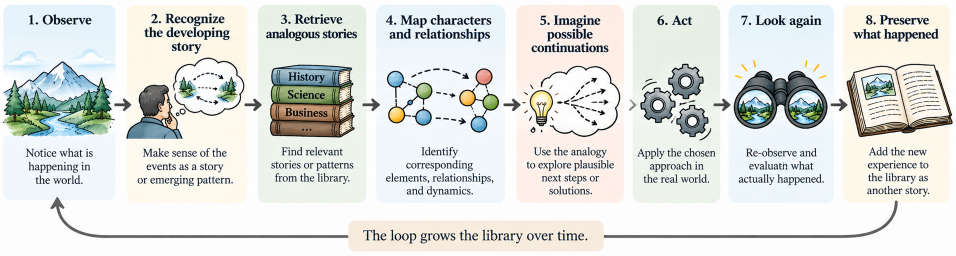
The LLM could be enormously powerful inside such a system without needing to be the entire system.
Notes on Related Work
I should be clear that this line of thinking did not begin for me with the research below. It began when I saw the “Darmok” episode on its first run in 1991. I remember thinking even then that the Tamarians still had to learn the underlying stories before their references could mean anything, and that humans already communicate this way to a lesser extent through history, literature, parables, movies, television, and shared experience. “Darmok” first aired on September 30, 1991.
There is, however, a substantial line of research nearby. In 1983, Dedre Gentner introduced structure-mapping theory, arguing that analogy depends primarily on mapping relationships between a source and a target rather than matching their superficial attributes. Gentner, “Structure-mapping: A theoretical framework for analogy” That idea was subsequently turned into the computational Structure-Mapping Engine (SME) by Brian Falkenhainer, Kenneth Forbus, and Gentner in 1989, and followed by decades of research on structural alignment, similarity, analogy, and metaphor. Falkenhainer, Forbus & Gentner, “The Structure-Mapping Engine”
MIT’s Patrick Winston approached a neighboring problem from the direction of stories. His 2011 Strong Story Hypothesis proposed that story telling and story understanding have a central role in human intelligence. Winston, The Strong Story Hypothesis and the Directed Perception Hypothesis That work developed into the Genesis Story Understanding System, which went beyond simply reading stories: Genesis compared and aligned stories, recognized recurring concepts, reasoned by analogy, answered questions, generated summaries, and even constructed new stories and hypothetical variations. The Genesis Story Understanding and Story Telling System The Genesis Enterprise
The arrival of LLMs has brought these old questions into a new setting. In 2023, researchers at Google DeepMind and Stanford demonstrated analogical prompting, in which an LLM generates relevant examples or lessons from which to reason about a new problem. Large Language Models as Analogical Reasoners The research has continued rapidly enough that a 2026 systematic review now describes a four-decade field spanning symbolic approaches, cognitive models, and newer LLM-based analogy generation and evaluation—and notes that whether LLMs are performing genuine analogical reasoning remains an open question. A Systematic Review of Analogy Generation and Evaluation
I am certainly not claiming that stories and analogy have gone unexplored. What interests me here is a somewhat different assembly. That is, stories decomposed into manageable elements; graphs, vectors, and process models used to retrieve corresponding stories or fragments; analogy used to identify what transfers; and salient pieces from several old stories recombined to construct a solution to a new one.
It may help to make some of the nearby work more concrete. As it is in this AI-driven and Internet-disbursed world, I discovered as always, I’m not nearly the only one to explore this area. I found these works before posting. They all surprised me even though I’m not naive to think there is anything new under the sun.
| Work | What It Actually Does | Where It Overlaps with This Article | What Is Outside Its Stated Scope |
|---|---|---|---|
| The Genesis Enterprise — Winston & Holmes, MIT (2018) | Genesis is explicitly built around story understanding as a model of human intelligence. It reads stories, makes inferences, recognizes concepts, measures conceptual similarity, aligns stories, reasons analogically, summarizes them, constructs new stories, and performs story-grounded hypothetical reasoning. | Stories are treated as structured objects rather than merely text. Story alignment, analogy, concept recognition, and construction of new stories are especially close to the argument here that stories can become computational units for higher-level reasoning. | Genesis predates the current LLM-centered architecture. It is not presented as an external experience repository combining modern semantic/vector retrieval with graph, temporal/process, and symbolic representations of the same story. |
| YARN — Enhancing Structural Mapping with LLM-derived Abstractions for Analogical Reasoning in Narratives (2026 preprint) | YARN uses an LLM to decompose narratives into event-level units, derives several levels of abstraction from those units, and then explicitly maps elements across stories for analogical reasoning. Its purpose is specifically to move beyond surface similarity toward structural correspondence. | This is probably the closest work here to my proposal to dereference a story into manageable elements and deliberately map those elements across stories rather than relying entirely upon analogy to emerge implicitly from an LLM. YARN even preserves temporal ordering and represents events according to their role within the larger narrative. | YARN is an analogy framework rather than a persistent memory of accumulated experiences. Its present implementation uses event phrases and several abstraction levels for pairwise structural mapping; the authors themselves identify richer whole-story structured representations such as AMR or ASP as future work. |
| Narrative Knowledge Weaver — Narrative-Centric Retrieval-Augmented Reasoning for Long-Form Text Understanding (2026 preprint) | Narrative Knowledge Weaver aligns source text, atomic facts, graph structure, entity profiles, interactions, episodes, and storylines. It represents characters as changing states and organizes events according to their roles in narrative progression rather than treating a story as ordinary document chunks. | It is remarkably close to the multi-representational side of this article: the same narrative can be approached through text, graph structure, character state, events, episodes, causal relationships, and larger storylines. | Its stated problem is long-form narrative question answering and evidence assembly. The paper does not present these representations as a library for cross-domain analogy, structural transfer between unrelated experiences, or recombination of pieces from several stories into a new solution. |
| APEX-EM — Non-Parametric Online Learning for Autonomous Agents via Structured Procedural-Episodic Experience Replay (Findings of EMNLP 2026) | APEX-EM stores complete procedural-episodic execution traces in a typed Procedural Knowledge Graph. It retrieves prior experience through semantic search, structural-signature matching over abstract operation sequences, and graph traversal, while retaining both successful and failed experiences. Its experiments show that structural signatures can transfer where semantic similarity alone is insufficient. | This strongly overlaps with the process-memory side of the argument: preserve what actually happened, retrieve prior experience structurally as well as semantically, and reuse experience whose operational structure resembles the current problem even when the vocabulary differs. | Its primary object is an agent/task execution trace and reusable procedural experience. It is not presented as a general story library in which arbitrary human or system experiences are dereferenced into characters, situations, relationships, lessons, metaphors, and other story elements for explicit analogical mapping. |
| ExpGraph — Model-Agnostic Experience Learning with Graph-Structured Memory for LLM Agents (2026 preprint) | ExpGraph takes historical agent trajectories, distills them into reusable skills and failure lessons, organizes those experience units in a self-evolving graph, and retrieves them through graph diffusion and utility-aware ranking. It is explicitly intended to keep accumulated experience outside the LLM so that the underlying executor can be replaced. | It shares the idea that experience should become persistent external memory rather than disappear after an interaction, and that relationships among experiences can reveal transferable strategies that ordinary nearest-neighbor semantic retrieval may miss. | ExpGraph focuses on distilled skills and failure lessons from task trajectories rather than stories as rich, first-class exemplars. Its paper does not frame retrieval as explicit story analogy or describe mapping characters, situations, sequences, relationships, and other sub-story structures across domains. |
These systems make it clear that the ingredients are not imaginary or isolated. What I am describing in this article sits at the intersection of those directions:
- Stories retained as reusable experiences.
- Stories dereferenced into manageable elements.
- Multiple representations preserving different aspects of the same experience.
- Retrieval by semantic, relational, and temporal/process resemblance.
- Explicit mapping of what transfers and what does not.
- The possibility of recombining salient pieces from several stories into a candidate response to a new situation.
I am not claiming that each ingredient is new. The interesting question is what happens when those ingredients are deliberately assembled around an LLM rather than left primarily as capabilities that emerge implicitly within it.
Discounting the capabilities already demonstrated by this related work, what remains is largely an assembly problem. The missing piece is a persistent repository in which the same experience can retain its original narrative while also being dereferenced into characters, situations, relationships, events, causes, outcomes, lessons, constraints and other story elements. Those elements can then be represented simultaneously through vectors, graphs, temporal/process structures and explicit symbolic forms, all tied back to the same underlying story and provenance.
Retrieval would need to operate across those representations—not merely finding semantically similar stories, but finding corresponding relationships, sequences, conflicts, mechanisms or lessons at the level of story fragments. A deliberate analogy process would then map what corresponds, identify where the analogy fails, test the mapping against the conditions of the current situation, and potentially recombine salient pieces from several different stories into a new candidate solution.
The architecture would also need to preserve both kinds of generalization discussed here:
- Abstractions across many related stories, such as a Markov model of recurring process behavior
- The very different ability of a single story to carry a lesson whose applicability extends far beyond that one instance.
Finally, because the world continues to change, the resulting memory cannot be static. New experience must be incorporated, old assumptions re-observed when warranted, and the story library allowed to evolve along with reality.
Darmok and Jalad at Tanagra
Perhaps stories survived for thousands of years not simply because humans enjoy entertainment. Stories may be one of the primary ways we serialize experience:
- References point to them.
- Metaphor compresses them.
- Analogy reuses them.
- Curiosity searches among them.
- Language transmits them.
- And intelligence turns what happens next into another story.
That is why I increasingly suspect that stories and analogy are not peripheral capabilities to bolt onto an LLM. They may be a significant part of what we need to build around the LLM. Maybe humanity’s encounter with AI today (LLM-centric at the time of writing) is a metaphor based on the Darmok episode. In other words, Picard and Dathon at El-Adrel.


4 thoughts on “Stories, Analogies, Metaphors—the Layer After LLMs”