TL;DR
The central premise is that creative questions often arise from connecting knowledge across seemingly unrelated domains. LLMs offer extraordinary breadth across documented human knowledge. People contribute diverse, often undocumented experience distributed among individuals, teams, and organizations. Knowledge graphs provide explicit, traversable relationships, while the Insight Space Graph (ISG) and Tuple Correlation Web (TCW) capture observations and measured relationships arising from enterprise BI activity. Each source has different strengths, costs, and limitations. Time Molecules adds another dimension by representing event sequences as probabilistic process models enriched with contextual properties.
A small experiment with Grok demonstrates how a generalized prompt can encourage more diverse lines of inquiry rather than numerous variations of the same approach. It also raises the question of how to evaluate creativity through conceptual diversity, non-obviousness, investigability, and potential decision impact.
Promising questions can lead to multiple independent calculational pathways, estimates with explicit uncertainty, and further investigations guided by the value of information.
The goal isn’t simply to generate more questions or better answers. It’s to discover promising relationships we might never have thought to investigate—and determine which ones are worth pursuing.
Notes:
- This article is:
- Related to my 2024 book, Enterprise Intelligence. This article precedes a “refresh” of the book’s accompanying GitHub repository, which should be rolled out by the end of 2026.
- Part 2 of Abductive Calculation, which explores how we can creatively discover ways to estimate unknown quantities when we don’t have a direct calculation. But before constructing a calculation, we must discover which relationships might make the unknown estimable.
- Some of the figures are very busy. For a full view, click on the Figure, and hit the Browser’s back arrow to return to this article.
Creativity, Analogy, and the Questions We Ask
I’ve written quite a bit about my belief that creativity is largely based on analogy. We encounter something in one context, sense familiarity to other situations, and realize that the characteristics of those familiar situations might provide a way to solve a current problem. The connection may be obvious in retrospect, but recognizing it in the first place can be the creative act.
This suggests that the breadth of our knowledge has a considerable influence on our creative potential. The more varied our experiences and knowledge, the greater the pool of possible analogies from which we can draw inspiration. Someone familiar with biology might recognize a solution to an engineering problem. Someone familiar with history might recognize a pattern applicable to business strategy. These connections are not guaranteed to be productive, but without the underlying knowledge, we might never think to explore them.
I’ve explored the role of analogy/metaphor in creativity and artificial intelligence across several earlier articles, progressing from how humans recognize unexpected connections to how LLMs might draw upon their extraordinary breadth of knowledge to discover and develop new ideas:
- Analogy and Curiosity-Driven Original Thinking — Creativity arises from recognizing patterns across seemingly unrelated domains and adapting familiar processes to unfamiliar problems.
- Long Live LLMs! The Central Knowledge System of Analogy — The extraordinary breadth of LLM knowledge provides a vast reservoir of potential analogies that smaller, specialized models may lack.
- Stories, Analogies, Metaphors—the Layer After LLMs — Stories preserve relationships, sequences, and outcomes that can be mapped onto new situations and recombined into creative solutions.
This is the top reason I think LLMs are so intriguing. They’ve been trained on an extraordinary breadth of documented human knowledge, ranging from books and scientific papers, to articles and blogs, down to discussion forums. Most of that knowledge also exists collectively among humans alive today. However, it is fragmented across billions of individual minds, connected through relatively slow interfaces such as conversation, writing, and teaching.
Even when knowledge is successfully communicated, the degree to which it is understood, assimilated, and incorporated into someone’s existing knowledge varies enormously. LLMs bring our documented knowledge together in a way that facilitates relationships across distant domains to be explored remarkably quickly—in a single data structure (the LLM model). If analogy is indeed such an important source of creativity, this provides an extraordinary reservoir of potential inspiration.
But this fragmentation isn’t necessarily a weakness of human intelligence. Human intelligence is naturally distributed across space and time because that’s how we exist in the physical world. Throughout most of history, traveling to another part of the world could take months, and even today, no individual can experience the entire world at once, much less across time. Instead, each of us develops knowledge adapted to our own circumstances, surroundings, and experiences. This is a tremendous advantage of distributed intelligence: billions of people simultaneously encountering different conditions, solving different problems, and developing different perspectives. The fragmentation of knowledge isn’t merely a limitation imposed by slow communication. It’s also a source of the diversity from which human ingenuity emerges.
However, there is another side to this comparison. Humans possess an enormous amount of knowledge that has never been documented. Our understanding is shaped by our senses, physical capabilities, emotions, motivations, limitations, and our countless experiences living in an extraordinarily complex physical world. These attributes act as drivers and filters, influencing what we notice, how we interpret it, what we remember, and which relationships we recognize. Much of what we learn is tacit, highly contextual, or so subtle that we cannot adequately articulate it (or we don’t feel it’s worthy of formal articulation), even when it plays an important role in our decisions. Consequently, much of that knowledge never enters the books, articles, online discussions, or other material from which LLMs learn.
I think this creates a fundamental mismatch between human and artificial intelligence. LLMs have an extraordinary advantage in accessing and connecting patterns across documented knowledge, while humans possess deeply contextual, embodied knowledge derived from actually living within the systems we’re trying to understand. Neither form of knowledge completely represents the other. This is not merely a matter of which intelligence knows more. They have different sources of knowledge, different ways of acquiring it, and different blind spots. And that suggests an important complementary relationship: AI can help us discover possibilities across an immense range of knowledge, while humans can contribute observations, experiences, and judgments that may never have been available to the AI in the first place.
Of course, having access to a great many relationships is not the same as recognizing which ones are worth exploring since time and resources (compute) are still finite. An LLM can produce a perfectly reasonable answer while failing to consider an entirely different approach that might reveal something important.
This brings me to a question arising from my previous article on Abductive Calculation. Before estimating something we don’t know, how does an intelligence discover the relationships that might make an estimate possible? And can we deliberately encourage an LLM to generate more creative questions by getting it to explore beyond the most immediately apparent relationships?
The Creative Value of Not Knowing the Answer
Recently, my wife and I were discussing something of a subject neither of us knows well. For some reason, neither of us pulled out our ever-connected phones to ask Grok or ChatGPT, or “Google” the question in what is now an “old-school” Web search. We thought about, tossed out a couple of hypotheses. It was fun. My favorite activity is thinking through things.
That kind of conversation is rare today, at least in my circle. For most of human history, when people discussed something they didn’t know, they brainstormed. Someone might recall something from a book, another might contribute an experience from an entirely different subject, and someone else might offer a wild guess. The conversation could wander through several seemingly unrelated topics, perhaps never reaching a satisfactory answer. People often walked away with nothing more than a few interesting possibilities.
The Internet gradually changed that. Search engines and progressively easier Internet access made answers easier and easier to obtain, and now LLMs provide an extraordinarily integrated knowledge across a massively broad collection of documented human knowledge through a conversational interface. Instead of spending an evening speculating about something, we can often obtain a credible answer in seconds. This is a remarkable achievement. But I wonder whether something is being lost in the process.
One of the interesting characteristics of those old-fashioned conversations is that the participants often had very different levels and kinds of knowledge. Some might know the subject well, while others knew practically nothing about it. Yet the person who knew the least could contribute something consequential—not necessarily an answer, but a question or analogy that wouldn’t occur to someone more knowledgeable. An inaccurate recollection, an improbable suggestion, or even a misunderstanding could send the conversation in an unexpected direction. Most such detours probably led nowhere. But occasionally, they might have exposed a connection nobody would otherwise have considered.
This seems closely related to my argument about distributed human intelligence. People possess different combinations of knowledge, experience, assumptions, and perspectives. Even when we communicate, the knowledge transferred is imperfectly understood and assimilated. Ordinarily, we regard that as an inefficiency. But perhaps some of that imperfection contributes to creativity—in fact, a kind of imperfection (DNA copies) is a foundational piece of biological evolution. It’s not merely the diversity of knowledge that provides the opportunity; it’s also the somewhat unpredictable interaction among people who interpret the same information differently.
LLMs can simulate brainstorming and explore alternative perspectives, but their natural tendency is often to organize what they know into a coherent, plausible response. Even mixture-of-experts architectures don’t recreate the interaction among independently situated people, each possessing different experiences and interpretations. An LLM can be prompted to explore unlikely possibilities, but there is a difference between deliberately generating alternatives and the spontaneous conversational drift of people who genuinely don’t know where the discussion is going.
This raises a question I think deserves further investigation: Does the immediate availability of plausible answers sometimes reduce the diversity of questions we think to ask? We could investigate this by comparing open-ended discussions among people, LLM-assisted discussions in which answers are immediately available, and discussions where participants deliberately postpone looking up answers. We could then evaluate not merely whether the participants eventually arrived at a correct answer, but the diversity, originality, and investigability of the questions and relationships they generated along the way. It would be interesting to discover whether deliberately preserving a period of uncertainty produces ideas that an answer-first approach tends to overlook.
I’m not suggesting that ignorance is preferable to knowledge, or that we should delay verifying claims indefinitely. The point is that arriving at an answer and exploring the possibilities surrounding a question are two different intellectual activities. An answer can terminate a line of inquiry, but it can also open another. Perhaps we should be more deliberate about when we want convergence toward an answer and when we want divergence into unfamiliar possibilities.
One of the capabilities we might want to cultivate in AI is knowing when not to answer a question just yet. Sometimes the more valuable contribution may be another question—particularly one nobody in the conversation would have thought to ask.
An Experiment in Creatively Eliciting Questions
In my previous article on Abductive Calculation, I described an experiment in which I asked Grok to estimate the number of physical books in my home office. One of the more interesting failures was that Grok’s estimates became progressively worse as it incorporated additional assumptions about my circumstances. The problem was not simply a lack of information. It was that Grok failed to recognize some of the questions it should have asked, focusing too much on estimating a calculation based on shelf-space in the repurposed secondary bedroom of my typical suburban home.
The actual number was 300 books. Grok’s initial estimate was relatively close, but its subsequent attempts to refine the estimate moved farther away from the actual count.
That led me to wonder about a different capability. How creatively can an LLM discover questions that might expose relationships it has not initially considered? This is not the same as estimating an answer. Before constructing a calculation, an intelligence may need to discover what could influence the unknown in the first place.
I decided to conduct a small experiment using Grok 4.7.
Before continuing, I’d like to make an important clarification about abductive calculation. Unlike Sherlock Holmes constructing a hypothesis to explain a mysterious event, or MacGyver improvising a solution to a practical problem, our objective is to estimate an unknown quantity for which we don’t already have a direct calculation. The creative act is discovering a plausible relationship that makes the quantity estimable. That relationship becomes a working hypothesis for how to calculate it. Once we have an approach, AI and other information sources can help supply or estimate the necessary inputs, carry out the calculation, and evaluate the uncertainty. The more creative challenge may therefore come before the arithmetic: recognizing which relationships could provide a path to the unknown.
First Attempt: Ask for 30 Creative Questions
I began with a straightforward request. I asked Grok what 30 questions it would ask me, given only one opportunity (non-iterative approach), to estimate the number of physical books in my home office. I specifically encouraged it to be creative and acknowledged that some questions would naturally be obvious.
The complete initial conversation is preserved here.
Grok produced 30 reasonable questions. It wanted to know about the number of bookcases, shelf lengths, shelf occupancy, book dimensions, horizontal stacks, storage boxes, acquisition rates, and disposal habits. It also asked about my willingness to part with the books, the organization of the collection, and whether others had commented on its size.
These were legitimate questions. But I was disappointed by how many approached essentially the same underlying problem. Asking about the number of shelves, linear shelf footage, the length of a hypothetical row of books, and the number of books on one representative shelf provides several factors towards the simple approach of estimating physical capacity. They are not necessarily several different ways of thinking.
For example, Grok didn’t ask whether I used a Kindle or another electronic reading format. That could be consequential because electronic formats have drastically cut down my purchasing of physical books. Of course, that relationship could work in several ways. Someone might adopt Kindle and stop buying paper books while still retaining hundreds acquired decades earlier. Even identifying the relationship is only the beginning; the intelligence must consider what the relationship actually implies.
The point was not that Kindle was the missing answer. It was that the possibility of technological substitution represented an entirely different line of inquiry from measuring bookshelves.
Second Attempt: A Generalized Prompt
I asked ChatGPT to construct a prompt that would encourage more creative question generation. I asked ChatGPT to do this since it has a better ability to gauge what will work on it than I have. My initial concern was that such a prompt could become too leading. If we specifically instructed Grok to consider electronic reading, historical accumulation, alternative storage, and retention behavior, then discovering those factors would prove very little.
I therefore asked for a generalized prompt, applicable to almost any unknown quantity, in a Fermi estimation-style approach, that would encourage the AI to explore multiple possible explanations and relationships without supplying the particular factors to investigate.
The resulting prompt, Creative Question Generation Under Imperfect Information, asks the model to explore the problem broadly, consider connections to other concepts, challenge its assumptions, seek potentially consequential missing information, and avoid generating numerous variations of the same idea. It also permits exploring external knowledge sources, including knowledge graphs.
I asked for 30 questions, each accompanied by an explanation of why it was selected and how different answers might affect the estimate.
Importantly, the prompt does not mention Kindle, electronic books, historical accumulation, inherited collections, or the other book-specific possibilities we had discussed.
I opened a fresh private Grok session (which at this time means it supposedly doesn’t consider our past conversations), supplied the generalized prompt, and specified the unknown as simply the number of physical books in my home office. I supplied no other personal information.
The complete second set of 30 questions here.
What Changed?
The second response was noticeably broader. Grok still began with physical constraints, such as room dimensions and shelving capacity. Those remain perfectly legitimate factors, since there are a few books in my home office that are not on a shelf. But it expanded into several other categories of explanation for why someone might possess a particular number of books.
| Relationship explored | Questions Grok introduced |
|---|---|
| Technological substitution | Does the person use an e-reader, tablet, digital books, or audiobooks? |
| Accumulation versus retention | Are the books old, and has the person retained them despite changes in reading habits? |
| Social transfer | Were books inherited, gifted, or contributed by other household members? |
| Competition for physical space | Do records, CDs, games, or other collections occupy space that could otherwise hold books? |
| Functional versus decorative ownership | Are the books retained for reference and retrieval, or primarily as part of the room’s appearance? |
| External constraints | Do weight limits, allergies, household preferences, or other circumstances restrict the collection? |
| Substitution through borrowing | Does library use reduce the need to purchase and retain books? |
| Discontinuous changes | Have moves, major life events, or large-scale disposal altered the collection? |
Grok had not been told to consider any of these specific factors.
The Kindle-related question was particularly interesting because I had identified that omission in the first experiment. Grok independently introduced electronic reading in question 14 and then, in question 27, separately considered whether someone retains physical books despite preferring digital formats:
27. What is your general attitude toward physical books versus digital versions for long-term retention (keep physical for reference/sentimental value, or prefer to own digitally and discard physical)?
Why: Retention preference is a stronger predictor than current reading format. It distinguishes collectors from utilitarian readers.
Impact: Strong preference for physical retention raises long-term accumulation; preference for digital and discard lowers it.
That second category, Accumulation versus retention, is arguably more important than the first category. What someone currently acquires is not necessarily a good measure of what they have accumulated and retained over many years.
ChatGPT’s Assessment of Grok’s Response
I showed the second response to the 30-question prompt from Grok to ChatGPT and asked whether the experiment had been contaminated by leading instructions.
Its assessment was that the prompt did not coax Grok toward Kindle or any particular book-count explanation. It did deliberately encourage broader exploration, alternative hypotheses, and less redundancy. This is an important qualification: we were testing whether general instructions could elicit more creative investigation, not whether Grok would spontaneously do so without encouragement.
ChatGPT also identified meaningful limitations. Grok still devoted many questions to conventional room and shelving measurements—which it should. Although it considered digital reading, it did not explore why some kinds of books—particularly technical books containing diagrams or requiring frequent cross-referencing—might resist replacement by electronic formats. It asked about textbooks acquired through formal education, but did not independently consider substantial self-education outside formal schooling.
And its final question effectively asked me to estimate the approximate number myself:
If you had to guess the order of magnitude before any calculation (tens, low hundreds, mid-hundreds, high hundreds, or 1,000+), what range feels intuitively right, and what makes you lean that way?
In fairness, asking for an intuitive estimate isn’t necessarily unreasonable. It could serve as a prior belief in a Bayesian approach, although we’d need to examine how that belief was formed.
These omissions are interesting because they suggest that even a broader set of questions can remain confined to familiar ways of representing the problem.
There is also a limitation in Grok’s claim that it consulted external sources. The transcript records that claim, but does not establish precisely what was retrieved or whether an actual knowledge graph was traversed. That’s not much different from us consulting an article, book, or another person.
The generalized prompt appears to have produced a broader collection of potentially consequential questions. That does not establish that the eventual numerical estimate would improve.
Evaluating the Quality of Creative Questions
This experiment raises another question. How should we evaluate an AI’s ability to generate creative questions? Simply counting the number of questions isn’t sufficient. Thirty variations of the same basic approach may contribute less than five questions exploring entirely different relationships.
I think there are at least four dimensions worth evaluating:
| Dimension | What we’re evaluating |
|---|---|
| Conceptual Diversity | How many fundamentally different relationships or explanatory mechanisms does the AI explore, rather than variations of the same idea? |
| Non-Obviousness | Does it discover potentially consequential relationships that were not apparent from the initial representation of the problem? |
| Investigability | Can the question lead to evidence, an observation, an experiment, or a calculation that could help establish whether the proposed relationship holds? |
| Decision Impact | Could answering the question materially change our estimate, explanation, or intended course of action? |
These dimensions are related, but they aren’t interchangeable. A highly unconventional question may be fascinating yet impossible to investigate. An easily answered question may contribute almost nothing to a decision. And a relatively obvious question may be extremely consequential if it exposes a critical assumption.
In the present experiment, the second set of questions appears to perform better in conceptual diversity and, to some extent, non-obviousness. But that is a qualitative assessment of a single comparison, not a validated measurement. A more rigorous experiment would require repeatable evaluation criteria, multiple trials, and ideally independent assessments of the questions produced.
Why This Experiment Interests Me
There are at least two ways an intelligence might discover an unexpected relationship. It may construct a previously unconsidered relationship from the circumstances and knowledge available to it, or recognize that an insight from a completely different problem could be transferred to the one now being investigated.
The Kindle connection suggests the general idea that a function once served by a dedicated physical object may later be performed by another technology, changing the acquisition and retention of the original object.
An obvious second example are cameras. Digital photography largely replaced film for everyday use, dramatically reducing demand for traditional cameras and film. But that doesn’t mean people who embraced digital photography immediately discarded the film cameras and developed photos they had accumulated. Some retained them for sentimental reasons, occasional use, or because they had become collectibles. Just as owning a Kindle tells us relatively little about how many physical books someone still possesses, using a digital camera tells us relatively little about how many film cameras someone still owns.
That relationship could be relevant to estimating physical books, VHS tapes, clocks, photographic equipment, or countless other things. Yet the specific connection to Kindle would not be appropriate for most of those questions. What we would want to preserve is the underlying reasoning, together with the conditions under which the analogy is plausible.
From Creative Questions to Far-Reaching Possibilities
One of the capabilities that fascinated me when LLMs first appeared was their ability to hypothesize chains of relationships between things that seemed to have little or nothing to do with one another. I had already been working on a related problem in my book, Enterprise Intelligence, particularly through what I called the Tuple Correlation Web (TCW).
The TCW explores statistical relationships among qualified metrics across the many domains represented by an enterprise semantic layer. For example, we might investigate whether the consumption of water in Brazil has any relationship to the price of oil in China. The two measures appear unrelated, but perhaps there are intermediate economic, industrial, agricultural, or environmental relationships that could connect them.
An Earlier Experiment with ChatGPT
I actually experimented with this several years ago while writing Enterprise Intelligence. In the chapter Tuple Correlation Web, beginning on page 288, I describe an experiment on pages 318 (Figures 114–117) involving a slight correlation found in the TCW between the price of oil in China and water consumption in Brazil. The two seemed unlikely to be related, so I asked ChatGPT to hypothesize a possible chain of cause and effect connecting them.
Figure 1 recreates the prompt to ChatGPT and its response (Figures 114 and 115 in the Enterprise Intelligence book).
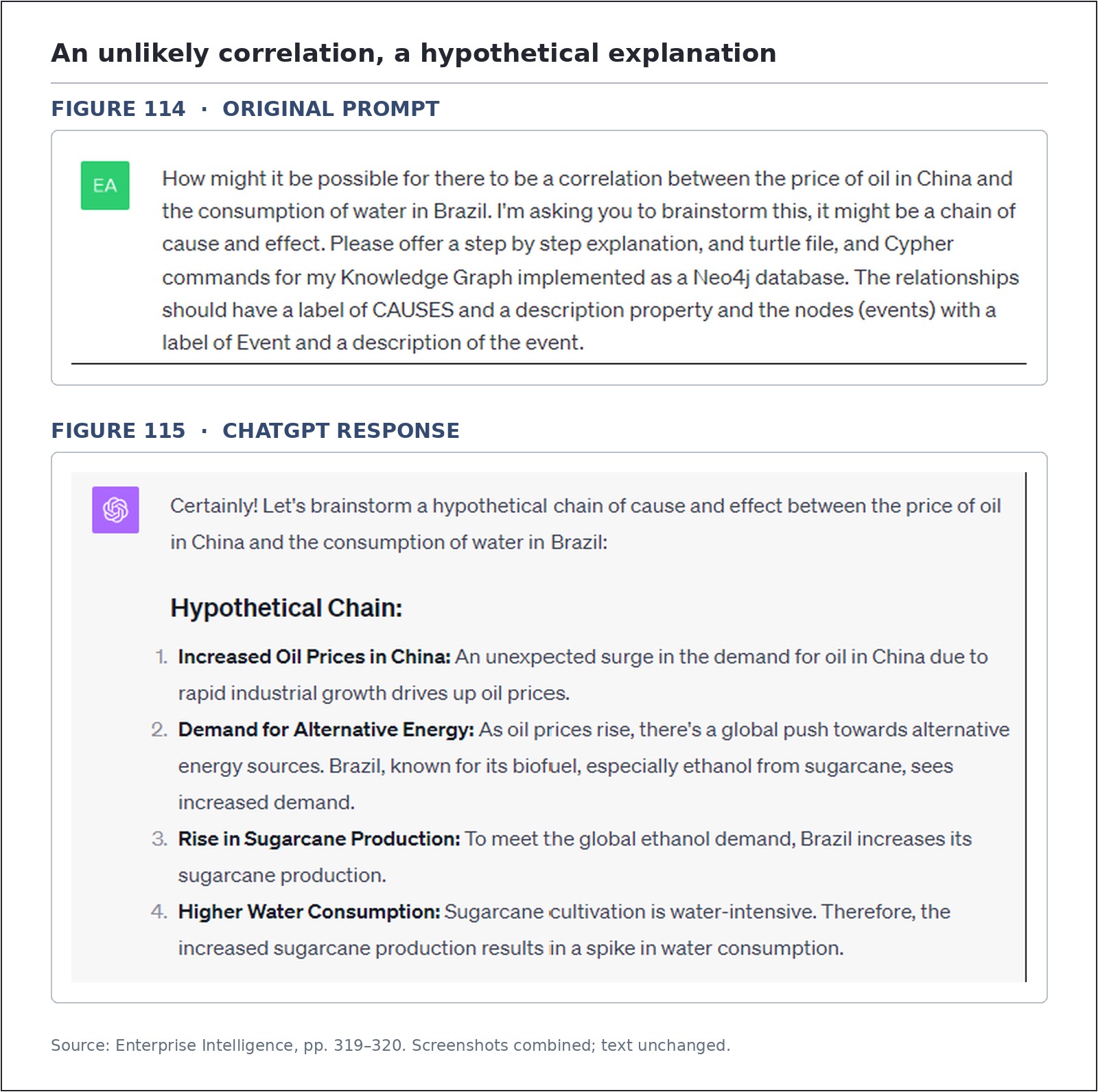
Importantly, I had to explain that this was a brainstorming exercise. I wasn’t asking ChatGPT to retrieve an established explanation, but to imagine how such a relationship might be possible.
ChatGPT proposed that rising oil prices in China could contribute to increased global interest in alternative energy. Brazil, a major producer of sugarcane-based ethanol, might respond by expanding sugarcane production, which could increase water consumption associated with cultivation. It also generated an RDF/Turtle representation of the hypothetical chain, which I used to illustrate how the proposed relationships could be represented in the TCW.
Of course, this was speculation, not validation of the original correlation. Each proposed relationship would need to be investigated, and some might prove incorrect. But that was precisely what interested me. Given two seemingly unrelated measures, ChatGPT proposed intermediate relationships that transformed a puzzling observation into a series of questions we could investigate.
This is essentially the same capability I’m exploring in the current experiment. The LLM’s contribution isn’t necessarily knowing whether a relationship exists. It is formulating possible relationships that reveal what we should be asking, drawing from domains that a human investigator might never think to connect.
Human investigators can also originate such chains by drawing upon observations that have never been documented. Analysts working in different enterprise domains may contribute observations that are related without realizing it. The TCW can expose statistical relationships among these observations, while LLMs can hypothesize intermediate connections that might explain them. Either humans or AI can initiate the investigation.
See these sections of Enterprise Intelligence:
- page 228, Finding Indirect Pathways versus Direct Correlation
- page 345, Trophic Cascades in the TCW
Formulating the Possibilities
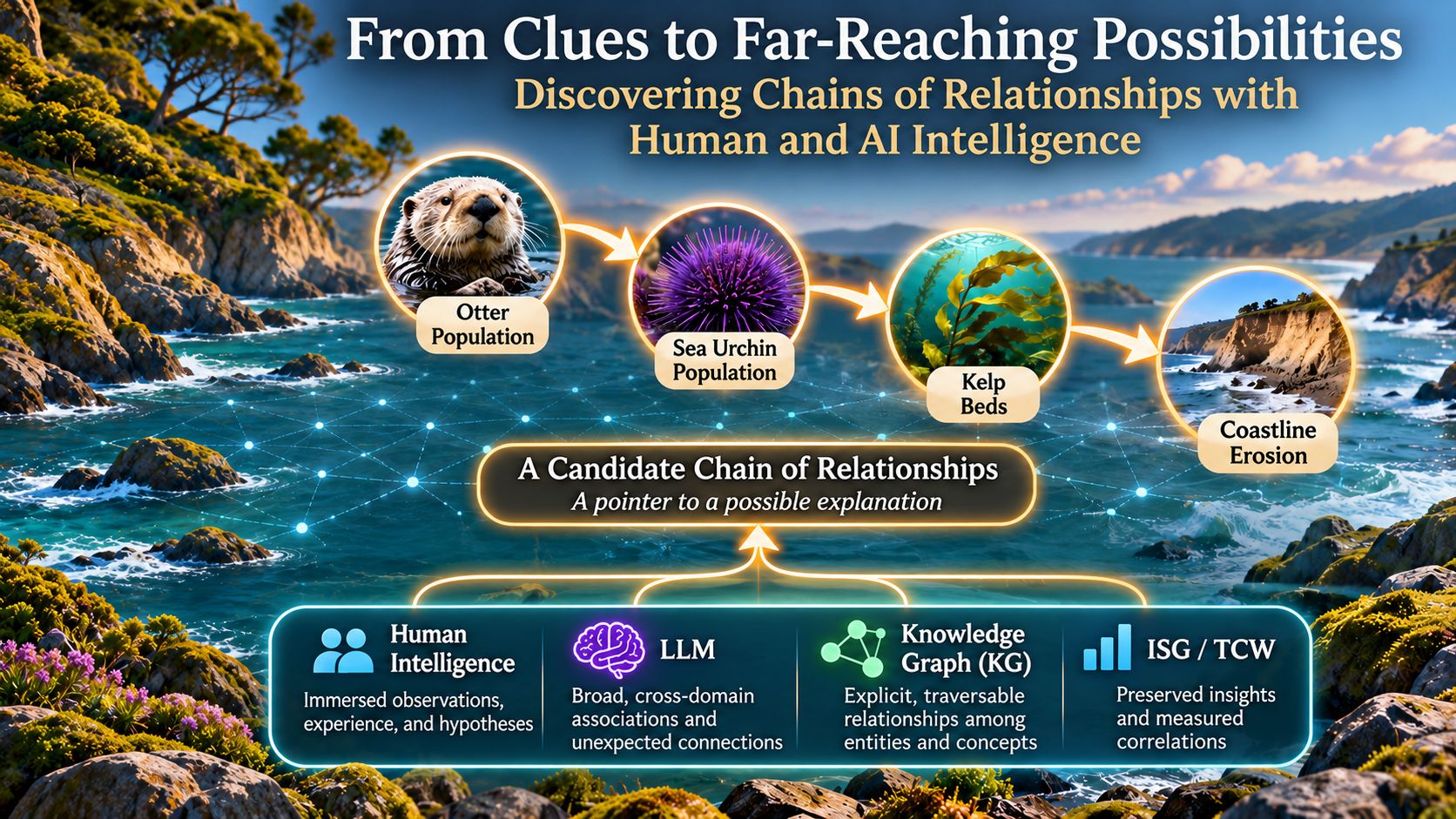
Another example, which helped inspire the TCW, is the trophic cascade involving sea otters, sea urchins, and kelp forests. As I discussed in Correlation Is a Hint Towards Causation, we might investigate whether historical hunting of sea otters contributed indirectly to coastal erosion in California. An LLM could suggest a possible chain: increased hunting pressure leads to fewer otters, which may allow sea urchin populations to grow, reducing kelp forests and potentially altering coastal exposure to wave action.
Each link raises questions that can be investigated through historical records, ecological data, scientific research, or direct observations. The proposed chain is not proof of causation, and other factors may be involved. Its value is that an apparently distant relationship becomes a series of smaller, investigable questions. Some may be answered with existing data; others may require new observations or experiments.
Extending the Search Beyond the Enterprise
There are several complementary sources from which an intelligence might discover candidate relationships. These sources contribute different kinds of information and should not be treated as interchangeable. Figure 2 illustrates their complementary roles in discovering and investigating possible chains of relationships.
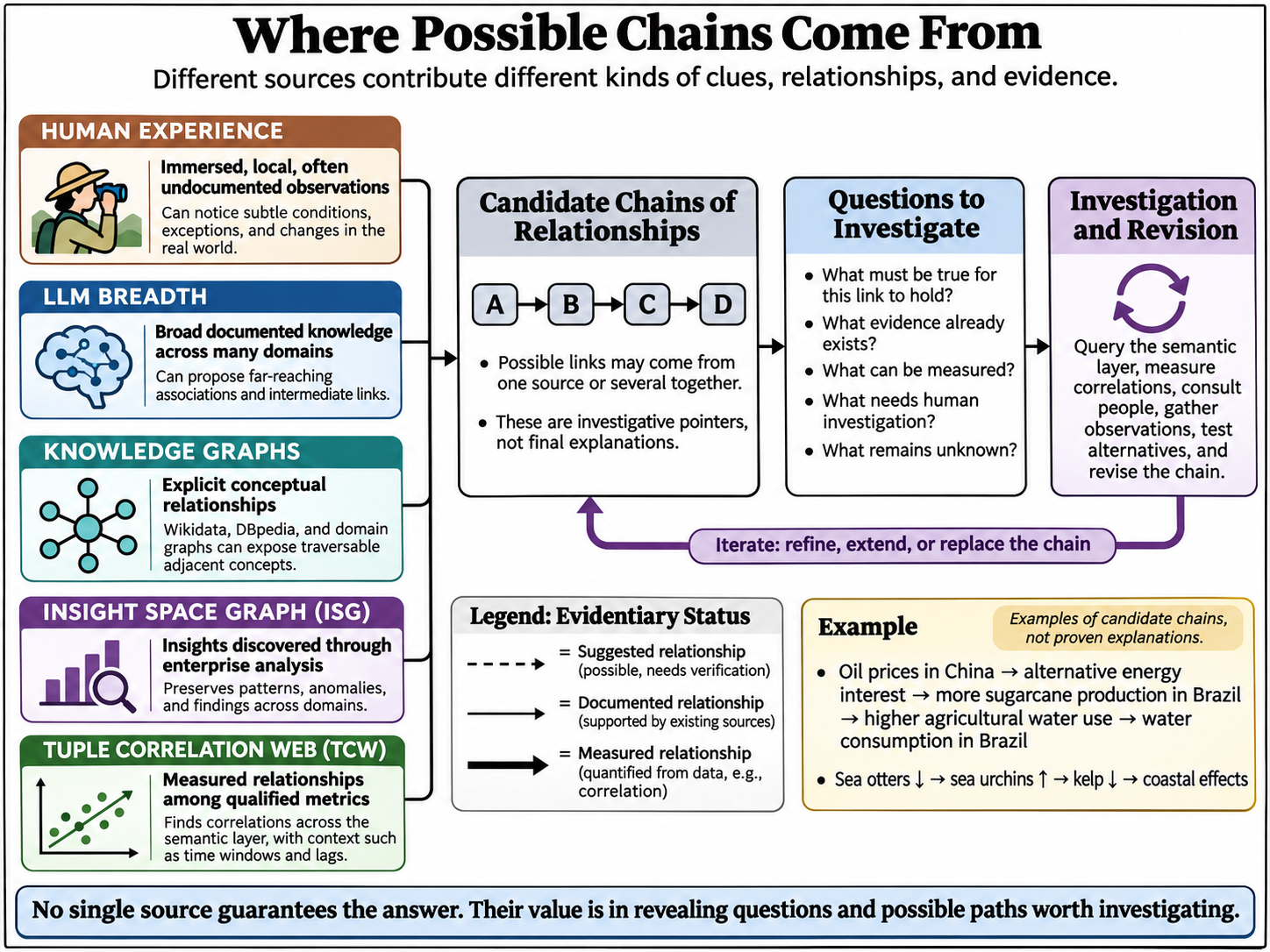
Figure 2 illustrates why these sources are complementary rather than interchangeable. The LLM draws upon broad documented knowledge to propose possible relationships, while humans contribute local observations and experiences that may never have been documented. Knowledge graphs such as Wikidata and DBpedia expose explicit, traversable conceptual relationships.
Within the enterprise, the ISG preserves insights discovered through analysis, while the TCW explores measured relationships among qualified metrics across the semantic layer. In Explorer Subgraph—The Dynamic Cartography of Relation Space, I described how external knowledge graphs can extend this exploration. Such traversals need not be performed for every question, but they can reveal additional connections that are more specific, current, or absent from the LLM’s immediate response.
Cross-Domain Knowledge: Different Strengths and Trade-Offs
Humanity possesses an extraordinary breadth of knowledge, but that knowledge is distributed among the brains of billions of people with different combinations of skills and experience. Teams bring together complementary expertise, while “polymath types” (the modern interpretation—who have expertise in multiple domains) connect domains within their own minds. This distributed arrangement produces enormous diversity and ingenuity, but communication and assimilation between individuals are relatively slow and imperfect.
Note that “imperfect” communication among people is often a good thing. It can lead down unexpected paths. See The Intelligence of a Business.
LLMs offer a different advantage: they bring patterns from a vast body of documented human knowledge into one model, making it possible to suggest associations and analogies across distant domains without coordinating numerous experts.
Graphs offer another approach. Cross-domain knowledge graphs such as Wikidata explicitly represent relationships that can be inspected and traversed, generally at much lower query cost than generative LLM inference. The ISG and TCW are also graphs, but their knowledge originates differently. The ISG accumulates observations derived from the BI investigations of analysts and knowledge workers, each possessing a different mix of expertise. The TCW discovers measured relationships among qualified metrics across enterprise domains, building on the governed data provided by the semantic layer. These graphs can connect knowledge arising from otherwise independent activities without requiring the people involved to recognize those connections themselves.
One important engineering consideration is that the ISG and TCW depend on a high-performance semantic layer. Discovering and validating relationships across potentially enormous volumes of enterprise data can require a tremendous number of analytical queries, particularly as AI agents and an expanding population of knowledge workers become BI consumers. This is why I emphasize building AI on top of a solid BI foundation. A platform such as Kyvos combines governed, consistent business semantics with pre-aggregated OLAP performance, making broad, iterative investigations far more practical. The more relationships we want to explore, the more important the cost and speed of each query become.
There are trade-offs. An LLM can propose relationships not explicitly encoded anywhere, but its learned knowledge is implicit, potentially outdated, and sometimes incorrect. Graph relationships are inspectable and relatively inexpensive to traverse once established, but their coverage is limited to what has been authored, observed, or calculated. Building and maintaining those relationships also incurs costs. The opportunity is to combine these different strengths: broad learned associations, distributed human experience, explicit semantic relationships, accumulated analytical observations, and measured correlations. Together, they can expose unexpected connections that suggest creative questions and new paths of investigation.
Figure 3 illustrates how these sources contribute possible relationships to an investigation. Figure E compares their cross-domain capabilities, costs, strengths, and limitations.
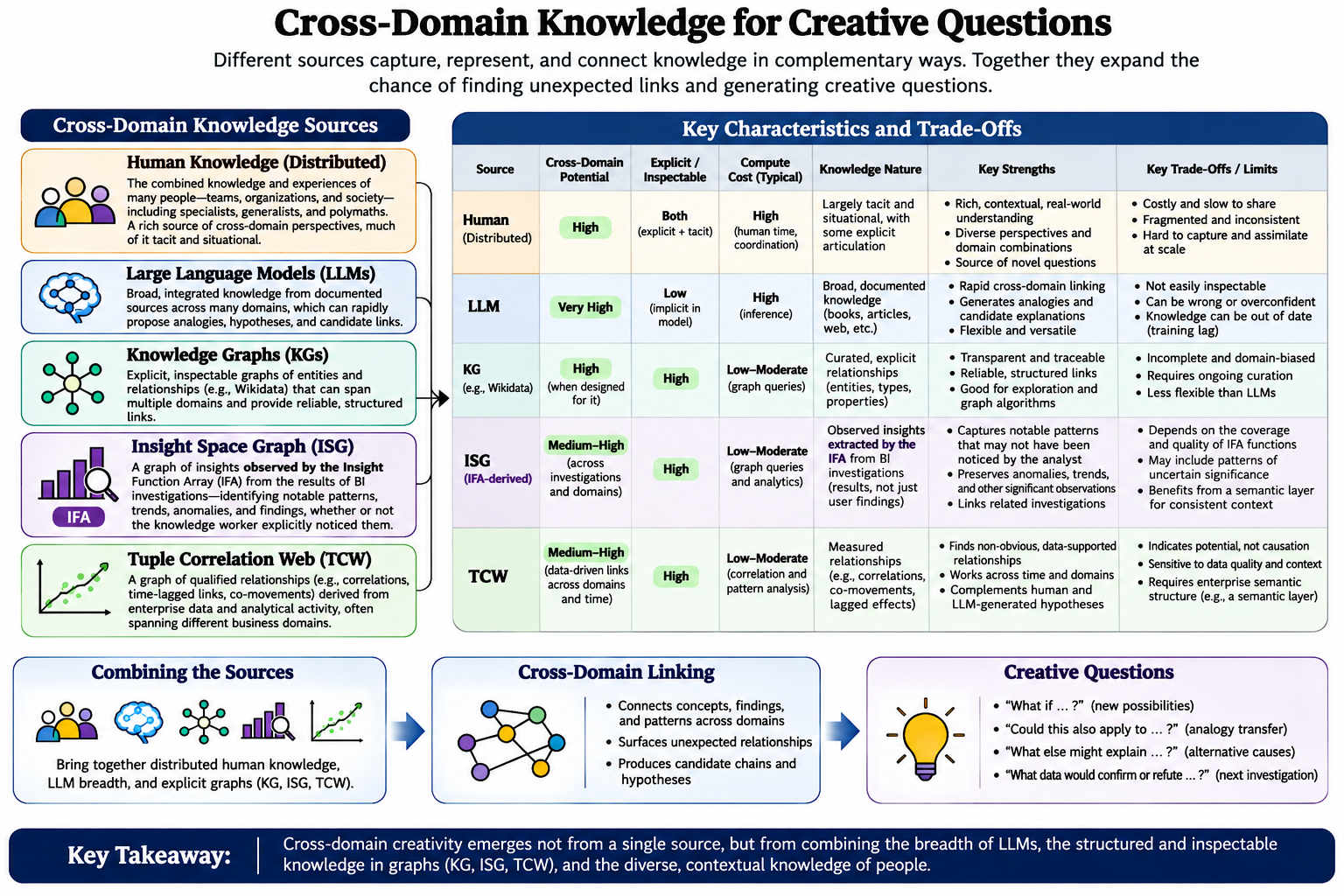
The preceding examples illustrate how cross-domain knowledge can expose unexpected relationships, including possible explanations for observations. For Abductive Calculation, we’re interested in applying that same creative process toward a more specific objective: discovering relationships that make an unknown quantity estimable. In the book-count experiment, technological substitution and long-term retention suggested an entirely different calculational approach from measuring shelf capacity. The important step is recognizing that another way of estimating the unknown might exist.
For illustrations of the cross-domain structures in greater detail, see: Cross-Domain Knowledge: Five Complementary Paths to Creative Questions
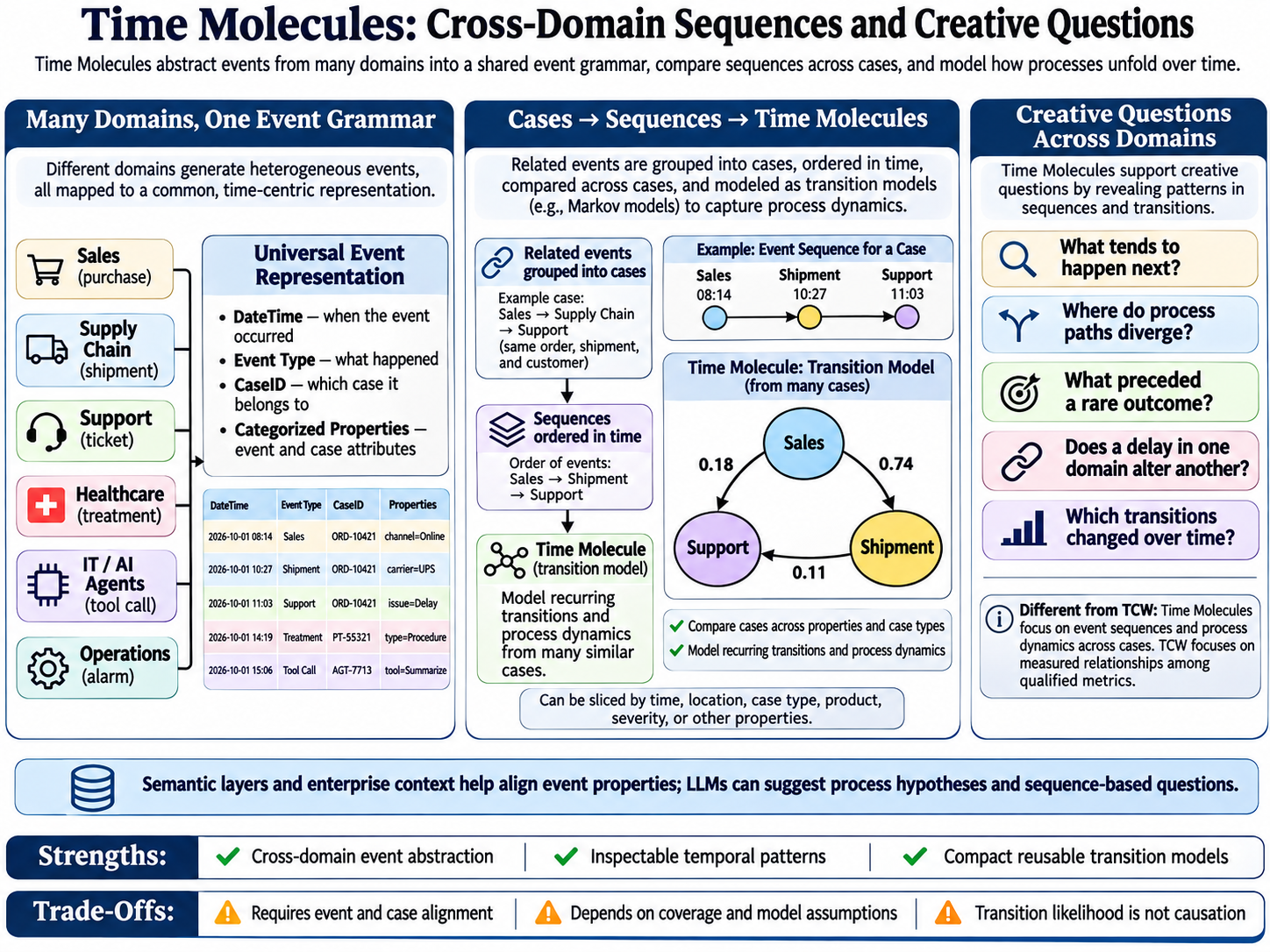
Time Molecules: Cross-Domain Knowledge Through Sequences
Time Molecules, the subject of my second book, introduces another form of cross-domain relationship: sequences of events. Unlike the preceding structures, which primarily connect concepts, observations, and measured relationships, Time Molecules abstracts the behavior of processes over time into reusable models.
I initially set it aside because it approaches relationships from a different perspective. The preceding examples focus primarily on connecting concepts, observations, and measured relationships across domains. Time Molecules is concerned with abstracting sequences of events into reusable models of how processes unfold over time. However, since sequences are themselves chains of relationships, this belongs in our exploration of creative questions.
At its foundation, Time Molecules represents events through a common structure consisting of a date/time, event type, case identifier, and collections of categorized properties describing events and cases. A customer purchasing a product, a shipment leaving a warehouse, a patient receiving treatment, or an AI agent invoking a tool can all be represented using this same general structure. Events are organized into cases, forming sequences that can be examined individually or collectively. These sequences can be abstracted into probabilistic Markov models representing recurring event transitions across populations of cases.
However, a Time Molecule is more than a Markov model containing transition probabilities. Its underlying events carry properties that provide substantially more context about the processes being modeled. As described in the Event Properties in Time Molecules tutorial, these include:
- ActualProperties (what happened), IntendedProperties (what we wanted to happen).
- ExpectedProperties (what we believed would happen).
- AggregationProperties (measurements and statistics accumulated across events).
An optional TriggerFunction can also record the logic and inputs that initiated an event. Together, these support comparisons not only of event sequences, but also of objectives, expectations, actual outcomes, and the circumstances under which processes unfold.
Consider a delivery process. A Time Molecule might represent the probabilities of an order proceeding through payment, shipment, delivery, and perhaps a support incident. But properties can also preserve the intended delivery time, the predicted arrival time, the actual arrival time, accumulated delays, and the rule that initiated a particular action. We can therefore investigate whether cases that missed their objectives followed different sequences, whether certain conditions tended to precede problems, or whether different triggering rules were associated with different outcomes.
This is fundamentally different from the Tuple Correlation Web (TCW), although both rely heavily on time and quantitative information. The TCW discovers statistical relationships among qualified metrics, potentially connecting observations from otherwise unrelated business domains through time-series correlations. Time Molecules examines the structure and dynamics of event sequences, enriched by the properties and measurements associated with those events and cases. A chain of strong correlations is not the same thing as a chain of events making up a process.
Turning Possibilities into Investigations
I envision three activities working together:
- The intelligence formulates candidate relationships, potentially constructing several alternative chains between the information we have and the unknown we’re trying to understand.
- It identifies what values or observations would be needed to investigate those relationships and obtains whatever information is available.
- It explores different paths and combinations of relationships, revising the possibilities as evidence becomes available.
Databricks’ Genie Agent Mode illustrates how far AI-assisted analysis has progressed. It can plan investigations, generate and test hypotheses through successive SQL queries, and suggest follow-up questions. Its MemCurrent architecture also provides persistent memory of prior interactions and reusable workflows. These are substantial capabilities. What interests me beyond them is the deliberate exploration of unconventional calculational pathways, including hypothesized relationships beyond the information initially available, and systematically evaluating which questions might materially change an estimate or decision. I have not found this combination demonstrated as an integrated methodology in Databricks’ published documentation.
These activities are iterative rather than strictly sequential. An unsuccessful attempt to measure one relationship may suggest another possibility. An unexpected observation might expose an entirely different chain. Sometimes the next step isn’t another calculation, but a question that requires a person to investigate something in the physical world.
This is where the complementary components we’ve discussed become particularly relevant, both for discovering possible relationships and investigating whether they hold:
- Knowledge graphs provide explicit relationships that can be traversed and examined for supporting evidence.
- The ISG preserves observations extracted by the IFA from BI investigations, including patterns the original knowledge workers may never have noticed or considered significant.
- The TCW provides measured statistical relationships among qualified metrics across enterprise domains, including correlations and time lags.
- Time Molecules approaches the problem differently, examining sequences of events across cases to identify recurring process patterns, transitions, and the conditions under which they occur.
These sources provide different ways to investigate a proposed connection, and each can also suggest additional questions.
Of course, different kinds of evidence support different conclusions. An explicit relationship in a knowledge graph is not necessarily correct. An ISG observation may be outdated or dependent on its original context. Correlation in the TCW does not establish causation, and a recurring event sequence in Time Molecules does not necessarily establish why events occurred in that order. Even when multiple sources appear to support a hypothesis, their evidence may not be independent. The objective is to progressively strengthen, revise, or reject our proposed relationships as additional evidence becomes available.
We must remain willing to challenge the relationships and reconstruct the possibilities as our understanding changes.
From Creative Questions to Multiple Reasoning Paths
Once we’ve generated a collection of potentially revealing questions, we can use them to construct several different ways of estimating the same unknown quantity. We don’t necessarily want to combine every factor into one enormous calculation. Instead, different questions may suggest different models, each using a subset of the available information.
Consider the home-office book experiment, which can involve multiple approaches:
- Estimate physical capacity from shelf space and average book dimensions.
- Estimate the accumulation of books over several decades, accounting for acquisitions and disposals.
- Extrapolate from a representative sample of shelves. Each approach uses different information and offers a different perspective on the same unknown.
There is an interesting parallel with random forests in machine learning. Individual decision trees are constructed using different samples and subsets of features, and their predictions are combined. No single tree needs to consider every available feature. Similarly, we can explore many potentially relevant factors without requiring every factor to participate in every abductive calculation. The analogy isn’t exact, since our models may represent fundamentally different relationships rather than variations of the same statistical method.
When different models converge on similar estimates, that can increase our confidence. When they disagree, the differences may expose assumptions worth investigating. But convergence alone doesn’t establish accuracy. Apparently independent models may rely on the same questionable input or assumption, so we need to understand where their evidence overlaps rather than simply count how many produce similar answers.
The objective is to develop multiple plausible calculational paths, compare their results, and determine whether they collectively provide a more credible ensemble estimate than any individual approach. But each model will also contain uncertain inputs, and its resulting estimate may be a range rather than a single number.
That brings us to the next problem of representing and combining these uncertainties without losing the information contained in the different estimates?
Each Answer Is a Distribution
An important consideration is that the answer to an individual question may itself be uncertain. We might estimate that a typical shelf holds between eight and twelve books per linear foot, depending on book sizes. We might have only a rough idea of how many physical books someone acquired annually over several decades. Rather than assigning each unknown a single value, we can represent our uncertainty with a probability distribution.
Not every distribution will resemble the familiar bell curve. Some quantities may be relatively uniform across a range, others may be heavily skewed, and some might have several concentrations of likely values. Even when the quantity we’re estimating has one actual value, a distribution can represent our uncertainty about what that value is. We should also distinguish uncertainty about an unknown value from genuine variation within a population.
We can propagate these input distributions through each calculational model. One way is through Monte Carlo simulation, repeatedly selecting plausible combinations of input values and calculating the resulting estimate. The collection of simulated outcomes forms an estimated distribution for that model. Importantly, related inputs cannot always be sampled independently; their dependencies may affect the results considerably.
We now have distributions from several different models. We can plot these on the same chart and examine where their probability densities overlap, where they differ, and how widely each spreads. We can also calculate central estimates, such as means or medians, and intervals containing a specified proportion of the estimated probability.
Combining these distributions requires some care. We might construct a weighted mixture, giving greater influence to models supported by stronger evidence or better historical performance. But we shouldn’t invent confidence weights merely to produce a convenient average. If we cannot reasonably justify how the models should be weighted, it may be more informative to present their distributions separately.
For example, suppose two plausible models produce estimates concentrated around 100 and 300, respectively. An average of 200 might sound like a reasonable compromise, even though neither model considers values near 200 particularly likely. A combined distribution might instead have two peaks. That disagreement is part of our current knowledge and shouldn’t be concealed by reporting a single number.
Ultimately, we’d like to produce a central estimate and a range that communicates the uncertainty involved. A range containing, say, 90% of the modeled probability is more informative than an arbitrary minimum and maximum, provided the probabilities are reasonably calibrated. We should also retain the possibility of outcomes beyond the reported interval.
This provides a richer result than a single Fermi estimate. We have a representation of possible answers, the likelihoods assigned to them under our assumptions, and the uncertainties that remain unresolved.
But how narrow does that distribution need to be? Is a 20% margin of error acceptable, or must we get within 2%? The answer cannot come from statistics alone. It depends on what we’re planning to do with the estimate and what happens if we’re wrong.
The Cost of a Plan and the Consequences of Being Wrong
Once we have a reasonable estimate and an understanding of its uncertainty, we still need to determine whether that uncertainty is acceptable. That depends on what we intend to do with the estimate.
An important separation here is between the cost we expect to incur by executing a plan and the consequences we risk if our assumptions or estimates are wrong. Suppose we’re planning a project with a budget of $1 million. That’s the expected cost of executing the plan. But what happens if the actual cost is higher? A 3% overrun might be easily absorbed. A 15% overrun might require difficult adjustments to scope or funding. A 60% overrun could threaten the project entirely, damage credibility, or create obligations we cannot fulfill.
These consequences aren’t necessarily proportional to the estimation error. Crossing a contractual deadline, exhausting available funding, or failing to meet a critical requirement may trigger consequences far greater than the numerical difference between the estimate and reality. The direction of the error can be important, too. Overestimating demand may leave us with excess inventory, while underestimating it may result in lost sales and dissatisfied customers.
This suggests that we need another model alongside our estimation models: one that describes the consequences of possible outcomes. The execution cost is part of the plan, although it may itself be uncertain. The risk of being wrong concerns how deviations from our expectations affect our objectives, resources, commitments, and reputation. Even a correct estimate doesn’t eliminate every risk associated with carrying out a plan.
We can therefore examine the probability of crossing consequential thresholds, rather than judging an estimate solely by how close we expect it to be. A distribution with a fairly narrow center might still contain a small probability of a disastrous outcome. Conversely, considerable numerical uncertainty might be acceptable if the consequences throughout the plausible range are relatively minor.
Our tolerance for error is thus determined partly by the consequences we’re prepared to accept. An estimate suitable for preliminary exploration may be wholly inadequate for an irreversible commitment. We should establish what constitutes an acceptable outcome, a manageable problem, and an unacceptable failure before deciding how much confidence we need.
And that raises a practical question: if the current level of uncertainty is unacceptable, which additional questions should we investigate?
Which Question Should We Ask Next?
We began by asking an AI to generate 30 potentially revealing questions. But we certainly wouldn’t want to investigate all 30 merely because they were generated. Some might have little influence on the eventual decision. Others might expose uncertainties that could substantially alter our conclusions.
We can now prioritize questions according to their expected contribution to the decision. A question that would considerably narrow an estimate might be less valuable than one that could reveal a serious problem with a relatively small probability of occurring. What we’re trying to determine is not simply how much information a question might provide, but whether that information could change what we decide to do.
Consider a project whose estimated cost is comfortably within budget, but whose completion depends on a critical component arriving before a contractual deadline. Refining the estimated cost of routine supplies might improve the overall budget forecast. Investigating the supplier’s ability to meet the deadline, however, could be much more consequential. That answer might lead us to select another supplier, negotiate different terms, or reconsider the schedule entirely.
We must also consider the cost of obtaining additional information. Some questions can be answered from existing data or through a relatively inexpensive calculation. Others require research, new measurements, experiments, or considerable human effort. The expected benefit of answering a question must be weighed against that cost, along with the time available before a decision must be made.
This connects to the statistical concept of value of information: the expected improvement in a decision made possible by obtaining additional evidence. We won’t always have sufficiently reliable probabilities to calculate that value precisely, but the principle provides a way to guide further investigation.
There is also a stopping point. We could continue asking questions indefinitely, always discovering another possible influence or alternative explanation. At some point, the anticipated improvement no longer justifies the effort, or we must act because the opportunity or deadline will not wait.
This makes creative question generation an iterative process rather than a one-time questionnaire. We investigate, revise our understanding, identify the uncertainties that remain consequential, and generate further questions directed toward those uncertainties.
Remembering Ingenuity Without Becoming Captive to It
There is also value in remembering previous investigations. As I discussed in Stories, Analogies, Metaphors—the Layer After LLMs, stories can serve as reusable units of intelligence, preserving the original problem, the reasoning used to construct a solution, the assumptions involved, and what ultimately happened.
But remembering an investigation requires more than preserving the proposed solution. In Time Molecules, I distinguish between intended, expected, and actual properties of events. What we wanted to happen, what we predicted would happen, and what actually happened are three different things. We might produce an inaccurate estimate, adjust our plan, and still accomplish our intended objective. Conversely, we might calculate something accurately, execute a plan flawlessly, and fail to achieve what we wanted.
There is also the familiar data mining problem of obtaining the actual outcomes. Often, we never learn what happened. Even when feedback arrives, the original plan may have changed considerably, making it difficult to determine which decisions contributed to the result. A remembered experience should preserve this uncertainty rather than classify an approach as successful or unsuccessful without sufficient evidence.
Both successes and failures can provide inspiration. An unexpected success might reveal an ingenious relationship, while a spectacular failure might expose a misleading assumption that would otherwise go unnoticed. Structures such as the Expert Reasoning Graph (ERG) and Trade-Off Semantic Network (TOSN) suggest ways to represent aspects of those investigative experiences and the conditional relationships discovered through them.
But I wouldn’t want the intelligence to become dependent upon a repository of previously successful solutions. The circumstances under which a tactic worked may no longer apply, and no recorded story can capture its entire context. As I’ve argued elsewhere about re-observation, even perfectly correct information can become obsolete.
Remembered stories can therefore provide inspiration without dictating the next solution. We can preserve especially informative experiences while still allowing the LLM to construct fresh possibilities, reconsider old assumptions, and investigate the circumstances as they exist now.
The opportunity I see is not merely to make AI better at answering questions. It is to encourage AI to explore the enormous space of possible relationships, formulate explanations we haven’t considered, and expose the questions that would help determine whether those explanations hold. Some questions will be answered through existing information, some through new calculations, and some through human investigation.
And some of the most valuable questions may be those for which nobody yet knows how to obtain an answer.


