Prologue
Several recent blogs have developed different pieces of the same larger problem. That is, how an intelligence can reason and act when the information available to it is necessarily incomplete:
- In Even ASI Cannot Escape Imperfect Information, I argued that no intelligence, regardless of how capable it becomes, can possess a perfectly complete and current representation of the world. Information will always be missing, stale, inaccessible, ambiguous, or simply not yet knowable.
- Expert Reasoning Graphs considered reasoning itself as something worth representing and preserving, rather than retaining only the conclusion. If the path by which something was inferred is explicit, its assumptions, dependencies, and intermediate steps can themselves become information available to future reasoning.
- In Updating Decision Data Points: Why a Fast Semantic Layer Is Part of the Intelligence Loop, I looked at another consequence of imperfect information. Even an observation that was correct when it was made may no longer be sufficiently current for the decision now being considered. Intelligence therefore needs the ability to return to the underlying information, selectively re-observe, and recalculate.
- In Stories, Analogies, Metaphors—the Layer After LLMs, I explored how prior experience can become reusable reasoning material. A developing situation can be recognized as structurally similar to an earlier story, allowing relationships and possible continuations from the earlier case to inform reasoning about the new one. The value lies not merely in remembering what happened, but in recognizing which structure can transfer.
In other words, it is the situation in Star Trek IV: The Voyage Home (yes, a Star Trek reference in two consecutive blogs) when Spock cannot calculate their return precisely because an important variable is no longer known. McCoy tells Spock (playing the part of an LLM), “Guess, Spock. Your best guess.” Later, when Kirk (playing the part of the human) is willing to rely on that estimate, McCoy explains to Spock: “He feels safer about your ‘guesses’ than most other people’s facts.” Spock then says he will try to make the best guess he can.
That is close to the problem considered here. Sometimes an exact answer is impossible because the necessary information simply does not exist or is no longer available. The alternative is not necessarily ignorance or recklessness. It can be a disciplined estimate that remains explicit about what is known, what is assumed, and how the answer was constructed.
This blog brings those pieces together around the extremely ordinary activity of estimating something we do not directly know.
Sometimes the answer is not available to retrieve. More importantly, no predefined relationship may exist for calculating it. The information we do have may have been collected for entirely different purposes. Intelligence must then construct a provisional path from what is available to what it wants to know. It may retrieve a reasoning structure from an analogous problem, construct a new one from the circumstances at hand, or do both. Several independent paths may be possible, giving us a way to compare estimates, expose assumptions, and identify which uncertainties are worth re-observing.
I use Abductive Calculation to describe this calculational case: constructing one or more provisional relationships that make an otherwise unavailable quantity estimable from the information at hand. This is not a claim that people have suddenly discovered a new kind of reasoning. I am interested in making an ordinary but fundamental behavior explicit within an intelligence architecture designed to operate under imperfect information.
Ideas and Information
One of the books that had a lasting influence on how I think about information is Arno Penzias’s Ideas and Information: Managing in a High-Tech World, which I read way back in 1989 or 1990. It profoundly affected me as until even years later, I had never known a person of the type who could thrive at a place like Bell Labs.
Ideas and Information affected me more broadly than this one example. What stayed with me was Penzias’s way of looking past the machinery to information itself—how it can be represented, transformed, organized, and ultimately turned into something more valuable than the information with which we began. That fit deeply with how I would later come to think about higher-order information, knowledge, and ideas. The barber problem is a wonderfully compact example of that larger theme.
Penzias tells of his son David being asked during a job interview: How many barbers are there in the United States?
It’s the type of question most of my target BI audience has encountered in job interviews many times. The question was not intended to test whether David happened to know the number. It tested whether he could construct a reasonable answer to something he had never been explicitly taught how to answer.
David estimated from the number of barbers in his own town and scaled that ratio to the population of the United States. The interviewer approached the problem from another direction, estimating the number of people getting haircuts, how often they got them, and how many haircuts a barber could perform. Penzias tried yet another path, estimating total spending on haircuts and dividing that by the amount of revenue necessary to support a barber. The three approaches produced estimates in roughly the same region, although Penzias noted that the reported occupational count at the time was considerably lower—something like his guess of about 200-250K and the actual was closer to 100K.
The example fascinated me because the important thing was never the number of barbers. The interviewer wasn’t testing the range of his knowledge. It was the ability to construct ways of knowing something that was not directly known.
William Poundstone’s later How Would You Move Mount Fuji? explored another family of interview puzzles intended to reveal how people approach unfamiliar problems rather than simply recall learned answers. Both books helped reinforce an idea that has remained important to me:
What we explicitly know is not necessarily the boundary of what we can reasonably infer.
That’s especially true in a “frontier field” like programming (at least back during my early career–1980-1990s), and now AI, quantum computing, robotics, etc.
Testing Whether Modern AI Can Do This
After reacquainting myself with the barber example from Penzias’ book, I decided to test a current AI before telling it the source. That’s in the likely event the LLM is familiar with the book.
I asked ChatGPT:
How many barbers are in the United States? You cannot cheat by checking for a reported figure of the number of barbers or extrapolating from an older figure of the number of barbers or allocating from something like a worldwide figure of barbers. You can only use data that is fairly called “common knowledge” or that people in general have a rough estimate in their heads.
As it was for Penzias’ son, David, the goal was explicitly not to arrive at the exact occupational count. I wanted to see whether the AI could construct an estimate using only surrounding information.
It began with haircut demand. Starting with the population, it estimated the population likely to use barbers, haircut frequency, the share of those haircuts performed by barbers, and the number of customers one barber could handle. That produced one estimate.
What caught my attention was that it then attacked the question from another direction without being told to do so. It imagined a typical American community, estimated how many barbers such a community might support, and scaled that number to the national population.
Then it tried an economic route that estimated the total annual spending on barber services and divided that by the approximate annual revenue associated with one barber.
The result was much more interesting than the numerical answer. It had constructed three temporary models for the same unknown.
Only after the experiment did I tell the AI that the question came from Penzias. When we examined the original passage, we discovered that the three approaches were strikingly similar to those Penzias described.
That creates an ambiguity that is important to acknowledge. The model may have independently reconstructed those approaches. But Penzias’s example is published material, and the passage or descriptions derived from it could have appeared in the model’s training data. ChatGPT admitted on its own that there is no responsible way to claim that the three approaches were invented independently during my experiment.
But that possibility led somewhere interesting of its own. If exposure to the Penzias example influenced the model, then perhaps what was retained was not merely an answer to a barber question. What may have been available for reuse were reasoning structures: representative-unit scaling, demand divided by capacity, and economic throughput.
That suggested that past examples of reasoning might themselves be valuable information.
How would you go about calculating a guess for how many barbers are in the United States? You cannot cheat by checking for a reported figure of the number of barbers or extrapolating from an older figure of the number of barbers or allocating from something like a worldwide figure of barbers. You can only use data that is fairly called “common knowledge” or that people in general have a rough estimate in their heads. I don’t want to know the answer. I want you to tell me how you will approach the problem and what specifically inspired the approach.
Testing Transfer
I next tried a question that was structurally similar but much less likely to be a famous estimation problem:
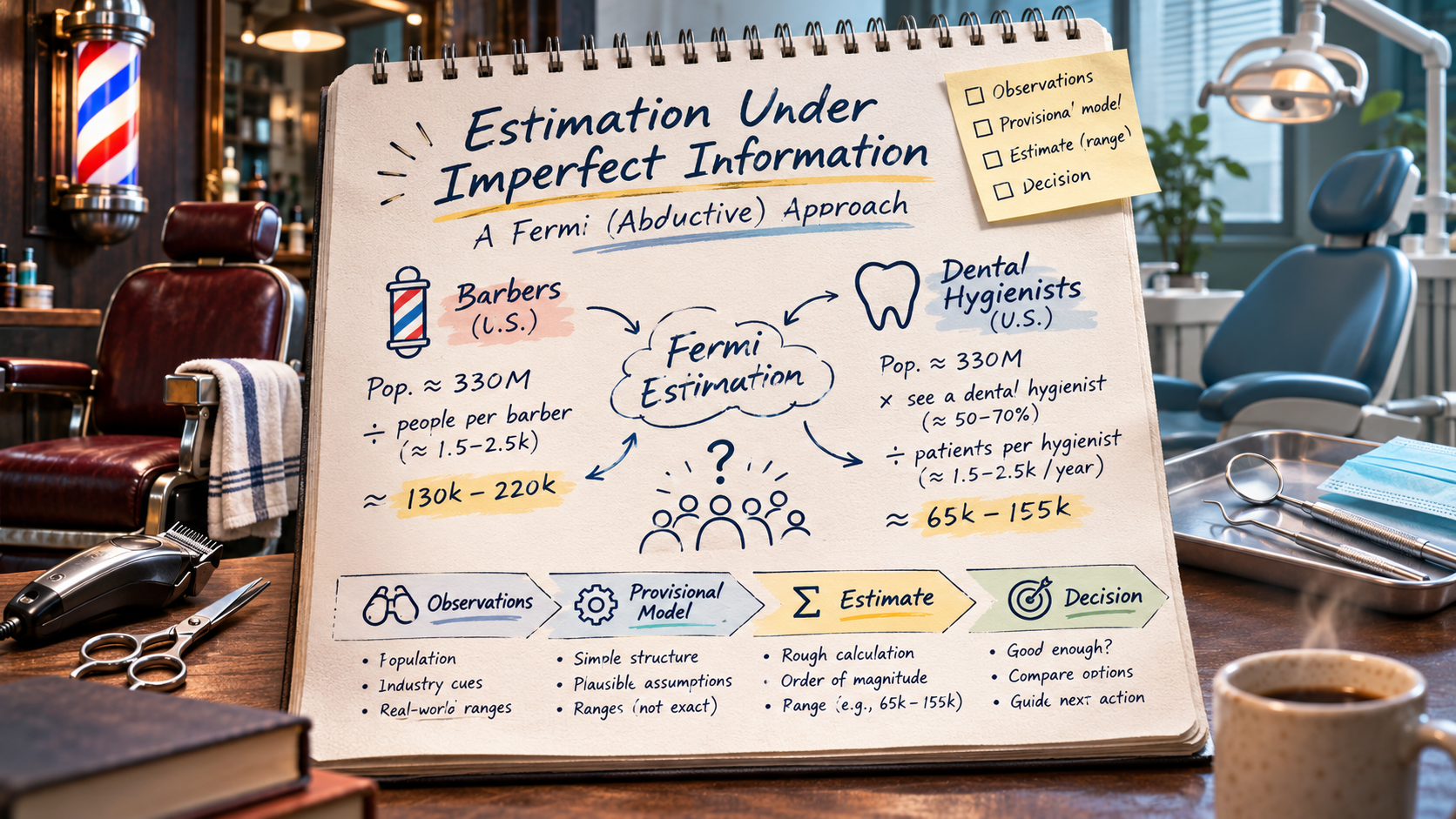
How many dental hygienists are there in the United States?
Again, the AI was not permitted to retrieve the occupational count. But I expected this to be more difficult than the barber question. Haircuts are unusually convenient for estimation because almost everyone gets them with some regularity, even if the frequency varies. Dental hygiene is different. It would be easy to begin with the familiar recommendation that people see a dentist twice a year, but that does not tell us how many people actually do. Some people follow a regular preventive schedule, some go less often, some go only when something hurts or another problem appears, and some may go for long periods without seeing a dentist at all.
The demand being estimated is therefore not simply population multiplied by a reasonably regular frequency. The calculation first has to approximate the much less observable behavior that actually generates dental-hygiene visits.
It constructed a demand-and-capacity path. Roughly how many people receive dental hygiene care? How often? How many appointments does that create? How many patients can a hygienist reasonably see in a day? How many days does a hygienist work? Because part-time work is common in occupations of this sort, it also recognized that a full-time-equivalent estimate might need to be converted into an estimate of actual people.
It then attacked the question from a different direction by imagining how many hygienists might be supported by a community of a given size and scaling that estimate nationally.
The reasoning structure transferred. The barber example had suggested, directly or indirectly:
service demand ÷ service capacity → approximate number of workers
That relationship could be adapted to another occupation.
This raises the possibility of maintaining a catalog of prior reasoning episodes—not a catalog containing “barbers = X,” but one containing ways previous problems were transformed into answerable problems.
This transfer is itself a form of analogical reasoning. The value of the barber example is not that another occupation can reuse the same calculation, but that the reasoner can recognize a structural correspondence between two otherwise different situations. A prior reasoning episode can suggest a candidate reasoning structure; the new problem then determines whether that structure actually fits. This connects to something I explored in Stories, Analogies, Metaphors—the Layer After LLMs. Prior experience can become raw material for solving a new problem when the relationships, rather than merely the surface details, correspond.
Fermi Estimation
The barber problem is also a classic example of what is generally called Fermi estimation, named after physicist Enrico Fermi: answering a question whose exact value is unknown by decomposing it into quantities that can be known or reasonably estimated. The classic example is estimating how many piano tuners there are in a city—often framed as Chicago. Rather than looking up the answer, one estimates the population, how many households might own pianos, how often those pianos are tuned, and how many tunings one person can perform. Those estimates can then be combined to work backward to the approximate number of piano tuners.
There is a very good historical detail here. Fermi became famous for making surprisingly good order-of-magnitude estimates from sparse information. The piano-tuner problem is the classic classroom example associated with him. But at the 1945 Trinity test, Fermi also dropped scraps of paper before, during, and after the blast wave passed, measured how far they shifted, and immediately estimated the explosive yield at roughly 10,000 tons of TNT. Fermi himself documented that procedure.
A Fermi estimate is not intended to produce false precision. Its purpose is to arrive at the right order of magnitude—which the barber example accomplished—expose the assumptions behind the answer, and often reveal which pieces of information would be most valuable to know more accurately.
Fermi estimation is particularly suited to questions where a numerical answer is unknown, unavailable, or difficult to measure directly, but where the quantity can be approximated by breaking the problem into smaller, more familiar quantities. The individual inputs need not be known precisely. They do, however, need to be reasonably estimable or constrained by what we already know. The objective is generally to establish an order of magnitude rather than an exact answer.
This is not limited to questions such as how many barbers or piano tuners exist in a particular area. Fermi estimation can be applied to problems involving time, cost, energy, capacity, material requirements, and many other quantities.
| Type of problem | Example question | Possible approach |
|---|---|---|
| Time | How long would it take to evacuate a packed sports arena? | Estimate attendance, available exits, exit throughput, and walking time. |
| Energy | How much electricity would a proposed data center consume annually? | Estimate computing equipment, average power consumption, operating hours, and cooling overhead. |
| Cost | What might a day of unplanned factory downtime cost? | Estimate lost production, contribution margin, idle labor, and other consequential costs. |
| Materials | How much concrete might be needed to construct a multistory building? | Estimate the dimensions and volumes of major structural components and their concrete requirements. |
| Data volume | How much storage would a city’s traffic cameras require over a year? | Estimate camera count, recording duration, average data rate, and compression. |
| Environmental impact | How much carbon dioxide might a delivery fleet produce annually? | Estimate fleet size, annual mileage, fuel consumption, and emissions per unit of fuel. |
| Physical quantity | Approximately how much does a large bridge weigh? | Estimate the volumes of its main structural elements and the densities of their materials. |
| Feasibility | Could the available charging stations recharge every electric vehicle attending a major event? | Estimate participating vehicles, average energy requirements, charging capacity, and available time. |
| Economic scale | Could a proposed budget realistically support a nationwide program? | Estimate the population served, resources needed per participant, operating duration, and unit costs. |
The common characteristic is that the problem can be reduced to quantities for which reasonable approximations are possible. These estimates can then be combined to establish a plausible numerical range. A good Fermi estimate also exposes which assumptions have the greatest influence on the result.
Not every unknown is suitable. If there is no credible basis for constraining the intermediate quantities, the result may be little more than an arbitrary guess. And if an incorrect estimate could have serious consequences, an order-of-magnitude answer may be insufficient. The required accuracy depends on what we intend to do with the answer.
What interests me here goes somewhat beyond the usual presentation of Fermi estimation. Fermi estimation is an important example of the behavior I am interested in, and often requires inventing the decomposition itself. I am using Abductive Calculation as a broader framing for how a calculational relationship is:
- Treated explicitly as a provisional hypothesis,
- Potentially constructed from whatever information happens to be available,
- Compared with alternative relationships,
- And carried forward with its assumptions and provenance.
In fact, it seems safe to say that knowledge of Fermi estimation already provides the fundamental technique for asking questions similar to the barber example. I tested Google Gemini and Grok, prompting both with:
How many people in the greater Boise area will make inari today? You cannot use direct answers. I want to you to list your work, what inspired your approach, and provide your guess.
Both cited Fermi estimation. Figure 1 shows Gemini’s inspiration for the approach.
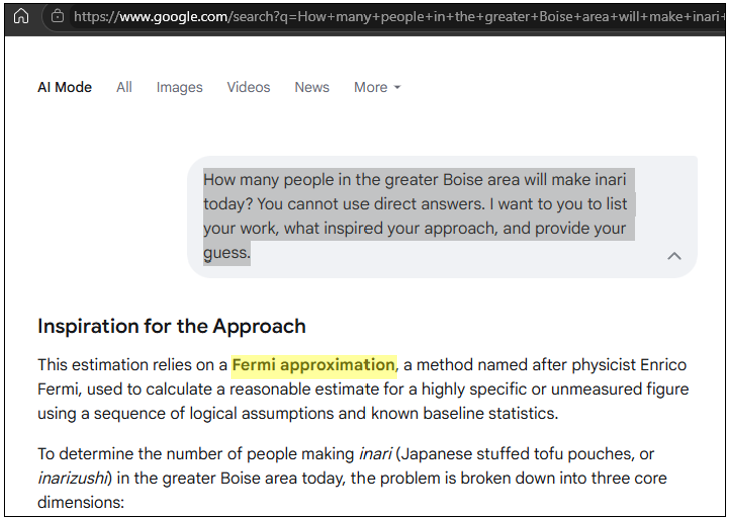
See gemini_fermi.md for Gemini’s full response and work.
Figure 2 shows Gemini’s calculation.
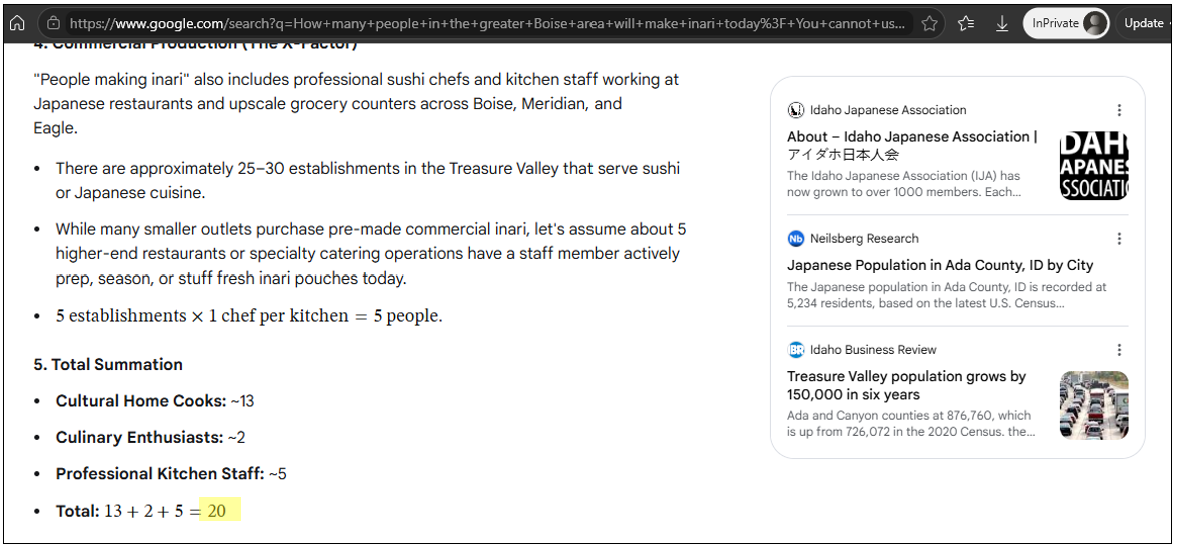
Figure 3 shows Grok’s answer.
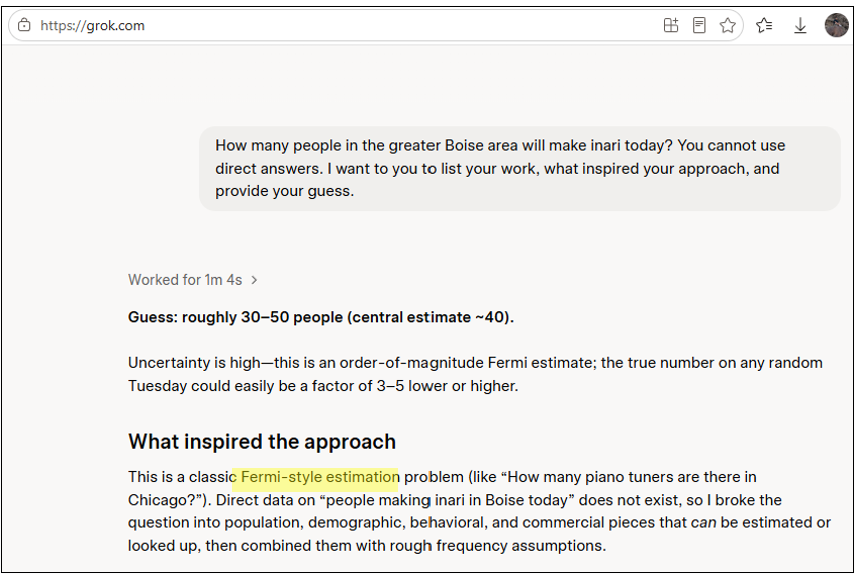
See grok_fermi.md for Grok’s full response and work.
Beyond the Classic Fermi Decomposition
That result makes it important not to redefine something that already has a well-established name. Questions such as barbers, piano tuners, dental hygienists, or people making inari can fit naturally within Fermi estimation.
But there is a larger family of problems in which the challenge is not simply decomposing an unknown into quantities that can be roughly estimated. Sometimes the reasoner must first discover how the available information could become evidence for the desired quantity at all.
| Problem class | What the reasoning must do | Example |
|---|---|---|
| Proxy or indirect measurement | Propose another observable quantity as evidence for something that cannot be measured directly. | Estimate competitor activity from hiring, web traffic, shipments, locations, or other observable signals. |
| Inverse problems | Work backward from observable effects toward the hidden state or cause that could have produced them. | Infer underground structure from seismic waves or infer characteristics of an object from radiation reaching a detector. |
| Opportunistic measurement | Recognize that information or an object collected for another purpose can serve as an improvised measuring instrument. | Use an object of known size in a photograph to estimate a person’s dimensions. |
| Analogical transfer | Recognize that a previous problem has a relevant structural similarity and adapt its reasoning to the new problem. | Transfer a demand-and-capacity approach from barbers to dental hygienists. |
| Evidence triangulation | Construct several substantially different evidence paths to constrain the same unknown, while examining whether they really are independent. | Estimate a competitor’s scale from hiring, facilities, supplier activity, pricing, and customer traffic. |
| Latent-state reconstruction | Infer a hidden quantity when what we observe has been filtered or distorted by another process. | Estimate actual demand when observed sales are suppressed by stockouts, or actual infections from reported cases affected by testing behavior. |
| Counterfactual estimation | Estimate something that cannot be directly observed because the alternative state never occurred. | Estimate what revenue would have been if a promotion had not taken place. |
| Relationship or model discovery | Propose or discover the relationship connecting observations when the functional relationship itself is not already known. | Determine how several operating conditions appear to combine to produce an observed performance measure. |
There is another way to look at Fermi estimation: as an example of a broader reasoning mindset. When confronted with an unknown, the first question need not be whether an exact answer is available, but whether existing information can reasonably constrain an estimate. The appropriate methodology depends on the problem. Estimating the number of barbers lends itself to decomposition into demand and capacity. Estimating an individual’s fast-food consumption might instead begin with population base rates and tentative adjustments based on observable characteristics. Estimating the size of a personal book collection might involve room capacity, decades of accumulation, and retention behavior. These are different methodologies, but they share a willingness to construct a provisional relationship between available evidence and an unknown quantity. The challenge for an intelligent system is not merely to know these methodologies, but to recognize when each is appropriate—or when a new approach must be constructed.
These are not all synonyms for abductive calculation, nor is every instance of them abductive. They are established kinds of analytical problems that illustrate a broader space than the familiar piano-tuner-style decomposition. In each, there can be a point at which the relationship between what is available and what is wanted is itself uncertain and must be proposed, selected, adapted, or discovered.
That is the territory I am interested in. The question is not merely:
What factors can I multiply or divide to estimate this unknown?
It can also be:
What could the information available to me become evidence for, and what provisional relationship would allow me to use it that way?
A Guitar as an Improvised Measuring Instrument
In another experiment, I asked ChatGPT to estimate the height of a guitarist from a photograph. Rather than relying entirely on visual impressions, it identified a possible guitar model and recognized that the instrument’s known dimensions could provide a reference for estimating the person’s height. That still required assumptions about camera perspective, pose, and the instrument’s position, so the result could only be approximate.
What interested me was how the reasoning process recognized an opportunity that had not been explicitly provided. The guitar was not placed in the photograph as a measuring instrument. Yet its physical dimensions could become evidence for something entirely different. The challenge was not merely performing a calculation, but recognizing that a relationship existed that could make the calculation possible.
From Known Formulas to Temporary Analytical Models
Most conventional calculation begins with a known relationship. If I know revenue and cost, I can calculate margin. If I know distance and time, I can calculate average speed. If a semantic layer contains a defined metric, I can request the metric and let the system execute its predefined calculation.
The examples above are different because the relationship itself is not supplied.
- For dental hygienists, the reasoning process proposes something like: number of hygienists ≈ annual hygiene appointments ÷ annual appointment capacity per hygienist
- For the photograph, it constructs: known object dimension → image scale → anatomical estimate → estimated stature
These relationships do not have to become permanent ontology, business logic, or semantic-layer definitions. They can exist solely for the problem being considered. I think of them as temporary analytical models.
This suggests a specific form of abduction that I will call for now, Abductive Calculation.
Abductive Calculation is the construction of one or more provisional calculational paths from available information to a quantity that is not directly known or explicitly modeled.
Ordinary calculation starts with a relationship and searches for or supplies its inputs. Abductive Calculation can start with the desired output and ask what relationship might plausibly connect it to things we already know.
The relationship itself is the hypothesis.
This is slightly different from the way the Sherlock Holmes style of abductive reasoning is usually described. Abduction commonly asks what hypothesis could plausibly explain an observation. Given what I see, what might account for it?
Sherlock Holmes, of course, did not limit this kind of reasoning to developing hypotheses about crimes. He frequently used observations to construct hypotheses about people and their circumstances, sometimes with startling conclusions:
- In The Adventure of the Blue Carbuncle, Holmes examines an old, battered hat and infers things about its owner: that he was once prosperous, had fallen on difficult times, had become careless, and that his wife might no longer love him. He constructs a plausible history of a person from clues that, to Watson, initially suggest almost nothing.
- In The Sign of the Four, Holmes performs a similar exercise using Watson’s pocket watch. Scratches on the case, markings made by pawnbrokers, and wear around the winding mechanism lead him to infer that the watch belonged to Watson’s older brother, who experienced financial difficulties and eventually developed a drinking problem. Watson is astonished that Holmes could construct such a detailed account from an ordinary object.
What interests me is that Holmes is not merely identifying facts or following a predetermined calculation. He is assembling observations into possible explanations of how things came to be as they are. The result is effectively a story that accounts for the evidence.
Of course, a plausible story is not necessarily a correct one. An unbrushed hat hardly proves that someone’s spouse no longer loves them. Several different stories might account for the same observations. That is precisely why hypotheses should retain their provisional status until additional evidence supports or eliminates them.
Abductive Calculation asks a narrower question:
What calculational relationship could connect the information I have to the quantity I want?
I am not suggesting that this represents a newly discovered form of human reasoning. People obviously make estimates this way all the time:
| Area | Typical unknown | Example of an abductive calculation |
|---|---|---|
| Market sizing | Potential market for a product or service | Eligible population × likely need × adoption × spending |
| Staffing | Number of workers required | Expected workload ÷ productive capacity per worker |
| Capacity planning | Resources required to meet demand | Expected demand ÷ capacity per resource |
| Valuation | Approximate value of a company or asset | Expected future cash generation transformed through an assumed valuation model |
| Forecasting | Future demand, revenue, cost, or activity | Current conditions × trend/seasonality/behavioral assumptions |
| Epidemiology | Actual cases, infections, or exposures | Observed cases adjusted by estimated detection/reporting rates |
| Competitive intelligence | Competitor sales, customers, capacity, or market position | Observable proxies such as locations, traffic, hiring, production, or pricing converted into an estimate |
| Engineering | Load, material requirement, lifetime, throughput, or performance | Known dimensions and operating conditions transformed through a physical or empirical model |
| Scientific measurement | Quantity that cannot be directly observed | Measurable effects or proxies transformed through a hypothesized relationship |
| Logistics | Fleet size, warehouse capacity, delivery time, or inventory need | Shipment demand × distance/time requirements ÷ resource capacity |
| Intelligence analysis | Force size, stockpile, production rate, capability, or intent | Partial observations combined with estimated operational relationships |
| Everyday decisions | Time, cost, quantity, size, or likelihood | Whatever relevant observations are available combined into a temporary estimate |
What interests me is what this familiar behavior means when placed inside a broader architecture for intelligence.
This also places abductive calculation somewhat upstream from rule systems such as Prolog or SWRL. Those systems can be extremely powerful once the relevant facts, relationships, and rules have been represented. If a system already knows that service demand divided by productive capacity provides an estimate of required workers, applying that relationship is relatively straightforward.
The harder problem considered here occurs when no such relationship has been supplied because nobody anticipated the question. The reasoner must first propose a candidate relationship. Once proposed, that relationship can be handed back to more deterministic tools for calculation, consistency checking, or further reasoning. Abductive calculation therefore does not replace rule-based or knowledge-graph reasoning; it can construct the provisional bridge that gives those systems something new to reason over.
One Path Is Not Enough
The Penzias example contains another important lesson. A reasoner need not settle for the first plausible abductive calculation it finds. The barber question was approached three different ways:
| Reasoning path | How it worked | Estimate |
|---|---|---|
| Representative-unit scaling | David Penzias observed about 10 barbers serving a town of a little over 10,000 people, or roughly one barber per 1,000 people, then scaled that nationally. | ~200,000 |
| Demand ÷ capacity | The interviewer estimated about 100 million people getting one haircut per month, with each barber able to perform about 400 haircuts per month. | ~250,000 |
| Economic throughput | Arno Penzias estimated about $10 billion in annual haircut spending and divided that by roughly $30,000 in annual revenue needed to support one barber. | ~300,000 |
The three estimates cluster in the same general region even though they reach the answer through quite different information. That convergence is informative—but, as Penzias also pointed out, the reported U.S. Department of Labor figure at the time was actually just under 100,000. That discrepancy becomes important, because several plausible calculations can agree and still share assumptions or semantic mismatches that push them in the same direction.
If the results cluster, that provides some evidence that the estimate is in the right region. If they differ dramatically, that disagreement is itself information. It may reveal a bad assumption, a semantic mismatch, or an important missing variable.
But several calculations should not simply be averaged and called wisdom.
The Penzias example itself demonstrates why. His three approaches converged fairly well, yet the reported occupational count he cited was much lower.
Apparently independent paths may contain shared assumptions. A demand model and an economic model could both silently assume that nearly all male haircuts are performed by people formally classified as barbers. If that assumption is wrong, both calculations can be wrong in the same direction.
A reasoning system therefore needs to preserve more than equations and outputs. It needs the dependency structure behind them. If three estimates all depend heavily on the same assumption, their agreement is weaker evidence than three estimates constructed from genuinely different observations.
That also suggests a better objective than simply producing an average. The system should identify the range supported by the calculations, determine which assumptions dominate that range, and ask which additional observation would most reduce the uncertainty.
Hallucination Is Not Hypothesis
This creates a problem that is particularly important in the current discussion of AI. Abductive reasoning requires generating things that are not known to be true. So does scientific hypothesis formation. So do forecasting, diagnosis, scenario planning, strategy, design, and creative reasoning.
That is uncomfortably close to the behavior commonly condemned as AI “hallucination”. But they are different in a critical way:
A hallucination presents an unsupported invention as if it were known. A hypothesis presents an unsupported possibility as something to test.
The difference is not whether the AI generated something that was not already established. The difference is whether it preserves the epistemic status of what it generated. In other words, we qualify what kind of statement we are making—whether something is known, observed, estimated, hypothesized, predicted, or simply being considered as a possibility.
| Hallucination | Legitimate hypothesis or estimate |
|---|---|
| “Americans average 7.3 haircuts per year.” | “Suppose haircut frequency averages roughly six to eight per year; what range would that imply?” |
| “There are 230,000 dental hygienists.” | “Under these participation and workload assumptions, the estimate is around 230,000.” |
| “That guitar is definitely model X.” | “The guitar appears consistent with model X; if that identification is correct, its dimensions provide a possible scale.” |
| “Three methods agree, therefore the answer is correct.” | “Three methods converge, but their shared assumptions should be examined before treating that agreement as strong evidence.” |
| Inventing a missing value and silently treating it as observed | Explicitly estimating the missing value and carrying its uncertainty through the calculation |
| Citing a statistic that was never retrieved | Declaring that no sourced statistic is available and testing a reasonable provisional range |
A hypothesis can also be bad without being a hallucination.
A model might propose that shampoo sales could somehow be used to estimate the number of barbers. That could turn out to be a terrible relationship. Generating it as a candidate and rejecting it is legitimate exploratory reasoning.
Creativity requires permission to produce possibilities that fail.
The discipline should therefore be something like:
generate possibilities → label them correctly → test them aggressively → reject them when warranted
rather than:
never generate anything unless it is already known to be true
The latter would prevent hallucinations, but it would also cripple abduction.
This suggests that an intelligent system should keep track of epistemic status throughout its reasoning. A directly measured observation is different from a retrieved fact. A retrieved fact is different from an estimate. An estimate is different from a hypothesized relationship. A derived result is different from a prediction. A deliberately imagined scenario is something else again.
The goal should not be to eliminate every statement that was not previously known.
The goal should be to prevent those categories from silently collapsing into fact.
What Kind of AI Work is This?
This also helped me think differently about the familiar categories of AI use. We often classify AI tasks by what the user appears to be doing: search, summarization, writing, coding, analysis, image creation, planning, or agentic work.
Those are legitimate categories, but they describe the visible job. Underneath them are different kinds of intellectual operations.
A request such as “What caused the 2008 financial crisis?” may largely require retrieval and synthesis. “Summarize these documents” compresses existing information. “Calculate the margin on these transactions” applies known relationships to known inputs.
As the answer becomes less directly available, the nature of the reasoning changes.
| Information situation | Typical reasoning operation | Consumer example | Enterprise example |
|---|---|---|---|
| Answer substantially exists somewhere | Retrieval and synthesis | “What is this?” | Regulatory or competitive research |
| Information exists but needs reduction or restructuring | Summarization / organization | Summarize an article | Consolidate interviews, reports, requirements |
| Inputs and relationship are known | Deductive calculation | Mortgage payment | Margin, utilization, defined KPIs |
| Inputs exist but no predefined relationship answers the question | Abductive Calculation | Infer an unknown from indirect evidence | Estimate an unmeasured market or operational quantity |
| Observations exist but explanation is unknown | Explanatory abduction | “Why might this be happening?” | Diagnose churn, failures, anomalies |
| Future state is unknown | Forecasting / scenario reasoning | Estimate future cost | Demand, cash flow, supply risk |
| Goal is known but route is uncertain | Planning / strategy | Plan a move or learning path | Transformation, market entry, operating strategy |
| Goal and authority to act are provided | Execution | Book or organize something | Agents acting across enterprise systems |
The same AI request can involve several of these operations.
“Estimate the market for this product” may begin with retrieval, require organization of available information, construct an abductive calculation, project adoption into the future, and eventually support a business decision.
Abductive Calculation is therefore unlikely to appear as a neat category in ordinary usage statistics. It is more likely to be a reasoning operation embedded inside harder tasks.
That becomes even more important when moving from consumer AI to enterprise intelligence.
Consumer AI is often asked to explain, retrieve, transform, recommend, create, or help decide.
Enterprise intelligence must increasingly integrate, analyze, estimate, predict, decide, plan, execute, and then observe again.
The farther we move along that sequence, the less likely it becomes that the exact answer already exists waiting to be retrieved.
The Enterprise Problem: Questions Nobody Designed the Data to Answer
Enterprise information systems are mostly built around anticipated needs.
Someone decides what data to capture. Someone defines the measures in the semantic layer. Someone models relationships in an ontology or knowledge graph. Someone writes functions, rules, reports, dashboards, and analytical applications.
This creates an enormous amount of information, but it does not guarantee that the next important question maps directly to anything somebody anticipated.
A company might suddenly need to estimate how many customers are experiencing a problem that was never explicitly tracked. It might need to estimate how much business a facility could support, how many competitors a market can economically sustain, how vulnerable production is to the disappearance of a supplier, or how much expertise will disappear when a group of employees retires.
The relevant evidence may exist.
The answer may not.
This is where I see a strong connection to the Information Space: the space of information that can potentially be derived from underlying data is far larger than the set of measures, queries, reports, or insights that have already been materialized.
A predefined semantic model gives us known functions over that space.
Abductive Calculation asks something different:
What temporary function could be constructed over the information we have to constrain the unknown we now care about?
This is where the guitar example becomes more than a curiosity.
The guitar was not data collected for measuring the player’s height. It became evidence for height because a reasoning process recognized that it possessed a known physical dimension.
An enterprise contains countless analogous pieces of information.
The question is no longer only:
What questions can this data answer?
It is also:
What can this information become evidence for?
Prior Reasoning as a Resource
The Penzias experiment also raises the question of whether a system benefits from remembering how previous problems were solved. There is important prior work here.
GORT, developed at the University of Edinburgh around 2009–2010, was a research system specifically designed for semi-automated guesstimation. Its estimation techniques were represented as proof methods that could be combined into customized proof plans. Related 2010 work connected the approach to Semantic Web resources, using relationships from OpenCyc and data from DBpedia to obtain information needed to complete those calculations.
The Semantic Web work around GORT made another point especially relevant here: uncertainty in the information and inference process should be exposed rather than hidden.
An even earlier line of work comes from Jaime Carbonell’s derivational analogy, developed in the early 1980s and described explicitly in his 1983 paper. Rather than simply remembering the answer to a previous problem, derivational analogy reconstructs the reasoning that produced it. Carbonell described storing decision sequences, their justifications, alternative paths, and dependencies so that relevant portions of an earlier derivation could be adapted to a new problem.
That suggests a richer form of reasoning memory. The Penzias episode would not be stored as:
- Question: How many barbers?
- Answer: approximately X.
Instead, it might preserve several reusable structures:
- Representative-unit scaling: observe a rate in a sufficiently representative unit and scale it to a larger population.
- Demand/capacity: estimate total demand for a service and divide by the productive capacity of one provider.
- Economic throughput: estimate total economic flow and divide by the flow associated with one participant.
Along with those structures, the system could preserve assumptions, dependencies, sources of uncertainty, failed alternatives, and eventually what happened when the estimate was checked against better information.
The reasoning episode becomes valuable because of how the answer was constructed, not because of the answer itself. That does not mean every new problem must be solved by retrieving an old template. The photograph experiment suggests that modern models can sometimes construct a new path from the circumstances immediately in front of them.
The stronger architecture therefore has two sources of candidate reasoning:
- Prior reasoning experiences that can be adapted to new problems
- New reasoning constructed from the circumstances at hand.
A precedent may suggest an approach. A model may invent another. If the new approach works well, that reasoning episode can itself become future experience. The interesting asset is not merely a knowledge base. It is a growing repository of ways of turning imperfect information into better information.
Imperfect Information Is the Normal Condition
This ultimately comes back to a broader point I have written about elsewhere: intelligence operates under imperfect information.
Some information is missing. Some is old. Some was never observed. Some is too expensive to obtain. Some exists at the wrong level of detail. Some is ambiguous. Some may be wrong. Some facts about the future do not yet exist at all.
Yet decisions still have to be made. Estimation is therefore not some niche activity used only for clever interview puzzles.
Market sizing is estimation. Forecasting is estimation. Valuation is estimation. Capacity planning is estimation. Intelligence analysis is filled with estimation. Scientific measurement often infers quantities that cannot be observed directly. Even apparently precise enterprise calculations can depend on assumptions, approximations, classifications, and stale observations.
The general pattern is that we begin with imperfect observations, construct a provisional model of what we know, use that model to estimate what remains unknown, and make decisions accordingly.
But the process should not end there. The need to make a decision should also prompt us to identify which uncertainties could meaningfully affect the outcome. We can then selectively re-observe what may have changed or what was insufficiently understood, recalculate our estimates, and reconsider the decision in light of the updated information. This is a continuous cycle of observation, estimation, decision-making, and re-observation.
A system that could access perfect information would have much less need for this. It could simply retrieve the answer or deductively calculate it from known relationships.
Real intelligence does not have that luxury.
Constraints on Abductive Calculation
The provisional nature of Abductive Calculation is not simply a weakness that needs to be controlled. It is part of what makes progress possible.
Progress requires ideas. An idea cannot begin as an established fact, because if it were already established there would be nothing new to discover. Scientific hypotheses, engineering designs, business strategies, analogies, explanations, and new calculational relationships all begin by proposing something whose validity has not yet been demonstrated. Some will prove insightful. Some will be partly right. Many will fail.
The alternative—allowing only propositions that are already known to be true—would leave us largely with retrieval and deduction. We could manipulate what we already know, but we would severely restrict our ability to discover new relationships.
This connects closely with what I took from Arno Penzias’s Ideas and Information. In introducing the barber problem, Penzias wrote that it was a way of discovering whether someone could:
“deal with the kinds of things not taught explicitly in engineering school.”
That is a remarkably compact description of the problem. The important questions do not always arrive with a formula attached. Sometimes the first intellectual task is constructing a way to approach them at all. (militaryaerospace.com)
Penzias carried a similar philosophy into his management of research at Bell Labs. In an earlier oral history, when asked whether he wanted researchers who could define problems rather than merely solve assigned ones, he replied:
“Absolutely! Because I don’t know what the problem is.”
That is an extraordinary management principle for innovation. Management cannot require researchers to work only on problems management already understands, because genuinely important problems may first have to be recognized by the people closest to the work. Penzias described department heads willing to press ahead with research directions even when he did not yet understand why they were important, and he pointed to UNIX as an example of work that emerged without management first commissioning a new operating system. (ethw.org)
This is not an argument that every unconventional idea is good. It is an argument that there is no progress without permitting ideas whose value has not yet been established.
Abductive Calculation applies that principle in a narrower analytical setting. When the relationship needed to answer a question does not already exist, the reasoner proposes one. Perhaps the number of service workers can be estimated from service demand divided by worker capacity. Perhaps an object of known size in a photograph can become a temporary ruler. Perhaps an enterprise quantity that was never explicitly measured can be constrained through several indirect observations.
Those relationships are hypotheses. They may be excellent, mediocre, or completely wrong. That is not the same thing as hallucination.
A hallucination presents an unsupported invention as though it were established information. A hypothesis explicitly retains its provisional status. It says, in effect: if this relationship is reasonable, then these observations would imply approximately this result.
The ability to generate such possibilities is necessary for progress. The appropriate response to that freedom is therefore not to suppress hypothesis generation. It is to impose stronger discipline on what happens afterward.
A temporary analytical model may answer a subtly different question from the one intended. A representative sample may not actually be representative. Different reasoning paths may share hidden assumptions. An analogy may transfer the wrong structural relationship. Approximate inputs can compound into substantial uncertainty. A model may anchor on its first estimate and unconsciously construct later estimates around it. An apparently current observation may already be stale. Even the identification of an object used as a reference may be wrong.
False precision is particularly dangerous. If the inputs are rough estimates, producing an answer such as 237,418 is not sophistication. It disguises the quality of the underlying information. A range such as 200,000–275,000, accompanied by the assumptions that produced it, may convey considerably more information.
Multiple calculations do not eliminate these problems. Agreement among several paths is evidence, but it is not proof. Several apparently independent paths may share the same hidden assumption and therefore fail together. Conversely, disagreement among paths is not necessarily a failure. It may reveal that one model is wrong, that the models are measuring subtly different things, or that an important variable has been overlooked. The disagreement can itself generate new information.
This is why the dependencies behind an abductive calculation should remain visible. For an important question, I would want to know what the system directly observed, what it retrieved from external sources, what it estimated, what relationships it hypothesized, which paths depended on the same assumptions, and how sensitive the result was to changes in those assumptions.
The system should also be able to ask a particularly important question:
What additional observation would most reduce the uncertainty?
At that point Abductive Calculation connects naturally back to re-observation. If an approximate answer is sufficient, we can act on the range. If an assumption has large consequences for the decision, we may decide to obtain fresher or more precise information and calculate again.
There is also a point at which estimation becomes irrational. If the desired quantity can be measured directly, cheaply, and reliably, obtaining the measurement is generally better than constructing increasingly elaborate indirect estimates. Abductive Calculation is most valuable when the needed information is unavailable, incomplete, expensive to acquire, stale, or was never collected for the question now being asked.
The governing principle is therefore not avoid making things up. Taken literally, that would prohibit much of the hypothesis formation on which discovery depends.
The stronger principle is:
Generate possibilities freely enough to discover something new, but never lose track of which things are observed, retrieved, estimated, hypothesized, derived, or predicted.
That combination—freedom to propose and discipline to test—is what allows provisional ideas to become progress rather than misinformation.
Abductive Calculation should therefore be inspectable rather than magical. Its speculative step is not something to hide or apologize for. It is the step that makes it possible to reason beyond what is already explicitly known.
Each candidate calculation can itself be represented as a reasoning graph: the desired unknown, the hypothesized relationships connecting it to other quantities, the observations or retrieved facts supplying those quantities, any estimated inputs, and the result derived from them. Provenance and epistemic status can travel with the nodes and relationships. This makes an important property visible: two calculations that look independent at the surface may trace back to the same estimated input or assumption. The reasoning graph therefore preserves not merely how an answer was calculated, but how independent its apparent corroboration really is.
An Ordinary Household Estimate
After working through the barber, dental-hygienist, and guitar examples, I decided to test the same kind of reasoning on a completely ordinary personal question: how many physical books are on the shelves in my home office? The office is simply one of the non-master bedrooms in the house. I gave an AI (Grok 4.7) my LinkedIn profile and nothing else, then asked it to estimate the number.
This is the initial prompt:
I’ll just tell you I’m Eugene Asahara and you can find more information about me on LinkedIn: https://www.linkedin.com/in/eugeneasahara/ I have a home office that is one of my bedrooms that is not the master bedroom. How many books do I have on book shelves in my home office? Please tell me your procedure and answer. Try your best. This is an experiment.
The full conversation is preserved in a file, grok_books_in_my_home_office_1.md.
The exercise was not intended to produce a precise inventory. It was meant to watch how an intelligence constructs provisional paths when the desired quantity is not directly available and no predefined relationship exists for calculating it.
The first response (Initial public search Stage in Table 7) was revealing. Despite being asked to try its best and describe its procedure, Grok searched for publicly available information and concluded that the answer was unknowable from those sources. I had to explicitly introduce Fermi estimation before it attempted an indirect calculation. Once it did, its initial estimate was reasonably close. Subsequent attempts to refine the estimate by inferring my habits actually moved it farther from the truth.
The successive estimates looked like this:
| Stage | Range | Central estimate | Dominant assumptions |
|---|---|---|---|
| Initial public search | — | Unknown | No interior information exists in public sources |
| First Fermi (room + profession) | 150–800 | ~400 | Typical bedroom shelving capacity × professional library density |
| Holmes-style refinement | 100–250 | ~150 | Limited wall space after desk + selective professional retention |
| After digital-first factors (Kindle, obsolescence, blogs/PDFs) | 20–100 | ~50 | Rapid field change + low rate of new paper purchases |
| After additional public factors | 15–120 | ~50 | Same as above + move history and authorship constraints |
| After retention reasons | 60–150 | ~100 | Foundational books + deferred culling + author copies |
| Actual count | 300 | 300 | No alternative storage + occasional lookup value |
Two things stand out.
First, the bedroom-scale Fermi step remained useful throughout. Once the office is recognized as an ordinary secondary bedroom in a typical suburban house, the available wall length after a desk and normal circulation only supports a limited number of ordinary bookcases. That physical upper bound never disappeared; it continued to constrain the high end of every later range. The exercise therefore still illustrated the classic Fermi value of decomposing an unknown into quantities that can be roughly estimated, even when other assumptions later proved misleading.
Second, the largest error came from overweighting a salient modern signal. The AI correctly inferred that I am technically savvy, work in a fast-moving field, and rarely buy new paper books. Those observations are true. What they do not imply is that few physical books remain. The actual constraints were prosaic and household-level: we have no other storage room, I have already discarded well over a hundred books in recent years, and every few months I still want to look something up that I once read. Those factors were not visible from outside and were not strongly suggested by the digital habits that dominated the later reasoning.
The conversation is a small, concrete case of the broader pattern described earlier. The desired quantity (books currently on the shelves) was not directly known. No predefined relationship existed for calculating it. The AI therefore constructed successive provisional paths—room geometry, professional profile, digital habits, retention motives—and revised them as new constraints were supplied. Some paths shared assumptions and therefore moved together. The physical room constraint was relatively independent and stayed informative. The final discrepancy was informative precisely because the assumptions behind it remained visible.
There was another important failure here. Grok did not sufficiently recognize which additional questions might have challenged its assumptions. Was there another place in the house to store books? How long had the collection been accumulating? Did I retain older books for occasional reference even though I rarely bought new ones? Grok did not need to know the answers to recognize that these were consequential unknowns. Identifying those questions could have prevented the digital-first explanation from dominating the estimates. This connects directly to an important part of abductive calculation: not merely constructing possible reasoning paths, but recognizing which additional observations would most reduce uncertainty.
A knowledge graph that recorded prior reasoning episodes could have helped here in a limited but practical way. It would not have contained the answer “Eugene has 300 books.” It might, however, have contained reusable structural hints:
- When estimating the contents of a personal workspace, room geometry and alternative storage options are often stronger constraints than acquisition rate.
- Digital preference and field obsolescence reduce new purchases but do not automatically determine the size of the retained collection.
- Occasional reference value plus lack of elsewhere to put things is a common reason physical objects remain.
- Author copies and foundational works form a relatively stable floor that is only weakly affected by digital substitution.
Such hints would not have guaranteed the correct number. They could have primed the AI to treat “no spare storage” and “residual lookup utility” as candidate relationships worth testing early, rather than letting the digital-habit path dominate until late in the conversation. In other words, the graph would supply candidate abductive relationships—provisional ways the available information might bear on the unknown—rather than pre-computed answers.
That is the modest practical claim. Under imperfect information, the useful artifact is often not a stored fact but a stored way of turning incomplete observations into a temporary analytical model, together with the assumptions and dependencies that model carries. The books example is ordinary enough that the same pattern appears in market sizing, capacity planning, competitive intelligence, and countless other enterprise questions for which the data was never collected in the form the new question requires.
A Possible Reasoning Loop
Without pretending that this is a new algorithm, the behavior I would want from an intelligence system is fairly clear.
- Begin with the unknown and determine whether it is already available directly.
- If it is not, inventory potentially relevant information.
- Retrieve prior reasoning episodes whose structure may apply, but do not restrict reasoning to those precedents.
- Construct additional candidate paths.
- Identify the intermediate quantities each path requires.
- Retrieve, derive, measure, or explicitly estimate those quantities while retaining their epistemic status.
- Execute the paths separately rather than allowing the first answer to anchor all subsequent attempts.
- Then compare the results.
Map their shared dependencies. Identify assumptions responsible for the greatest uncertainty. Reject paths that fail semantic or physical plausibility tests. Report a range appropriate to the quality of the evidence rather than a falsely precise point estimate.
If the decision is important enough, determine what additional observation would be most valuable and obtain it if practical.
Finally, if the reasoning episode proved informative, preserve the derivation and its eventual outcome so that future problems can benefit from it.
That process has elements of Fermi estimation, abduction, analogy, knowledge graphs, semantic reasoning, uncertainty management, and ordinary analytical practice. I am less interested in assigning ownership of the pieces than in seeing what happens when they are viewed together as a response to imperfect information.
More Than Retrieving What We Know
The Penzias barber question has stayed with me for decades because it points toward a subtle property of information.
The information we need is often not sitting there in the form we need it. I know that sounds quite “duh”, but it’s something we generally didn’t think about in our lives until AI crashed into our lives. As a BI/analytics architect, I used to say on pretty much a daily basis:
We might know that, but our software systems don’t.
For example, we might know that pushing a project too aggressively might result in a mutiny, but the project management software doesn’t know that.
Sometimes we retrieve an answer. Sometimes we calculate one from a known relationship. But sometimes we must first invent a reasonable way for the information available to us to bear on the question. That requires hypothesizing. It also requires knowing that we are hypothesizing.
The current concern about AI hallucination makes that boundary particularly important. An intelligence that freely invents facts and presents them as known is unreliable. But an intelligence prohibited from proposing anything not already established would be incapable of much of the reasoning we actually value.
The requirement is not simply do not make things up. It is:
Know what you know, know what you estimated, know what you hypothesized, and preserve the path between them.
Under imperfect information, that path may be as important as the answer. And when we’re in “creative mode”, where an exact answer isn’t possible, an answer that realistically is within a magnitude of the truth is good enough to keep the creative process moving along.
But there is another problem that comes before constructing those paths: How does an intelligence discover which relationships are worth exploring in the first place? It might be capable of performing an estimate using dozens of factors, yet overlook one unexpected relationship that would change the entire approach. Generating an exhaustive list of questions is not necessarily the same as creatively discovering what questions should be asked. An intelligence needs to consider possibilities outside its initial understanding of the problem, including relationships that might connect seemingly unrelated things.
That leads to another question. People have been creatively solving problems throughout history, often through insights that nobody initially anticipated. Sometimes those experiences are documented in considerable detail, including failed approaches, unexpected discoveries, and the reasoning that eventually led to a solution. Could we preserve that ingenuity, not merely the resulting knowledge? And could an intelligence generalize the underlying relationships so that an insight from one problem becomes a possible approach to an entirely different problem? This suggests extending the idea of reasoning graphs and reusable stories to preserve not just what people concluded, but how they discovered possibilities worth investigating.
Abductive Calculation addresses how we might construct an answer when the information we need is imperfect and no predefined calculation exists. But that leaves two important problems to investigate. First, how does an intelligence creatively discover possible relationships and formulate questions that might reveal something important, especially when no relevant precedent exists? Second, when previous problems have been solved through human ingenuity, how can we preserve and generalize those insights so they can be recognized and adapted to entirely different problems? Simply accumulating examples in a database or knowledge graph is not sufficient. We need a process for extracting the reasoning behind them, recognizing which relationships are transferable, and determining whether they apply to a new situation.
I intend to explore both problems in a follow-up article, beginning with an experiment in which I asked Grok to generate questions that might help estimate the number of books in my home office. The experiment raises an interesting question about the difference between exhaustively enumerating obvious factors and creatively discovering unexpected ones. From there, I’ll consider how documented problem-solving experiences might become reusable reasoning structures—and how an intelligence can continue discovering new possibilities even when no suitable experience is available.
The next challenge is not only to preserve the path between what we know and what we hypothesize, but to preserve the ingenuity that allowed someone to discover that path in the first place.
In Memory of Arno Penzias
I dedicate this article to Arno Penzias, whose book Ideas and Information profoundly influenced how I think over the past 30-something years. I don’t believe I’ve read it since 1989 or 1990, yet so much of what I took from it has stayed with me throughout my career. His example of estimating the number of barbers in America was one of those seemingly simple ideas that permanently changed how I approach problems throughout my software and business intelligence career. While working on this article, I was saddened to learn that he had passed away relatively recently—January 22, 2024. I wish I could have told him how much his book meant to me, and that more than three decades later, his ideas are still inspiring my own.


