In the latest installment of "Prolog’s Role in the LLM Era," several key topics were covered. These include integrating Prolog with traditional OLTP and OLAP databases, the concept of MetaFacts and MetaRules, and the development environment necessary for executing the exercises. The episode emphasizes the potential for creating dynamic and intelligent systems by combining Prolog with various data sources and advanced reasoning techniques. Through these integrations, real-time decision-making systems can be developed for optimized data processing and logic application, laying the groundwork for a distributed and scalable AI framework.
Category: Enterprise Intelligence (Book)
My book, Enterprise Intelligence.
Prolog and ML Models – Prolog’s Role in the LLM Era, Part 4
The blog post discusses the integration of Prolog with large language models (LLMs) and its application in machine learning (ML). It explores the relationship between Prolog and ML models like decision trees, association rules, clustering, linear regression, and logistic regression. It also provides an example of transforming decision tree rules into Prolog using Python.
Playing with Prolog – Prolog’s Role in the LLM Era, Part 3
This blog series explores the synergy between Prolog's deterministic rules and Large Language Models (LLMs). Part 1 and 2 set the stage and discussed using Prolog alongside LLMs and Knowledge Graphs. A practical use case demonstrates how Prolog, aided by LLMs, can make meaningful contributions to AI systems. The series hopes to reignite interest in Prolog.
Prolog AI Agents – Prolog’s Role in the LLM Era, Part 2
Prolog, discussed in my "Prolog's Role in the LLM Era - Part 2" blog, offers transparent, clear rules for decision-making. This contrasts with the complexity of neural network models. Fusing fuzzy LLMs with Prolog's determinism creates a stable, reliable AI system. As technology advances, this partnership will optimize efficiency and reliability in decision-making systems.
Prolog’s Role in the LLM Era – Part 1
The content is a comprehensive exploration of the relationship between Prolog and LLMs (Large Language Models), detailing their differences, strengths, and potential synergies in the field of AI. It discusses the distinctive attributes of Prolog as a deterministic knowledge base and its contrast with LLMs, illustrating scenarios where each excels. The content also delves into the potential of ChatGPT to assist in authoring Prolog and creating logical, methodical systems. Additionally, it references the emergence of the GPT Store, as a manifestation of the original idea of "separation of logic and procedure". The overall tone of the content is informative, educational, and forward-thinking, and it serves as a valuable resource for understanding the intersection of traditional logic-based AI and modern LLMs.
AI Winter? Bad or Good Timing for My Book?
The author recounts the challenges of pitching a product during the dot-com bubble burst, paralleling it with current skepticism towards AI. Despite the doubts, the book "Enterprise Intelligence" argues that AI, though not without flaws, can greatly enhance enterprise analytics. It emphasizes a balanced approach and offers practical knowledge for leveraging AI in business.
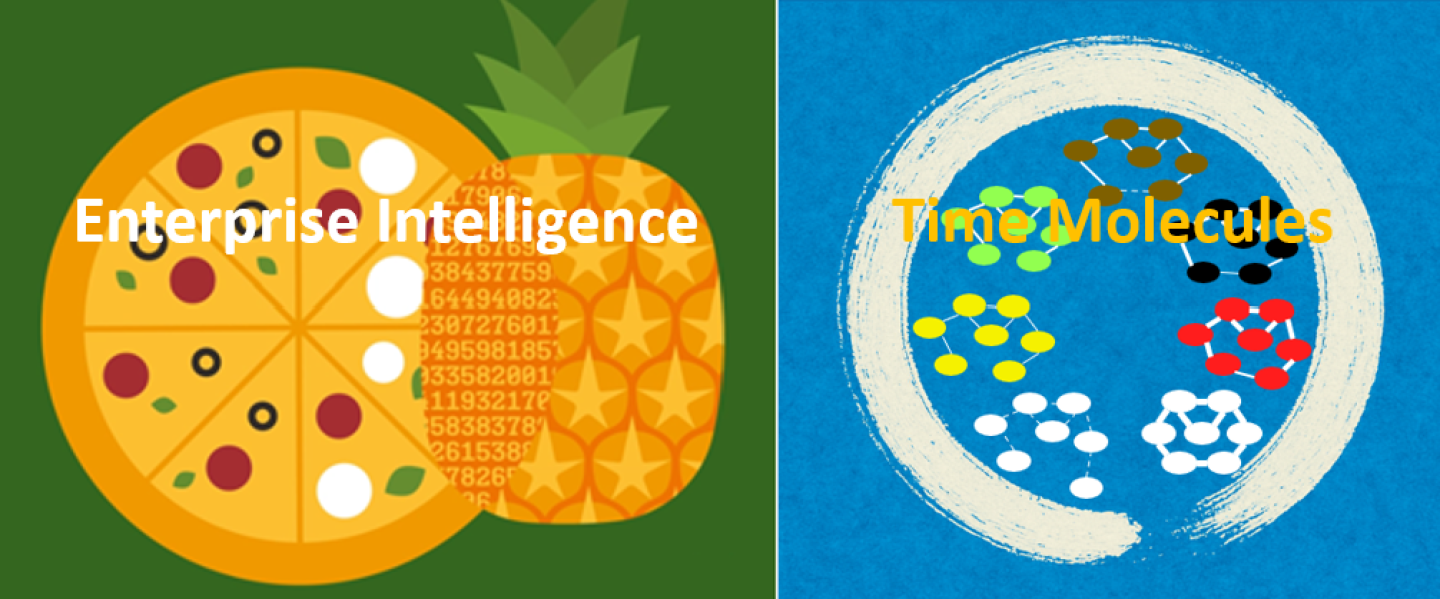
Hawaiian Pizza – Story of the Enterprise Intelligence Book Cover
The book "Enterprise Intelligence" was given a light-hearted cover with a Hawaiian pizza design, chosen by the author's wife. The pineapple and ham toppings symbolize the AI and BI aspects, and the colors reflect the author's hometown. Despite not being a fan of Hawaiian pizza, the author celebrated the book cover choice with a special order.
The Intelligence of a Business
"The Intelligence of a Business" is the title I had envisioned for my book published about a month ago (June 21, 2024). However, my book was instead given the name, Enterprise Intelligence. I do like the title--I approved it and understand how it could be more "marketable". But it doesn't capture the soul of the … Continue reading The Intelligence of a Business
Analytics Maturity Levels and “Enterprise Intelligence”
This blog revisits the traditional "analytics maturity model," providing a new perspective from the book "Enterprise Intelligence." The four analytics maturity levels: Descriptive, Diagnostic, Predictive, and Prescriptive, are explained along with their impact in the AI era. The blog emphasizes the importance of understanding these levels and their role in enterprise intelligence.
Enterprise Intelligence: Integrating BI, Data Mesh, Knowledge Graphs, Knowledge Workers, and LLMs
In today's rapidly evolving data analytics landscape turbo-charged by AI, businesses require an informationally-scalable infrastructure. "Enterprise Intelligence" offers a comprehensive framework integrating modern advancements like data mesh, knowledge graphs, and Large Language Models. The book addresses governance issues, providing a robust foundation for decision-making in an AI-driven world.