Note: This blog is mostly a “note-to-self”—an experience I want to remember for the next time. It’s a timely reminder that ChatGPT is my assistant, not my apprentice. The experience I present here with ChatGPT should already be familiar to everyone as a first-hand experience.
Over the past couple of years, I’ve written quite a bit about analogy, original thinking, learning, and the role of LLMs in AI. These subjects are intertwined in my books: Enterprise Intelligence, Time Molecules, The Assemblage of AI, and Semantic Webs of Meaning.
There’s a provocative conjecture running through much of that writing that I haven’t consolidated into one place:
Perhaps we’re not nearly as smart as we think we are.
I don’t mean we aren’t intelligent. The accomplishments of human civilization speak for themselves. But when we look at those accomplishments, we tend to attribute them to human ingenuity, particularly our ability to dream up something that never existed before.
What if we’re giving ourselves too much credit for the origins of those ideas?
What if much of our ingenuity is an unintended side effect of learning? We witness something, retain an imperfect, somewhat lossy representation of it, and later encounter something else that sort of resembles what we’ve already experienced. We recognize the resemblance, even though the two things aren’t really the same. Sometimes the connection is nonsense. But occasionally it works.
Then we improve upon it. Others improve upon it. Eventually, the result is so sophisticated that its humble beginnings are no longer apparent.
Recently, I wondered whether there might be anything scientifically novel in this conjecture. I asked ChatGPT to investigate, which led to an interesting exercise in formalizing the hypothesis and, ultimately, a lesson about what we should expect from AI as a research assistant. It’s not so much that the lesson is new. It’s more that it’s still there, only not as severe as before.
First, I want to bring together the argument I’ve been developing across my earlier articles.
Evolution Left Us an Enormous Library
In my June 27, 2025 article, Analogy and Curiosity-Driven Original Thinking, I opened with the proposition that original thinking doesn’t emerge from nothing.
The article was primarily about treating solutions as processes that can be represented, stored, searched, and adapted to other situations. It’s one of the underlying motivations for Time Molecules.
In the Key Takeaways, I included a point about how experience expands our pool of possible analogies. The more diverse the processes we encounter, the greater the opportunity to find a relationship that can be adapted to a problem in another domain.
But where did the first solutions come from?
Evolution had been exploring possibilities for billions of years before humans appeared.
Of course, evolution doesn’t intentionally invent things. Variation generates possibilities, and the environment acts as a validator through natural selection. I think of this as an enormous, reactive exploration of possibilities, with no understanding of what the eventual outcome will be.
An organism doesn’t need to know why something works. If a variation happens to improve reproductive success under the prevailing conditions, it may persist.
And this isn’t a single evolutionary process exploring one path at a time. Innumerable organisms, across enormous numbers of species, have been exploring possibilities simultaneously. They also interact and compete with one another, continually changing the environment against which their adaptations are evaluated.
The results are everywhere around us.
A shark’s teeth, a bird’s wings, an octopus’s camouflage, the coordinated hunting behavior of wolves—these aren’t descriptions of solutions stored in some book. The organisms themselves embody the library.
I explored this in The Solution Library of Nature, a section of my November 3, 2025 article, Long Live LLMs! The Central Knowledge System of Analogy.
I returned to the idea in An Interlude Before the Third Act of The Assemblage of AI, published February 17, 2026, where I described a progression from nature’s evolutionary solutions to human observation and analogy, and finally into an expanding cultural library.
Much of human ingenuity may come from recognizing imperfect matches to things we’ve already experienced, trying them in new situations, and refining what works. Evolution supplied an enormous library of possibilities, and we may be giving ourselves too much credit for discovering them.
A Megalodon Tooth and a Shattered Rock
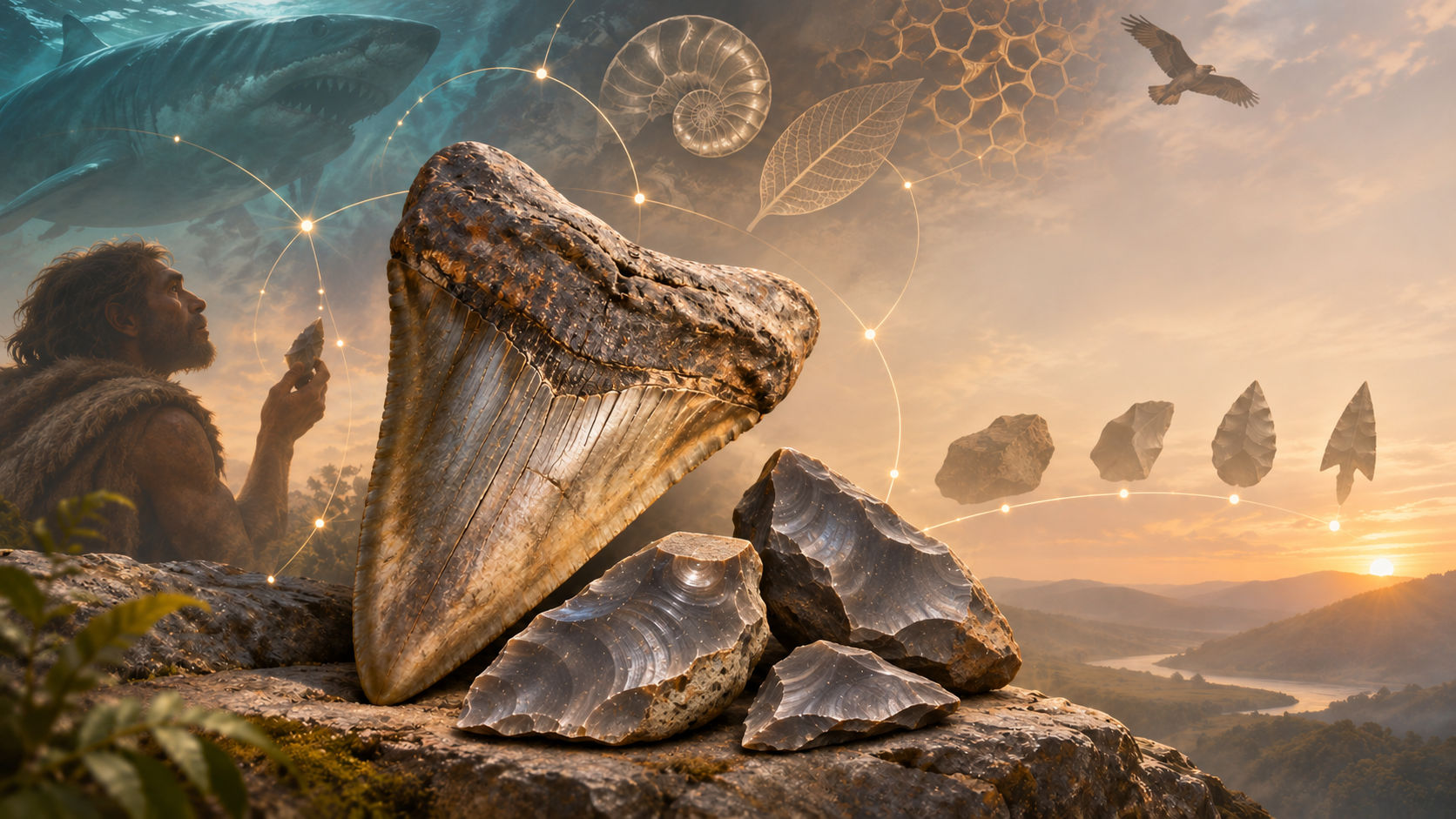
This is my favorite illustration. It’s a deliberately wild thought experiment, not an attempt to reconstruct prehistoric archaeology. I introduced it near the conclusion of Long Live LLMs!, where I wondered how our hominid ancestors might have discovered flint knapping. I’ve since thought more about the sequence leading up to it.
Imagine an early human discovering a large fossilized megalodon tooth. The megalodon had been extinct for millions of years. But its fossilized teeth remain in deposits around the world, sometimes exposed by erosion. No living megalodon needs to be involved in this story.
The observer knows that teeth cut and tear meat, having watched many others, fellow hominid or other toothed creatures, cutting off chunks of meat with their teeth. The fossil looks like an enormous tooth. Perhaps it occurs to someone that this big tooth might also be a cutting instrument.
That’s one possible analogical leap.
Now let’s back up a little. How did anyone figure out that a rock could be used as a weapon?
Perhaps someone witnessed a rock falling from a cliff and killing an animal, or even another person. The observer learned something from that event: a moving rock can inflict serious damage.
Later, in a completely different situation, someone throws a rock at prey or an enemy. The earlier observation provided a precedent for something worth trying.
Nobody necessarily set out to invent a weapon.
Now imagine that someone throws a rock, it strikes a boulder, and it shatters into several sharp fragments. One of those fragments resembles the large fossilized tooth.
The observer already has an association between a tooth’s shape and its ability to cut. Perhaps the resemblance is enough to suggest that the stone fragment might cut too.
And it does!
Now there’s another source of cutting instruments, one that doesn’t depend upon finding enormous fossil teeth. Over time, someone figures out how to deliberately fracture appropriate stones to manufacture sharp edges.
Eventually, the process is refined into sophisticated stone-tool manufacturing.
Notice how many independent experiences had to connect. Someone knew what teeth could do. Someone encountered a fossil. Someone witnessed the destructive force of a falling rock. Someone learned to throw rocks. A thrown rock fractured, and the fragments happened to resemble something associated with cutting.
These experiences needn’t have occurred to the same individual or even within one lifetime. Knowledge can accumulate and spread through observation, imitation, and teaching.
At no point did anyone necessarily envision a stone knife and then work backward to figure out how to manufacture it.
Yet, after generations of refinement, we could look at a beautifully manufactured stone tool and marvel at the ingenuity of its creators.
That ingenuity was certainly involved in its refinement. But what about its origin?
Again, I’m not claiming this sequence happened. The point is that a chain of ordinary observations, imperfect associations, and accidental events might eventually produce something we would consider an important invention.
And that is the process I’m interested in.
Learning, Abstraction, and Imperfect Recognition
This raises another question: What bootstraps our intelligence in the first place?
Infants and toddlers spend enormous amounts of time observing, recognizing, and generalizing patterns. At a basic conceptual level, I see similarities to how machine learning systems acquire representations from examples.
I’m not suggesting that biological brains and artificial neural networks employ identical learning mechanisms. But both can develop increasingly sophisticated recognition capabilities through experience.
As experience accumulates, recognition becomes more abstract.
Consider memory. We don’t preserve every minute detail of everything we’ve encountered. We can’t. We retain selected information, associations, relationships, and generalized meanings.
Memory research, including fuzzy-trace theory, distinguishes relatively precise recollections from representations of the essential meaning of an experience. The two can coexist, but the generalized representation is particularly interesting here.
Think about the rock falling from the cliff. The observer doesn’t need to remember its exact dimensions, the precise height of the cliff, or the animal’s location to recognize that a moving rock can injure something.
The retained relationship can be applied to another situation involving different rocks, different animals, and different circumstances.
Abstraction makes recognition more flexible precisely because every detail doesn’t have to match.
But that flexibility introduces another possibility. Something might look enough like a remembered experience to activate an association even though the match isn’t particularly good.
That can produce errors. It can also reveal an unexpected application that actually works.
In Long Live LLMs!, particularly the sections Maybe We’re Not as Smart as We Think and The Value of Moderate Probability, I discussed the importance of these uncertain recognitions.
I find the most interesting recognition isn’t necessarily the obvious one. It’s that feeling of having seen something like this before, even though we know the current situation is different.
That doesn’t mean every weak association deserves investigation. Most probably don’t. But a moderately plausible connection may point toward a region of possibilities that would otherwise never be explored.
And that brings us to deliberate creativity.
Purposeful Search Doesn’t Mean Starting From Nothing
My rock-and-tooth story emphasizes accidental discovery, but I don’t think deliberate invention operates through an entirely separate mechanism.
Consider chess. Experienced chess players don’t evaluate a board by treating every piece as an independent object and calculating every possible move. They recognize meaningful configurations built from experience.
This has been studied for decades. The classic research by Chase and Simon on chess perception demonstrated that strong players can remember meaningful chess positions far better than novices, but much of that advantage disappears when the pieces are arranged randomly. The expert has accumulated an enormous repertoire of patterns.
Recognition allows the expert to focus attention on promising possibilities rather than searching blindly through the enormous space of legal moves. Deliberate analysis is still necessary, but experience provides an extraordinary shortcut.
I suspect something similar happens in much of creative thinking. Even the most deliberate scientific investigation doesn’t begin from nothing. The investigator has accumulated observations, concepts, procedures, and relationships. A problem activates some subset of those experiences, suggesting promising lines of investigation.
Think of the monumental discoveries associated with Newton, Darwin, or Einstein. Their achievements involved extraordinary intellectual work, but they also emerged from accumulated knowledge and unresolved questions developed by earlier thinkers.
Darwin, for example, recognized the significance of Malthus’s work on population while investigating the mechanisms of biological change.
That’s not an accidental invention in the sense of someone stumbling upon a sharp rock. It’s a purposeful investigation in which a relationship from another subject contributed to a breakthrough.
The insight might be exceptionally rare, but that doesn’t mean it emerged from an intellectual vacuum.
I discussed this in the Preface to The Products of System 2, published March 4, 2026. Original thinking often begins with an imperfect resemblance that provides a starting point for further work.
The eventual solution might be extraordinary. The conceptual ingredients used to develop it generally have a much longer history.
Polymaths and Skill Stacks
This brings me to another aspect of the conjecture: the diversity of the library available to an individual.
I’ve recently been watching discussions about polymaths, including the work of Dr. Angela C. Meyers (YouTube channel, Dr Angela C Meyers), who studies contemporary polymaths and how people develop and integrate knowledge across disciplines.
A polymath doesn’t simply know more things. The variety of domains creates additional opportunities to recognize relationships between subjects that specialists might never think to compare.
That reminds me of Scott Adams’ concept of a skill stack, which he described in How to Fail at Almost Everything and Still Win Big. Adams wasn’t claiming to be the world’s greatest artist, writer, comedian, or business expert. His success with Dilbert came in large part from combining capabilities that accentuated one another, into a new, unique, integrated skill where “the whole is bigger than the sum of its parts”.
It’s not scientific proof of my conjecture, but it’s an appealing illustration. The breadth of knowledge expands the possible combinations. The depth of understanding improves the ability to recognize meaningful connections. And the ability to integrate them determines whether something interesting actually comes of it.
This suggests that creativity may depend as much on what an intelligence has had the opportunity to learn as on its underlying reasoning power. A brilliant person with a narrow range of experience may simply never encounter the material that would lead to a particular insight.
And someone with a broader range of experience might stumble upon a connection that would be entirely inaccessible to someone with superior reasoning abilities but a much narrower repertoire.
Are We Creating a Story About How Clever We Were?
There’s another component that makes this conjecture more provocative: We reconstruct our experiences.
Neurologist Oliver Sacks discussed the surprising unreliability of personal recollection in his 2013 essay, Speak, Memory. One of his examples involved a vivid childhood memory that he came to recognize as something learned through another person’s account rather than personally experienced.
We don’t merely retrieve perfect recordings of past events. We reconstruct them into coherent accounts using what we currently know and believe.
I wonder whether we do something similar when explaining our inventions. Imagine that a discovery began with an accidental observation, followed by an imperfect association that happened to work. The original idea was rough, perhaps even somewhat ridiculous. But it was subsequently tested, developed, improved, and refined.
Years later, when the inventor recounts the discovery, does the story give a disproportionate amount of credit to deliberate reasoning?
What happened may have been a messy series of accidents, partial recognitions, failed experiments, and adjustments. What gets remembered and retold is a coherent progression toward the successful result.
That’s a conjecture, not something I’ve established. But it would help explain why the sophistication of our accomplishments might give us an exaggerated impression of the ingenuity involved in their initial conception.
In my October 30, 2026 article, Stories, Analogies, Metaphors—the Layer After LLMs, I wrote about how stories compress complex experiences into reusable references.
The section Much of Language Is Fossilized Metaphor examines how we routinely apply familiar relationships in new contexts until the metaphor becomes so commonplace that we no longer notice it. Stories preserve knowledge. But they also involve selection, compression, and interpretation.
We may be exceptionally good at constructing plausible stories about how we arrived at something—stories that sometimes exaggerate how much we knew at the beginning.
The Next-Word-Prediction Insult
When ChatGPT first became a sensation in late 2022, one of the most common dismissals was that LLMs were merely predicting the next word. The argument was that such a simple training objective couldn’t possibly produce genuine intelligence.
I had almost the opposite reaction. Maybe next-token prediction is more powerful than it sounds. And maybe we’re not as smart as we think we are.
In fairness, modern AI assistants also incorporate tools, retrieval, and other processes that go well beyond the underlying model’s next-token prediction.
I wasn’t suggesting that human intelligence is literally next-token prediction. Biological learning is quite different from training a transformer, and human experience involves physical interaction, motivation, emotion, social learning, and many other mechanisms.
But comparison is provocative:
- What if sophisticated capabilities can emerge from relatively elementary learning processes when they’re exposed to an extraordinarily rich and varied body of experience?
- What if we confuse the sophistication of the outcome with the sophistication of the mechanism that originally generated it?
It’s another reason I’m interested in the relationship between learning, recognition, and ingenuity—both in humans and in AI.
The Hypothesis Paper That Wasn’t
Recently, I wondered whether there might be something scientifically novel in the conjecture I’d been developing across my blogs. I’m an engineer/architect who puts things together. Whenever I have a neat idea, I assume thousands of others have the same idea, and I just go ahead with applying it rather than attempting to establish precedence.
Of course, I asked ChatGPT to investigate the existing research. And to do it very carefully, thoroughly, etc.
This is precisely the sort of work I expect AI to help with. A serious investigation could involve cognitive science, evolutionary biology, developmental psychology, philosophy, and AI research. Traditionally, becoming sufficiently familiar with all that literature could take years, particularly for someone with a non-research day job.
One of AI’s great promises is its ability to navigate enormous bodies of accumulated knowledge, finding relationships that conventional keyword searches and ranked web pages might miss. That’s particularly interesting to me because my own work on Enterprise Intelligence concerns organizing and connecting knowledge scattered across different domains.
I also asked whether the conjecture might be suitable for a formal scientific hypothesis paper. I know how to develop and evaluate technical ideas, but academic publishing has its own conventions. Although I’ve read hundreds of academic papers over my life, I still felt to actually write one, I needed guidance. For that part, I deliberately relied on ChatGPT more than I normally would.
ChatGPT initially concluded that there was enough to justify pursuing a formal paper and recommended that we proceed. It identified relevant research, explained the requirements for a Hypothesis paper, and suggested how my ideas could be organized into a scientific proposition.
The resulting manuscript was titled The Evolutionary Library Hypothesis of Creative Intelligence (on the Enterprise Intelligence Github repo). It included an abstract, a proposed cognitive mechanism, references, limitations, and several experimentally testable predictions.
The writing was more academic than my usual conversational style, which was intentional. I wanted to present the conjecture in a form familiar to researchers evaluating scientific hypotheses.
We went through a few iterations of refinement, which included feedback obtained from Grok.
As the investigation progressed, ChatGPT identified several existing bodies of research that were substantially closer (but not yet completely covering) to my conjecture than its initial assessment had indicated.
Eventually, after we’d already developed and refined the manuscript, ChatGPT finally uncovered research close enough to my conjecture that it reversed its recommendation to write the paper.
That’s what irritated me. I’d explicitly asked it to investigate precedent before we began, and I continued questioning the novelty throughout the exercise. My suspicion is that ChatGPT hadn’t adequately understood (in the way a true apprentice would, not a helping-hands assistant) the conjecture to recognize how closely related some existing research was. If it had identified those papers initially, that would have answered my question, and I would have been perfectly satisfied.
Instead, we had developed an entire scientific manuscript before sufficiently close prior work was identified. ChatGPT was very capable of organizing my ideas into an academic paper, but the investigation that should have determined whether we needed such a paper in the first place had been inadequate.
Still, there’s another side to this experience. The entire exercise—from ChatGPT studying the background I’d written over the years to our decision to abandon the paper—took only a few hours. Thirty years ago, investigating a question spanning several disciplines might have required trips to multiple major libraries. Even five years ago, web searches would have made the task a magnitude or two easier, but finding and connecting the relevant research could still have taken days, weeks, or even months. Today, despite ChatGPT’s frustrating detour, we accomplished all of that in a few hours—failed fast. When I consider how much time and effort that once would have required, it’s actually quite astonishing.
What the Existing Research Says
The literature we eventually uncovered is genuinely interesting and a thorough read will comprise much of my Holiday Season reading for next month:
- Creative Cognition: Theory, Research, and Applications — Ronald Finke, Thomas Ward, and Steven Smith (1992). This work examines creativity through ordinary cognitive mechanisms, including memory retrieval, categorization, and recombination, rather than treating creative thought as a mysterious special faculty.
- Evolved to Adapt: A Computational Approach to Animal Innovation and Creativity — Oren Kolodny, Shimon Edelman, and Arnon Lotem (2015). This was especially striking because it explores how learning environmental regularities and organizing them hierarchically can support generalization and innovation. The researchers also implemented a computational model.
- The Role of Memory in Creative Ideation — Mathias Benedek, Roger Beaty, Daniel Schacter, and Yoed Kenett (2023). This review connects creative idea generation to memory search, the construction of candidate ideas, and the evaluation of novelty and effectiveness.
- Creativity as Emulation: The Cultural Basis of Creative Cognition — Steven Brown (2024). This examines the role of existing cultural products in the creation of new ones, including modification and recombination.
Some of the underlying theories have been established in cognitive psychology for decades. That doesn’t necessarily mean they are familiar to people primarily concerned with applying AI to business problems, building software, or developing intelligent systems.
The 2015 work by Kolodny, Edelman, and Lotem particularly caught my attention because of its proximity to my thinking about learning, generalization, and creativity.
These papers don’t necessarily settle every aspect of my conjecture, nor have I attempted an exhaustive comparison. But they establish substantial precedent for several of its central mechanisms, particularly learning-driven creativity, generalization, and the recombination of accumulated knowledge.
I will provide an update after I read over this material, after the Holidays, if it provides anymore insight.
What I Still Think
None of this changes what interests me about the conjecture. The existing research is fascinating, and I’m looking forward to reading more of it. But the questions that led me here remain interesting, particularly what they suggest about human intelligence and the AI systems we’re building.
One purpose of this site is to bring ideas that may be familiar to specialist researchers, but less familiar to BI and data professionals, to the attention of that audience. The research I encountered during this exercise fits that purpose.
We begin life with biologically inherited capabilities. We encounter a world already full of solutions produced through evolution and physical processes—over a time period of four billion something years. We learn from those encounters, but we don’t preserve exact copies of everything we’ve experienced. We retain increasingly abstract representations that can be activated by new situations.
Some of those matches are close enough to apply immediately. Others are imperfect but still suggest a path worth traversing.
When they work, the resulting solutions become additional experiences. Some are developed deliberately, shared, improved, and incorporated into human culture. That cultural library then becomes a source for future discoveries.
We don’t have to reinvent every solution from first principles. We can start from where countless organisms and generations of people have already left off.
This is also why I’ve been exploring, through my books and articles, AI systems that expand the range of accessible experiences, represent relationships and processes, search across apparently unrelated domains, and test whether a promising resemblance actually holds.
The broader the repertoire and the better its organization, the more possibilities an intelligence may be able to recognize.
Of course, having an enormous library doesn’t guarantee creativity. There’s an even more enormous amount of nonsense that can be generated by combining unrelated things. The ability to evaluate and refine ideas is essential.
The ordinary processes of imperfect recognition, abstraction, and mapping are sufficient to generate the candidates; what makes the cumulative result powerful is the selective pressure that keeps and transmits only the mappings that survive contact with the world, while discarding the rest. That filter, applied across individuals and generations, is what turns a library of near-misses into a growing set of reliable tools.
But that still leaves my original provocative question: When we admire the extraordinary products of human ingenuity, are we attributing too much of their origins to the brilliance of the individual, and too little to the enormous accumulation of solutions and experiences that made the discovery possible?
Perhaps the greatest accomplishment of human intelligence isn’t creating something out of nothing. Perhaps it’s our ability to recognize something that almost fits, imagine how it might be made to fit, and gradually turn it into something that works. And perhaps the reason we think we’re so extraordinarily clever is that we’ve become very good at telling the story afterward.
Closing Pro tip: Read one of my favorite books, The Ingenuity Gap, by Thomas Homer-Dixon. Homer-Dixon warned that the complexity of the problems we create can outpace our ability to solve them. That was concerning enough before AI arrived. In light of recent outages and reports of AI-assisted cyberattacks, his warning seems especially timely. I’ve never been particularly comfortable with autonomous AI agents, even though I’ve had to address them in my own work. I much prefer AI as an assistant—or, ideally, an apprentice—with humans firmly in control. Making technology more powerful is one thing. Developing the ingenuity to manage its consequences is another.


