- Update August 25, 2026: The supplemental GitHub repo for the Semantic Webs of Meaning is live. The supplemental repo has these main purposes:
- Post material that is too down into the weeds for the book (ex. install instructions, full appendices, code samples, and tutorials) but is mentioned there.
- Enable me to expand upon and/or clarify topics from the book, address the latest information, and add new thoughts.
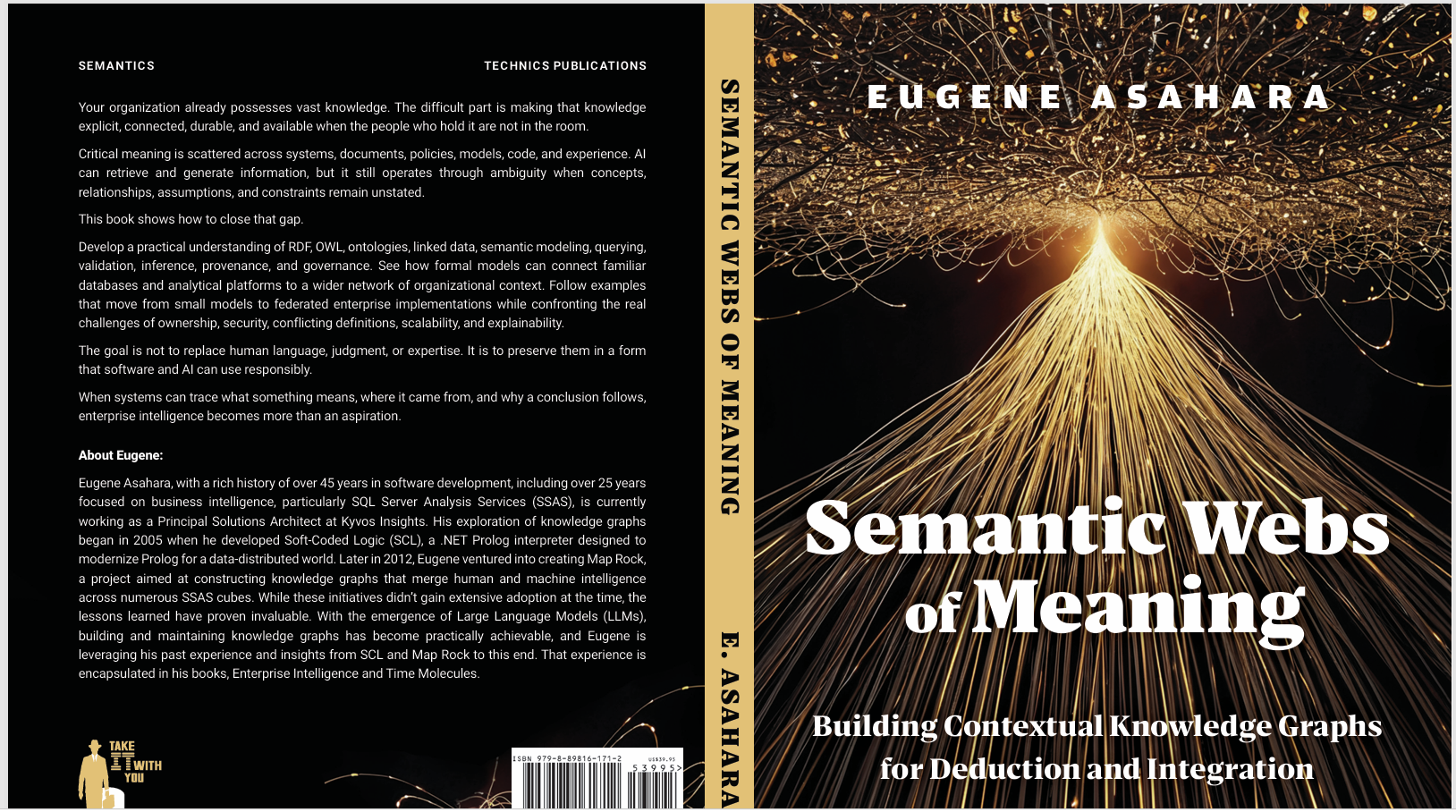
- Update August 19, 2026: Semantic Webs of Meaning published very early, to my surprise. Use the code TP25 for a 25% discount if purchasing on the Technics Publications website. Also available on Amazon.
Semantic Webs of Meaning: Building Contextual Knowledge Graphs for Deduction and Integration (set for mid-September 2026 publication) is about the critical role of knowledge graphs in an era already overflowing with data, software, business intelligence, and remarkably capable AI. Much of what people and organizations actually know still remains implicit—in the meanings of things, the relationships among them, the context surrounding those relationships, and the experience people apply without ever writing it down. The book explores how knowledge graphs make enough of that meaning explicit, durable, inspectable, and usable for reasoning, while developing the intuition and technical grounding needed to understand what KGs add beyond databases and LLMs, how they are built, and what it really takes to put them to work.
My goal is for database architects, BI professionals, AI engineers, governance leaders, technically inclined executives, and domain experts to understand why this is a critical matter and how the pieces as a system of AI fit together before worrying about every detail of the technology. I approached the book much as I would in my role as a solutions architect, called in to explain knowledge graphs to a cross-functional team that has decided it may actually need one: What is this really about, what value does it add, what are we getting ourselves into, and what do we need to know to move forward intelligently?
But this is not a theoretical book. We do get down to RDF, RDFS, OWL, SKOS, SHACL, Turtle, SPARQL, graph platforms, inference, security architecture, domain-oriented development, and the rather unglamorous problem of maintaining all of this after the first exciting version has been built. The broader intent is a big-picture reality check on the value, scope, and effort involved in building knowledge graphs—and what changes when those ideas are extended across an enterprise.
This is my third book from Technics Publications, but it came about differently from the first two. I proposed Enterprise Intelligence and Time Molecules, both based on work I’ve done since around 2004. In this case, Technics asked me to write this one—broadly, “on knowledge graphs and semantic modeling”. I jumped on it because I readily felt how it connected to the previous books.
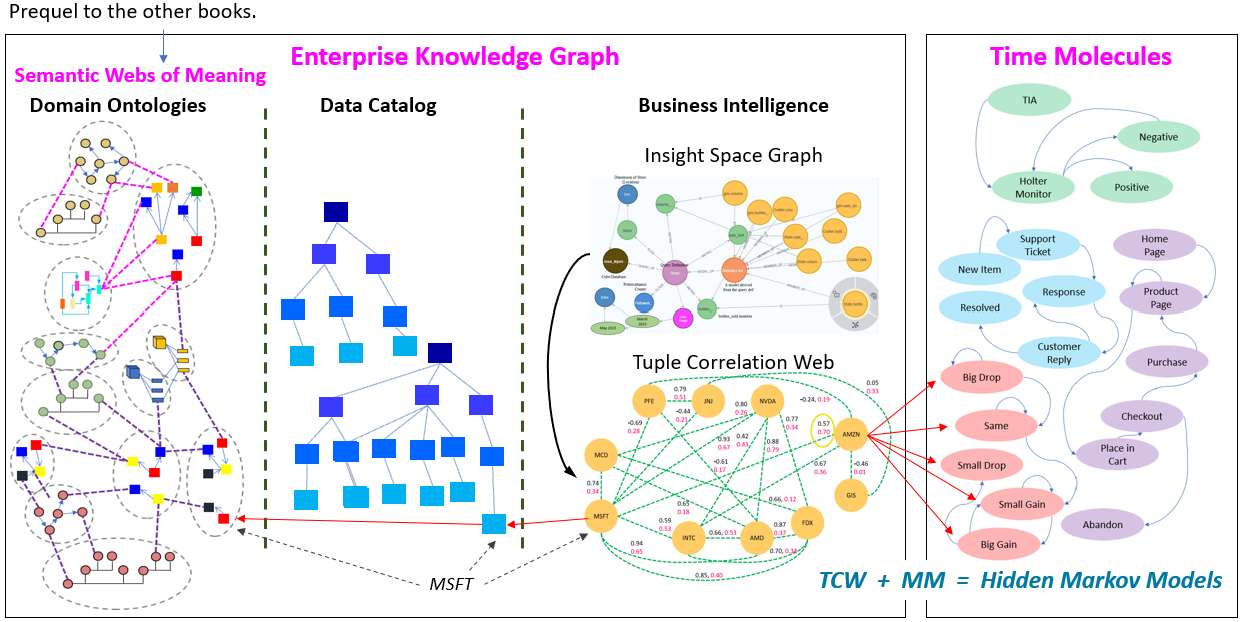
This third book feels like a prequel to the other two. Enterprise Intelligence contains some very graphy ideas, particularly the Enterprise Knowledge Graph and the Insight Space Graph/Tuple Correlation Web. Time Molecules approaches systems through events, Bayesian networks, Markov models, and relationships unfolding through time, reaching beyond the comparatively closed world of modeled enterprise systems.
Progression of Chapter Intention
Following are a progression of common questions within a discussion of knowledge graphs that I address in each chapter of the book:
- What does it actually mean to encode knowledge? We begin with ordinary human understanding and discover how quickly seemingly simple statements open into deeper layers of meaning. A knowledge graph is not reality; it is an explicit, deliberately simplified representation of what we believe about reality.
- What does the world of existing public knowledge graphs already give us? Before building an enterprise knowledge graph, we explore some of the best-known examples—Wikidata, DBpedia, Google’s Knowledge Graph, and others—and then narrow into domain-oriented resources such as SNOMED CT and IFC. They illustrate an important advantage of semantic technologies: an enterprise does not need to recreate the world’s knowledge inside its own walls. Its own meanings can connect outward to shared identifiers, vocabularies, ontologies, and knowledge maintained by others.
- What exactly is an ontology? Ontology is not just a fancy data model. It asks what kinds of things exist in a domain, how they relate, and what those relationships logically imply. Without sufficient meaning, a graph risks becoming little more than a knowledge bog: lots of connected assertions whose semantics remain mostly in people’s heads.
- What can knowledge graph people learn from databases, BI, and software engineering? Relational models, dimensional models, OOP, UML, MDM, and other familiar disciplines already contain fragments of semantic thinking. The interesting question is where their abstractions stop and the graph needs to go further.
- Where do LLMs fit? I treat LLMs and KGs as complementary rather than competing technologies. LLMs bring extraordinarily broad, flexible, probabilistic intelligence; KGs bring explicit identity, governed meaning, provenance, and deterministic reasoning. Increasingly, enterprise intelligence belongs to the assemblage rather than either component alone. I discuss this further in The Assemblage of AI.
- What are all these RDF technologies actually for? This is the most conventional chapter in the book: a tour of the Semantic Web stack. RDF provides the basic statement model; RDFS adds schema; OWL adds richer ontology and reasoning; SKOS handles controlled vocabularies and taxonomies; SHACL validates graph data; Turtle gives us a readable way to write RDF; and SPARQL lets us query it. The point is not to memorize a standards catalog, but to understand what job each piece performs and how they fit together.
- What happens when the graph begins to reason? Retrieval tells us what was stored. Deduction asks what follows from it. That introduces rules, inference, explanation, uncertainty—and a fundamental discipline: reasoning should be deliberately bounded, governed, traceable, and explainable.
- How can this possibly scale across an enterprise? Not by building one enormous ontology controlled by a central priesthood. I argue for composition: loosely coupled, domain-owned knowledge products connected through shared enterprise concepts, identifiers, governance, and interfaces. Data Mesh and Domain-Driven Design become highly relevant here.
- What does security mean when the system can discover things nobody explicitly stored? Traditional security asks, May this user read this fact? An inferential system must also ask: May these facts be combined? May this conclusion be derived? May the system reveal that conclusion? Security therefore extends from protecting data to protecting reasoning, meaning, and disclosure. The same graph can also become a strategic instrument for modeling risks, adversaries, and paths to undesirable outcomes.
- What does the life of knowledge graph authors look like? An enterprise knowledge graph is not a project that reaches “done.” Business language changes. Systems change. Regulations change. People discover mistakes and ask questions the ontology could not answer. The lifecycle therefore begins with competency questions and cycles through modeling, construction, validation, publishing, consumption, feedback, and evolution. Ultimately, the organization is not merely managing triples. It is managing meaning.
My intention is beyond making the case for implementing a knowledge graph in an enterprise. It is to give architects, data and AI professionals, governance leaders, technically inclined executives, and domain experts enough intuition to recognize where explicit meaning can create leverage—and enough implementation grounding to understand what building and sustaining it really entails.
An Enterprise’s Representation of Uniqueness in Their System of AI
Before we can ask what an enterprise has observed, what it has learned, or how its systems behave through time, we need some way to state what the things in that world mean. We need identities, concepts, relationships, context, provenance, and enough explicit semantics to reason about them. That is the ground covered by Semantic Webs of Meaning. An Enterprise Knowledge Graph (EKG, the protagonist of Enterprise Intelligence) is therefore not simply another database underneath the other ideas. It is closer to a semantic foundation upon which they can build.
That realization reminded me of V’Ger in Star Trek: The Motion Picture. At the center of V’Ger remained Voyager 6, a primitive probe created by humanity with a simple purpose: learn what it could and return that knowledge to its creator. A civilization of living machines (what I don’t think we wish to become) vastly enhanced it, and during its journey it accumulated an almost incomprehensible amount of additional knowledge. Yet at the center of everything V’Ger became was still that original human artifact and its original purpose.
An EKG has something of that character. Its core comes from the enterprise: its customers, products, processes, terminology, policies, systems, accumulated expertise, successes, mistakes, and peculiar ways of doing things. But it does not have to stop there. A knowledge graph can link outward into public and specialized external knowledge graphs (ex. Wikidata, DBPedia). Enterprise observations can incorporate events occurring outside the organization. Extend that far enough into the territory of Time Molecules, and those events can include things actually sensed happening in the physical world.
Had V’Ger originated with another intelligent civilization, presumably the knowledge it accumulated would have evolved differently around that different core. The same is true of enterprises. Two companies can use the same software, subscribe to the same external data, and increasingly have access to the same extraordinarily capable AI models, yet they remain different organizations because of what they have experienced, what they value, how they understand their domains, and the relationships they have accumulated over time.
That distinction seems increasingly important in the AI era. I believe one important competitive frontier is therefore not who has AI, but what their AI has been given to understand about their enterprise.
LLMs effectively dimensionalize enormous amounts of our collective knowledge. They make a remarkable portion of humanity’s accumulated information and patterns available to almost everyone. That is enormously valuable, but as access to such capability becomes commonplace, access itself becomes less of a competitive distinction.
Knowledge graphs can help preserve the other side of the equation: what makes an enterprise particular.
The EKG can encode the meanings and relationships peculiar to that organization. The Insight Space Graph can accumulate what the organization has noticed. Time Molecules can preserve aspects of what its systems have experienced through time. External knowledge and events can continually enlarge that picture, but they do so around a core that remains particular to the enterprise.
This is important because competition is central to growth. A world in which one organization eventually wins the entire pot would be a very drab world. Technology may increasingly make it difficult for individuals to compete purely on access to information or generic analytical ability, but there remains enormous room for competition at the corporate level. Organizations can differentiate themselves through what they collectively know, what they notice, how they interpret what happens to them, and how effectively they convert that understanding into action.
So one way to summarize all three books, in their new conceptual order, is:
- Semantic Webs of Meaning: What do we know, and what does it mean?
- Enterprise Intelligence: What does the enterprise notice and learn?
- Time Molecules: What happens, in what order, and how do systems behave through time?
Semantic Webs of Meaning starts at the beginning: How do we make enough of what we know explicit that we can reason with it?
That is a question about technology, but it turns out to be at least as much a question about ourselves.
Preserving Dynamism
As general-purpose AI makes extraordinary amounts of collective knowledge and analytical capability available to almost everyone, we should not want the result to be a world in which organizations gradually become interchangeable, a handful of winners capture everything, and the rest of us settle into technological stasis. Human progress has depended upon competing ideas, competing organizations, competing interpretations of the world, and the surprises that result when they collide. In Virginia Postrel’s terms, dynamism depends upon preserving room for experimentation and difference rather than converging on a single prescribed answer.
LLMs can increasingly give everyone access to a remarkable common foundation of intelligence. Knowledge graphs offer one way to preserve and develop what remains particular: what a person, a domain, or an enterprise knows, believes, notices, values, and learns through experience. The competitive frontier may therefore shift from who has the smartest AI to whose system of AI has developed the richest understanding of its own world.
I would much rather see a future populated by millions of such distinct, evolving centers of intelligence than one in which we all draw the same conclusions from the same enormous machine. The point is not just that machines know more, but to make sure that, as they do, we still have something uniquely our own worth knowing.


