
This blog is based on a “deleted scene” of my book, Semantic Webs of Meaning, available on Technics Publications and Amazon. Use the code TP25 for a 25% discount if purchasing on the Technics Publications website.
In your journey to building knowledge graphs, this is where knowledge graph people can start to sound like the “Comic book Guy” on the Simpsons or Sheldon Cooper on the Big Bang Theory. But AI is a magnitude worse. And we’ll need to deal with it in an increasingly automated fashion, which means we need to start getting into that mindset.
It’s surprising how much our brains do towards correctly interpreting what we people say to us using our loose language. But the looseness of language means there is the door for misinterpretation. For AI, this is even worse since it currently doesn’t live immersed into our physical world.
A fundamental lesson in RDF and OWL can be found in this ordinary statement:
A sedan has four doors.
To a human, that sentence seems simple. But what exactly does it mean?
Does it mean that four doors are part of the definition of the class Sedan? Does it mean that sedans typically have four doors? Is it in the context of one particular sedan? Are the doors merely counted, or are the doors themselves things we want to represent and reason about?
| Interpretation | What it means |
|---|---|
| “Sedans have four doors.” | A general statement about sedans as a category. It is ambiguous: it may mean that four doors are typical, expected, or universally true of sedans. RDF/OWL forces us to decide which meaning is intended. |
| “A sedan has four doors.” | A statement about an unspecified member of the Sedan class. Depending on context, it could mean a typical sedan or an arbitrary sedan, so it still does not tell us whether the claim is descriptive or logically required. |
| “This sedan has four doors.” | A statement about one particular sedan individual. This is naturally represented as a property assertion on that individual, such as :MySedan :doorCount 4. |
| “Four doors are typical of sedans.” | A descriptive statement about the Sedan category, not a rule that must hold for every instance. This is better treated as annotation or descriptive metadata than as a universal OWL restriction. |
| “Four doors are part of my definition of Sedan.” | A formal ontological claim: membership in the Sedan class requires the specified door condition. This is the case for an OWL restriction or, if intended as a complete definition, an owl:equivalentClass expression. |
Those interpretations require different RDF and OWL statements.
Understanding the differences is important because RDF triples are very literal. The triple says something about its subject. It does not automatically turn a property attached to a class into a property of every member of that class.
The original title of this article was, “Does Semantics Make Us A-holes”. Clear understanding is necessary, but nonetheless, it doesn’t make you more fun to be around … hahaha.
The purpose of this article is to demonstrate the necessity for this level of semantic meaning. The good news is that this level of semantic diligence usually needs to be recorded in full only once and with proper maintenance, you’ll get a “million miles” out of it. Additionally, even today’s level of AI makes an incredibly good partner in hashing out the semantics.
Classes and Instances
Start with the basic taxonomy:
: <http://example.org/cars/> . rdf: <http://www.w3.org/1999/02/22-rdf-syntax-ns#> . rdfs:<http://www.w3.org/2000/01/rdf-schema#> . owl: <http://www.w3.org/2002/07/owl#> . xsd: <http://www.w3.org/2001/XMLSchema#> .# Car is a Class.:Car owl:Class .# Sedan is a subclass of Car.:Sedan rdfs:subClassOf :Car .
We have a hierarchy consisting of the root, Car, with a child of Sedan.
More precisely:
Every individual that is a
Sedanis also aCar.
Now we can introduce an actual car (a car I bought from a car dealership):
# My Taurus is a Sedan.:MyTaurus :Sedan .
From these two statements:
:Sedan rdfs:subClassOf :Car . # Sedan is a sub class of Car.:MyTaurus :Sedan . # My Taurus is a Sedan.
an RDFS or OWL reasoner can infer:
:MyTaurus :Car . # My Taurus is a car.
This is genuine class membership inheritance.
That distinction—class versus instance—becomes important when we add the doors.
Interpretation 1: One Particular Car Has Four Doors
Perhaps we are simply describing :MyTaurus.
The easiest representation is a datatype property:
# Define a property for the number of doors.:doorCount owl:DatatypeProperty ; rdfs:domain :Car ; rdfs:range xsd:integer .# My Taurus has 4 doors. This doesn't mean all Taurus' have four doors, nor do Sedans.:MyTaurus :Sedan ; :doorCount 4 .
This says:
MyTaurushas a door count of 4.
There is no statement here that all sedans have four doors.
Another sedan could have:
# Kevin's Camry has three doors. Odd, but it does.:KevinCamry :Sedan ; :doorCount 3 .
Nothing in the ontology as written prevents that.
The property assertion describes the individual car.
Interpretation 2: Four Doors Are a Characteristic of Every Sedan
Suppose we mean something stronger:
By definition, every Sedan has a door count of 4.
Then four doors are a class-level characteristic, but in OWL we normally express that characteristic as a restriction on the members of the class:
:Sedan rdfs:subClassOf [ owl:Restriction ; owl:onProperty :doorCount ; owl:hasValue 4 ] .
Read this as:
Every Sedan belongs to the class of things whose
doorCounthas the value 4.
Now if:
:MyTaurus :Sedan .
an OWL reasoner can infer:
:MyTaurus :doorCount 4 .
This is probably what we ordinarily mean when we informally say:
“Four doors is a property of the Sedan class.”
That statement is perfectly reasonable in human ontology language.
The technical subtlety is that OWL expresses a property that applies to members of the class using a class restriction.
Interpretation 3: “Sedans Typically Have Four Doors”
Now change the sentence slightly:
Sedans typically have four doors.
That is not the same assertion.
There are unusual vehicles, historical classifications, marketing categories, regional definitions, and edge cases. Perhaps four doors is merely how our taxonomy characterizes the category.
Then making this a hard OWL restriction may be too strong.
We could instead describe the class itself:
:typicalDoorCount owl:AnnotationProperty .:Sedan owl:Class ; rdfs:subClassOf :Car ; :typicalDoorCount 4 .
This says something about our concept of Sedan:
In this taxonomy, Sedan is characterized as typically having four doors.
It does not entail:
:MyTaurus :doorCount 4 .
That may be exactly what we want.
This distinction is especially important in taxonomies intended to describe tendencies, comparisons, or conventional characteristics rather than rigid logical definitions.
Why This Does Not Work the Way We Might Expect
Suppose instead we write:
:doorCount owl:DatatypeProperty .:Sedan :doorCount 4 .
A human might read this as:
Sedans have four doors.
But RDF sees:
Subject Predicate Object------- --------- ------:Sedan :doorCount 4
The subject is the resource identified by :Sedan.
It does not mean that every manufactured Sedan has 4 doors:
For every x: if x is a Sedan, x has doorCount 4.
There is no implicit propagation from properties asserted on a class resource to the instances of that class.
This:
:Sedan rdfs:subClassOf :Car .
has subclass semantics.
This:
:Sedan :doorCount 4 .
does not.
That is one of the easiest traps in RDF because ordinary language routinely blurs these two meanings.
Properties of the Class Versus Properties Defined by the Class
There is nothing wrong with a class having properties of its own.
Suppose we maintain ontology metadata:
:Sedan :definitionSource :AutomotiveTaxonomy ; :taxonomyCode "SED" ; :approvedBy :VehicleStandardsCommittee .
Those statements really are about the class Sedan itself.
They could mean:
The Sedan category has code SED.
The Sedan category comes from this taxonomy.
This committee approved the definition of Sedan.
We certainly do not mean:
Every individual sedan has taxonomy code SED and was approved by the Vehicle Standards Committee.
So properties attached directly to classes can be perfectly legitimate. We simply need to understand what they mean.
A useful distinction is:
| Intended statement | RDF/OWL technique |
|---|---|
| Something about the class itself | Property or annotation on the class |
| Something typically true of members | Class metadata/annotation describing the tendency |
| Something necessarily true of every member | OWL class restriction |
| Something true of one particular member | Property assertion on the individual |
Datatype Properties Versus Object Properties
So far we have represented the number of doors as a literal:
:MyTaurus :doorCount 4 .
That uses a datatype property because the object is a literal value.
MyTaurus ──doorCount──> 4 ^ literal
But perhaps the doors themselves matter.
We might want to know:
- which door was damaged;
- which door contains a particular sensor;
- which door was replaced;
- which door is open;
- whether front and rear doors differ;
- whether a particular component belongs to a particular door.
Then doors should become objects in the graph.
:Door owl:Class .:hasDoor owl:ObjectProperty ; rdfs:domain :Car ; rdfs:range :Door .
Now:
:MyTaurus :Sedan ; :hasDoor :Door1, :Door2, :Door3, :Door4 .:Door1 :Door .:Door2 :Door .:Door3 :Door .:Door4 :Door .
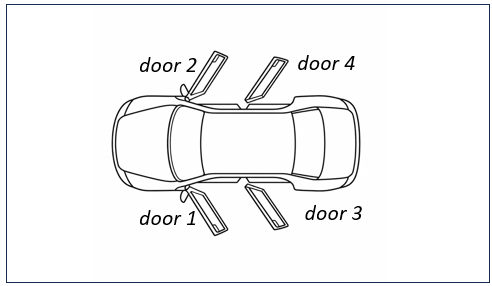
The graph is now:
                   Door1
                    ^
                    |
                   hasDoor
                    |
Door2 <--hasDoor-- MyTaurus --hasDoor--> Door3
                    |
                   hasDoor
                    |
                    v
                   Door4
This is an object property because it connects one resource to another resource.
Compare:
:MyTaurus :doorCount 4 .
with:
:MyTaurus :hasDoor :Door1 .
The first links an entity to a literal.
The second links one entity to another entity.
Defining Sedan Using the Door Objects
If we model doors individually, we can define the Sedan restriction in terms of :hasDoor.
For example:
:Sedan owl:Class ; rdfs:subClassOf :Car ; rdfs:subClassOf [ owl:Restriction ; owl:onProperty :hasDoor ; owl:qualifiedCardinality "4"^^xsd:nonNegativeInteger ; owl:onClass :Door ] .
This says:
Every Sedan has exactly four
Doorindividuals through thehasDoorrelationship.
This is richer than:
:doorCount 4
because the four doors now have identities and can themselves participate in the knowledge graph.
For example:
:FrontLeftDoor :Door ; :position :FrontLeft ; :contains :SideImpactSensor17 .:MyTaurus :hasDoor :FrontLeftDoor .
We can continue following relationships through the graph.
That is one reason knowledge graphs often model important things as entities rather than reducing everything to literal attributes.
But Cardinality Reveals the Open-World Assumption
There is another subtlety here.
Suppose our ontology says a Sedan has exactly four doors:
:Sedan rdfs:subClassOf [ owl:Restriction ; owl:onProperty :hasDoor ; owl:qualifiedCardinality "4"^^xsd:nonNegativeInteger ; owl:onClass :Door ] .
and an instance (real car) contains only:
:MyTaurus :Sedan ; :hasDoor :Door1, :Door2, :Door3 .
OWL does not necessarily conclude:
Error! MyTaurus has only three doors.
RDF/OWL normally operates under the open-world assumption. Absence doesn’t imply non-existance.
The graph says that three doors are known. It does not say there cannot be another door that has simply not been stated.
Similarly, suppose five door IRIs are listed. OWL cannot necessarily assume that all five denote different things unless their distinctness is known.
This is an important difference between:
reasoning about what must be true,
and:
validating whether a data record contains exactly the expected four values.
For strict data validation, SHACL may be the more natural mechanism.
The same innocent Sedan example therefore leads directly into one of the most important distinctions in Semantic Web technology:
OWL describes and reasons about the world; SHACL can validate whether supplied data conforms to expected shapes.
Necessary Versus Sufficient Conditions
There is still another possible interpretation of:
A Sedan is a Car with four doors.
Suppose we write:
:Sedan rdfs:subClassOf :Car ; rdfs:subClassOf [ owl:Restriction ; owl:onProperty :doorCount ; owl:hasValue 4 ] .
This means:
Sedan → CarSedan → four doors
Every Sedan is a Car with four doors.
But the reverse is not stated.
If we encounter:
:MysteryCar :Car ; :doorCount 4 .
we cannot infer merely from that definition that:
:MysteryCar :Sedan .
Four doors may be a necessary property of a Sedan without being sufficient to identify one.
Perhaps hatchbacks also have four doors.
Suppose, merely for illustration, we declare that being a Car with exactly four doors is the complete definition of Sedan. Then we can use an equivalent class:
:Sedan owl:equivalentClass [ owl:Class ; owl:intersectionOf ( :Car [ owl:Restriction ; owl:onProperty :doorCount ; owl:hasValue 4 ] ) ] .
Now the reasoning runs both ways:
Sedan →Car with four doorsandCar with four doors →Sedan
The second direction is much stronger.
It allows a reasoner to classify an individual as a Sedan from its characteristics.
Domain and Range Add Another Kind of Meaning
Consider:
:hasDoor owl:ObjectProperty ; rdfs:domain :Car ; rdfs:range :Door .
It is tempting to read this like a database constraint:
hasDoormay only be used on Cars, and its target must be a Door.
RDFS semantics are somewhat different.
If we state:
:MysteryObject :hasDoor :Something .
the domain and range can support the inferences:
:MysteryObject :Car .:Something :Door .
In other words, domain and range contribute meaning and inference. They are not merely error-checking declarations.
Again, RDF modeling asks us to distinguish:
What do I want to infer?
from:
What do I want to reject as invalid data?
Those are not always the same job.
One Sentence, Several Models
We can now return to the original sentence:
Sedans have four doors.
Depending upon what we mean, we might encode it in several different ways.
A particular sedan has four doors
:MyTaurus :Sedan ; :doorCount 4 .
Four doors are a necessary characteristic of every Sedan
:Sedan rdfs:subClassOf [ owl:Restriction ; owl:onProperty :doorCount ; owl:hasValue 4 ] .
Sedans typically have four doors
:Sedan :typicalDoorCount 4 .
where :typicalDoorCount is deliberately metadata describing the category rather than an inherited property.
The Sedan category has some administrative property
:Sedan :taxonomyCode "SED" .
That is genuinely a fact about the class resource.
A particular sedan is related to four actual door entities
:MyTaurus :hasDoor :Door1, :Door2, :Door3, :Door4 .
Having four doors is sufficient as well as necessary to classify a Car as a Sedan
Use an owl:equivalentClass definition rather than merely rdfs:subClassOf.
The English sentence did not tell us which of these meanings was intended.
The ontology must.
The Larger Lesson
This is one of the most important lessons in knowledge-graph modeling. RDF gives us an extremely simple structure:
subject → predicate → object
But that simplicity does not relieve us from deciding what our statements mean. Here is the checklist points for this article:
- A class is a resource.
- An instance is a resource.
- A property may connect a resource to another resource or to a literal.
- A class may have metadata describing the class itself.
- A class restriction may describe what must be true of its members.
- A subclass relationship says that membership in one class implies membership in another.
- An equivalent-class definition can allow classification in both directions.
- A descriptive statement such as “Sedans usually have four doors” should not automatically be promoted into a universal logical axiom.
The hard part is therefore often not writing Turtle. The hard part is deciding which claim we intend to make.
That is where knowledge graphs force discipline. Human language effortlessly slides between the interpretations of sedans and four doors.
To a human, context often resolves the difference without conscious effort. To an ontology, those are different claims.
Making those differences explicit is not an inconvenience of RDF. It is much of the point of RDF and OWL.
Also see a related blog, Judo, Jiujitsu, and BJJ: When a Name Turns the Family Tree Backwards. It’s about my confusion when I heard a BJJ practitioner say, “Judo is the ancestor of Jiujitsu”. To my “judo enthusiast” but not BJJ ears, that’s not right. It’s a fun story of a recent personal experience with mismatched semantics, and the importance of a semantic web as a component of a system of AI.


[like] Jennifer Nichols reacted to your message: