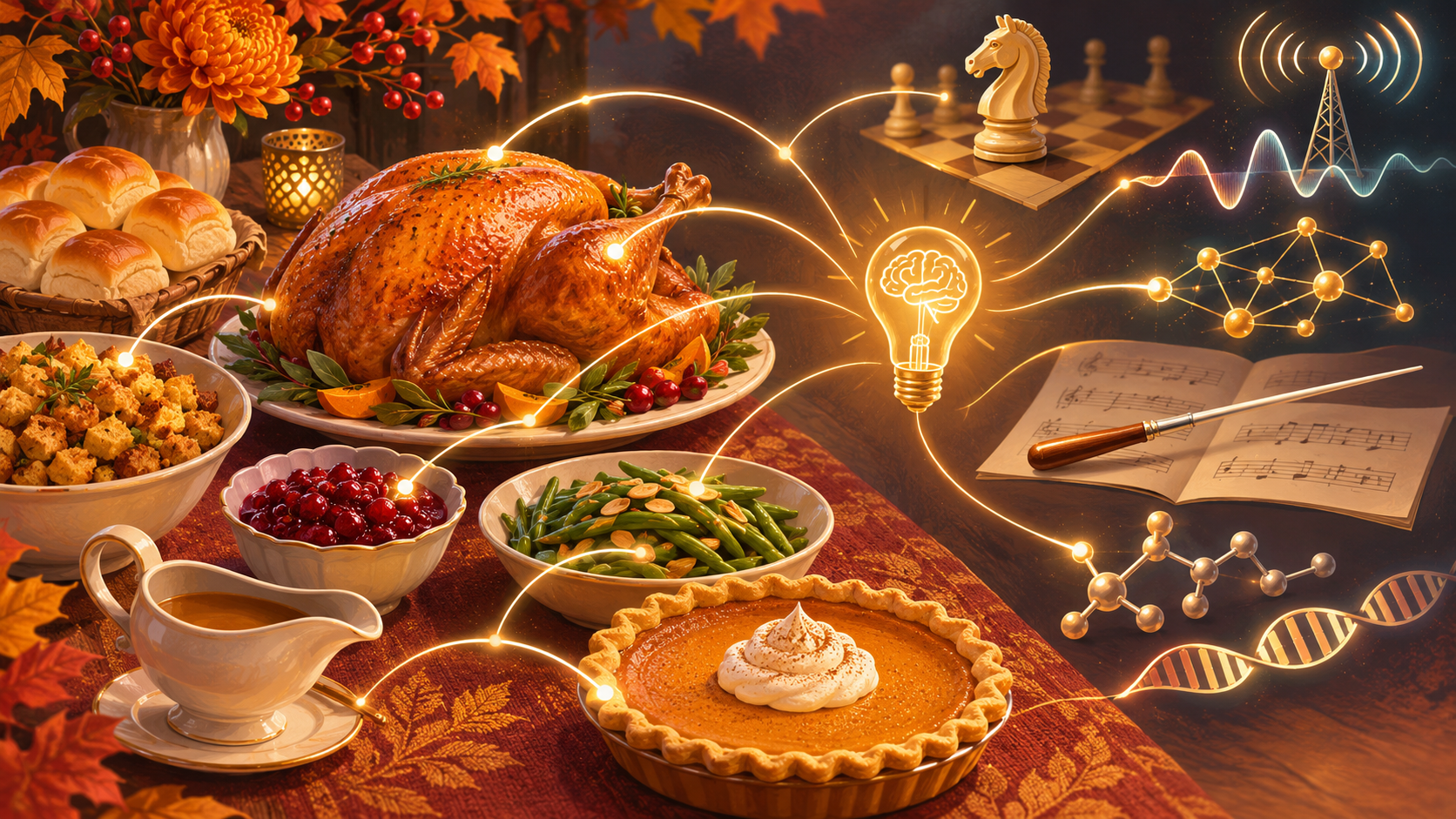
How analogical reasoning helps LLMs escape familiar answers and discover ideas from seemingly unrelated fields.
TL;DR
I recently came across a Stanford paper that I believe deserves much more attention than I’ve seen it receive: Unlocking LLM Creativity in Science through Analogical Reasoning, by Andrew Shen, Shaul Druckmann, and James Zou, released in May 2026.
The researchers demonstrate that explicitly directing large language models (LLMs) to identify relationships shared by seemingly unrelated problems can dramatically increase the diversity and novelty of scientific ideas.
They evaluated the approach across 50 biomedical research problems using three frontier LLMs. Their method improved solution-diversity metrics by 90–173% over conventional prompting approaches. They also implemented selected ideas across four biomedical research problems, reporting improvements on established benchmarks.
I’ve spent considerable time over the past couple of years writing about analogy, original thinking, the broad knowledge innately contained within LLMs, and the value of stories and experiences. Several of the Stanford findings align closely with ideas I’ve independently explored.
But the primary purpose of this article is to draw attention to the researchers’ work. I think this paper addresses something fundamental about intelligence.
A Paper I Almost Missed
I had a surprisingly difficult time finding this paper. It’s relatively new (preprint was submitted on May 11, 2026), for one. Perhaps I’ve simply been looking in the wrong places. The paper certainly hasn’t been ignored by the academic community. It has been accepted as a poster at NeurIPS 2026, Andrew Shen presented the research at a Stanford seminar in October, and James Zou discussed it in a September interview. But like many important papers, it can take more than a few weeks to gain mainstream attention.
Still, given what I consider its significance, I’m surprised I didn’t encounter it sooner. I had intended to publish a different blog this week, but my final round of due diligence finally dug up this paper.
There’s certainly no shortage of attention being devoted to AI agents, world models, increasingly capable reasoning models, and various architectural innovations. I follow those developments closely. Many are genuinely impressive.
But I believe there’s another dimension of intelligence that deserves at least as much attention: How do we discover an idea that wouldn’t ordinarily occur to us?
It sounds like a simple question. Suppose I ask an LLM to propose ten solutions to a difficult engineering problem. Chances are, several will be reasonable, and some may even be excellent. But what happens when I ask it again? Or ask a different LLM?
How many genuinely different approaches will I get? How many will be variations of the most familiar solutions already associated with the problem? The Stanford researchers investigated that phenomenon directly. And what they discovered is intriguing.
The Problem: LLMs Tend to Return to Familiar Solutions
The researchers describe a tendency toward mode collapse in open-ended scientific solution generation. An LLM may know an extraordinary amount about biology, economics, physics, mathematics, computer science, engineering, and countless other subjects. Yet when asked to generate solutions to a particular problem, it repeatedly gravitates toward a relatively narrow set of familiar approaches.
The issue isn’t necessarily that the model lacks the relevant knowledge. It may know something from a completely unrelated domain that could inspire a new approach, without making that connection on its own.
Consider the amount of knowledge encoded within a modern LLM. Much of that knowledge comes from disciplines that have evolved independently, across countless domains, often using different terminology to describe similar relationships.
We have developed methods for controlling traffic, managing financial risk, identifying astronomical signals, predicting chemical behavior, and evaluating chess positions. Some of the underlying relationships may be surprisingly similar. But when we’re working on a biomedical problem, why would we think of chess?
That is exactly the kind of question the Stanford researchers explored.
Analogical Reasoning: Relationships Rather Than Resemblance
The researchers introduce a method they call Analogical Reasoning (AR), drawing on established cognitive science, particularly the structure-mapping theory of analogy. An important idea is that an analogy doesn’t depend primarily on the outward similarity of objects. It depends on relationships. For example:
A CEO is to a company as a conductor is to an orchestra.
The CEO and conductor aren’t similar objects. Neither are a corporation and an orchestra. But both relationships concern coordinating the activities of many participants toward a larger objective.
The analogy may break down in numerous ways. That doesn’t prevent a particular relationship from suggesting something interesting. Stanford’s method explicitly represents analogies through object mappings and shared relations.
It consists of two primary stages.
1. Discover relationships across domains
- The LLM examines a research problem, identifies the objects involved, and considers their relationships.
- It then generates analogous situations from other domains, specifying the corresponding objects and shared relationships.
An analogy doesn’t have to account for everything about the original problem. Partial relational correspondences are permitted. This is particularly interesting because an unconventional idea may originate from a small piece of a much larger experience.
2. Investigate methods from the analogous domain
- The second stage gives the original research problem and the generated analogy to another LLM.
- It investigates whether an approach used in the analogous domain might be adapted to the original problem.
- The analogy provides a possible direction. The subsequent reasoning explores how that direction might become a viable approach.
The researchers compare this technique with simply asking for solutions and with prompting the model to look for solutions in other domains without explicitly generating relational analogies.
That’s an important experimental comparison.
Simply telling an LLM to search other fields was less effective than asking it to discover and explore the relationships connecting those fields.
My Favorite Example: Chess and Therapeutic Molecules
One of the paper’s most intriguing demonstrations connects chess evaluation with the prediction of therapeutic properties of short nucleotide sequences, called oligonucleotides.
In chess, the value of a piece depends partly on its position on the board. A knight near the center can be more valuable than one stranded at the edge. Traditional chess engines can encode this using piece-square tables, which represent positional values for different pieces.
In the biomedical problem, the properties of short nucleotide sequences can also depend upon the positions of particular sequence patterns.
The Stanford approach identified the relational similarity. An element’s contribution depends partly on where it occurs within a larger structure. That analogy suggested adapting positional evaluation techniques from chess to the prediction of oligonucleotide properties.
The researchers incorporated features inspired by piece-square tables into a simple linear model. They tested the approach on six smaller datasets under two evaluation settings. The positional features improved the linear baseline on five of six datasets in one setting and all six in the other. Combining those features with existing sequence features achieved state-of-the-art results on two of the six datasets.
These are limited but concrete results, not a claim that chess has somehow solved molecular biology.
What captivates me is the initial connection.
Someone investigating therapeutic nucleotide sequences might have deep expertise in chemistry and biology without ever thinking of chess evaluation.
Yet the relationship, once exposed, provides something that can be investigated mathematically and experimentally.
An unusual idea becomes a serious engineering hypothesis.
That’s a wonderful demonstration of what creative analogy can accomplish.
Three More Biomedical Examples
The paper includes three additional implemented case studies:
- Economics and cellular responses. Different consumers respond differently to an economic policy change, just as different cells may respond differently to the same chemical perturbation. Population averages can conceal important variations. The analogy led to finite mixture models from econometrics, which improved the prediction of cellular response distributions. Combining the approach with an existing baseline produced an approximately 13-fold improvement on one distributional error metric in the evaluated dataset.
- Telecommunications and cell-to-cell communication. Detecting a meaningful signal against background noise is a familiar telecommunications problem. In biology, detecting molecules associated with communication between cells doesn’t necessarily establish that meaningful signaling occurred. The researchers adapted a signal-to-noise approach, achieving the best reported performance on one benchmark metric against 14 comparison methods.
- Communication networks and brain-region interactions. Signals moving through a network have temporal relationships that can complicate the identification of interactions. The system used an analogy to communication networks to identify the PCMCI method for analyzing relationships between brain regions. The resulting interaction estimates showed strong agreement with an existing method across 18 neural activity sessions.
I encourage readers to examine the actual methods, results, and limitations in the paper rather than relying on these summaries.
The point is not that every distant analogy becomes a successful solution. It’s that analogical reasoning can provide new approaches that deserve investigation, even when they originate far outside the field containing the original problem.
What the Experiments Actually Demonstrated
The researchers evaluated three LLMs: Claude Sonnet 4.5, GPT-5.2, and Gemini 3 Flash. They compared ordinary solution generation, cross-domain solution generation, and their explicit Analogical Reasoning method across 50 biomedical research problems.
The results are kind of magnificent.
| Measurement | Stanford’s finding |
|---|---|
| Solution diversity | 90–173% improvement over comparison approaches |
| Breadth of source domains | Nearly 3.5 times as many unique domains as the strongest baseline |
| LLM-judged solution novelty | 50.4–68.8% of AR proposals classified as novel, depending on the model |
| Human evaluation | AR proposals preferred as more novel in 78% of paired comparisons against the cross-domain baseline |
| Practical case studies | Four implemented biomedical approaches with reported quantitative gains |
There are some qualifications worth emphasizing. The novelty percentages rely substantially on LLM-based judgments informed by literature retrieval, although the researchers conducted human evaluations as well.
The 78% figure measures relative novelty preference, not the percentage of solutions that succeeded. Human reviewers also judged 67% of the analogically generated proposals reasonable, compared with 86% for the cross-domain baseline. Agreement among reviewers about reasonableness was relatively low, especially for the analogical proposals.
That is a genuine limitation, and the researchers acknowledge that many creative analogies won’t lead to feasible solutions. This is a reminder of something fundamental about creative work. An unusual idea doesn’t need to arrive fully engineered. An idea is the trailhead of a direction worth exploring.
Some, often the vast majority, directions will prove fruitless. Others may be developed through additional reasoning, analysis, experimentation, and engineering. The scientific challenge is to discover promising directions without mistaking novelty for correctness.
Connections to My Earlier Writing
This research resonates with several ideas I’ve explored in articles over the past couple of years. I want to emphasize that analogy is an established subject in cognitive science. I’m not claiming to have invented it, nor am I suggesting that the Stanford paper validates every conjecture I’ve made.
What I am excited about is the independent experimental evidence from an incredibly prominent institution for several principles that have increasingly shaped my thinking.
| My earlier writing and examples | Connection to Stanford’s findings |
|---|---|
| Analogy and Curiosity-Driven Original Thinking — June 2025. I explored analogy as the seed of original thinking, including the idea that a CEO’s relationship to a company can resemble a conductor’s relationship to an orchestra. I also discussed representing analogical relationships in knowledge graphs. | Strong direct alignment. Stanford explicitly maps objects by their roles and shared relationships. Its experiments demonstrate that this approach can improve creative scientific ideation. |
| Long Live LLMs! The Central Knowledge System of Analogy — November 2025. I argued that the breadth of knowledge within LLMs helps enable unexpected cross-domain associations. I also explored an analogy between SSAS Multidimensional versus Tabular and large versus small language models. | Strong conceptual support. Stanford exploits cross-domain knowledge within existing LLMs. It does not establish my further conjecture that a large integrated model is inherently better for analogy than a distributed collection of specialized models. |
| The Products of System 2 — March 2026. My informal Buc-ee’s experiment showed how models could become trapped in familiar interpretations of an analogy. | Closely related evidence. Stanford measured convergence toward familiar scientific solutions and demonstrated that explicit relational analogy substantially broadened the range of responses. |
| Stories, Analogies, Metaphors—the Layer After LLMs — October 2026. I used Star Trek: The Next Generation’s “Darmok” to explore stories as compact references to relationships, events, and shared experiences. | Conceptual alignment. Stanford shows the effectiveness of explicit relational mappings. It doesn’t test the more ambitious architecture of persistent, reusable story libraries. |
| Eliciting Creative Questions from AI for Abductive Calculation — November 2026. My physical-books experiment showed how an LLM could repeatedly ask variations of familiar questions while overlooking another relationship, such as the substitution of electronic books for physical ones. | Supporting evidence for structured exploration. Stanford found that deliberately exploring alternative relationships increased idea diversity. It didn’t test my specific approach to generating creative questions. |
| Maybe We’re Not as Smart as We Think: Evolution’s Library and the Origins of Ingenuity — November 2026. I explored a hypothetical chain in which imperfect associations and unexpected observations might provide the starting points for inventions. | A related but untested hypothesis. Stanford provides evidence that analogical exploration can generate creative scientific approaches. It doesn’t establish how human creativity evolved or whether most inventions begin through accidental associations. |
I’m particularly pleased about the connection to the first three because they concern questions I’ve been exploring independently for some time.
But the broader significance is more important than the chronology. This research provides a concrete way to investigate how LLMs discover ideas across domains and offers evidence that deliberately constructing relationships can expand their creative range.
Buc-ee’s: An Example of the Familiar Interpretation Getting in the Way
I want to revisit the Buc-ee’s example briefly because it illustrates the challenge intuitively.
I posed this analogy to two LLMs in February 2026:
7-Eleven in Japan is the opposite of ______ in Texas, not in terms of cleanliness.
My intended answer was Buc-ee’s. Japanese 7-Eleven stores are compact, ubiquitous, and integrated into ordinary daily routines. Buc-ee’s is almost the opposite: enormous highway destinations, often visited deliberately as part of a road trip.
SuperGrok initially pursued the familiar comparison between Japanese and American 7-Eleven stores. ChatGPT found Buc-ee’s much faster, but initially interpreted the relationship as similarity rather than the intended opposition. With further prompting, it recognized the structural contrast. Interestingly, a restricted LLM-only attempt identified the intended opposition more directly.
Neither model lacked knowledge of the businesses. The challenge was recognizing which relationship I was asking about.
This small, informal experiment isn’t equivalent to Stanford’s research. But it helps explain my enthusiasm for their findings. Their technique deliberately encourages exploration of relational structures that an LLM might otherwise overlook.
Darmok, Creative Questions, and the Unexpected Connection
My Darmok article explored another aspect of analogy: a brief reference to a familiar story can carry a great deal of meaning if the listener knows the story and understands its relationships.
For example, calling Waimea Canyon on Kauaʻi the Grand Canyon of the Pacific depends upon what the listener knows about the Grand Canyon. The analogy is a pointer into a much richer collection of experiences and relationships.
My creative-questions experiment approached the problem from a different angle. When I asked Grok to generate questions for estimating how many physical books I owned, many of its initial questions concerned bookcases, shelf dimensions, and related measures of capacity.
Those questions were reasonable, but they explored much the same approach. What about the effect of Kindle ownership on buying physical books? Or books accumulated and retained from earlier periods of life? Those questions explored different relationships entirely.
With a more general prompt designed to encourage conceptual diversity, the model generated questions from a broader range of perspectives.
Again, that’s not the same experiment Stanford conducted. But it illustrates the same attraction: a different relationship may open an entirely different line of inquiry.
What This Paper Doesn’t Answer
I remain interested in another question: What happens to the creative work after an LLM discovers an analogy?
That question stems from my SQL Server Analysis Services background—which is essentially about how to preserve and quickly retrieve the product of heavy compute.
This is why I’ve been interested in caching analogical relationships in a knowledge graph, particularly the less intuitive ones that even an LLM might not readily think of. Once discovered, these relationships become reusable pieces of knowledge, quickly retrievable to inspire solutions to entirely different problems. Even an LLM can benefit from a cheat sheet.
My writing on stories as the transactional unit of human intelligence and the products of System 2 has explored the value of retaining experiences, relationships, hypotheses, and ideas rather than treating every reasoning session as something disposable.
At the scale of an enterprise, there may be enormous collections of experiences that aren’t available in an LLM’s training data. The analogies and ideas discovered while exploring those experiences might be worth preserving and recalling when related predicaments arise later.
The difficult question is how to retrieve an unexpected association from such a large collection.
I’ve been experimenting with that problem, including preliminary approaches using embeddings and story relationships. In fact, that is the subject of the blog I postponed upon finding this Stanford article a few days ago.
Why I Believe This Is a Fundamental Paper
Many advances in AI (at least at the time of writing) help systems perform known tasks more accurately, more quickly, or at greater scale. This paper investigates how we might expand the space of possibilities an intelligence considers in the first place. That capability seems fundamental to solving genuinely novel problems.
We can have an extraordinary collection of knowledge and still fail to discover a promising idea because we never consider the relationship that would bring it to our attention. Stanford’s Analogical Reasoning method provides a relatively straightforward way to broaden that exploration using existing LLMs.
The results don’t establish a complete theory of creativity, and the method doesn’t guarantee that a novel idea will become a successful solution. But the researchers show that explicit relational analogy can make a measurable difference, and that some of the resulting ideas can be developed into practical scientific approaches.
To me, that’s an important advance—or at least a useful pivoting of approach for enterprise implementation: Task oriented to competetive innovation.
The work also suggests an encouraging direction for AI: improving intelligence doesn’t always mean acquiring more knowledge or building a more powerful model. Sometimes it means finding better ways to explore the knowledge already available—which in the case of today’s frontier models is utterly massive.
Fittingly, there is an analogy for another reason why I find this paper so compelling. When I began developing Map Rock in 2011, my practical motivation as an SSAS expert was to squeeze more value out of existing OLAP cubes. Rather than acquiring more data, the idea was to discover potentially counterintuitive relationships within and across those cubes, accumulating them into a web of correlations that could lead to novel solutions to business problems. I see an analogous opportunity with LLMs today, except that the body of knowledge is vastly larger and the kinds of relationships we can explore are considerably richer.
Conclusion
I’ve spent the bulk of my professional life trying to find better ways to turn information into intelligence. One of the ideas I’ve increasingly returned to is that analogy provides the seed from which original thinking can begin.
An idea can emerge from an unlikely connection. The connection may be incomplete, imperfect, or initially absurd. What begins as a peculiar resemblance can, through further reasoning and experimentation, become something that works.
Shen, Druckmann, and Zou have made a significant contribution by showing how explicitly exploring relational analogies can broaden the scientific ideas generated by LLMs. Their results make me more confident that this direction of research deserves serious attention.
I don’t think a short blog post can do justice to their work. Nor do I want my interpretation to replace theirs.
I hope you’ll read the original paper, study its examples, and consider what analogical reasoning could contribute to problems in your own field:
- Unlocking LLM Creativity in Science through Analogical Reasoning — Andrew Shen, Shaul Druckmann, and James Zou (2026)
- Stanford’s GitHub repository, including code and prompts
I consider this one of the most thought-provoking AI papers I’ve encountered this year.
This Stanford paper preempted the blog I intended to post this week, but that’s OK. I’m a researcher at heart, but an architect/developer by trade. So, this paper thankfully (it is Thanksgiving, after all) strengthens my case with my readers and customers.
Safe travels on this day before Thanksgiving (today is Wednesday, 11/25/2026) and Happy Thanksgiving!


