TL;DR
Much of this is knowingly “duh”. Evolution works through variation, competition, failure, pruning, adaptation, and no permanent winner. Businesses already work much the same way: large enterprises provide scale, challengers pressure them, startups try strange things, many fail, and some failures leave behind knowledge that feeds the next attempt. None of that is new. What is new is dropping AI—an extraordinary accelerant—into that already complex system.
The problem is that signals are coming at us from every direction about the extremes: extraordinary investment costs, enormous expected returns, job displacement, surveillance, dependence, autonomous machines, loss of agency, concentration of power, and, at the other end, the answer genie that supposedly solves everything for us. That is understandable—those extreme versions are also more “fun” to click on. Many of those concerns and opportunities are real. But together they can pull attention away from a much more familiar direction sitting in plain sight. I am not proposing a compromise among the extremes or a new economic control panel to steer us to the “right” outcome. That would contradict the point.
I am suggesting a direction that’s worth keeping in mind as a compass. That is, use AI to strengthen a broad, competitive ecology of millions of enterprises and many more potential startups and individuals, all searching different parts of the solution space. Let successful companies become very large and exploit economies of scale, but preserve a credible path for challengers to churn things—like the corporate version of plate tectonics subduction. Let recoverable failures happen and carry what they teach forward. Avoid turning widespread best practices into strategic monoculture.
That also means separating the improving common intelligence of frontier models from the private accumulated experience of each enterprise: let the shared model raise the floor while private enterprise knowledge helps competitors move different parts of the frontier.
That creates the win-win-win-win I am arguing for (illustrated in Figure 1):
- People get cheap intelligence,
- Competitors get greater capacity for ingenuity,
- Big AI gets a vastly larger market,
- Society gets more of its mundane operational burden automated, monitored, and maintained.
The obvious part is how evolution works. What is easy to lose amid all the competing signals about AI is that evolution also gives us a familiar model for how very different participants can all benefit without requiring one final answer, one permanent winner, or one centrally designed compromise. It does not guarantee that everyone will be happy. But it points toward a direction in which the interests of people, competitors, Big AI, and society can reinforce rather than simply oppose one another.
Guiding Towards a Better Outcome
The scale of investment pouring into AI is extraordinary, and much of it is still speculative. I am not convinced we yet know what returns will justify trillions of dollars of investment—or even whether we really want any of the possible futures that investment could produce. At the same time, today’s frontier models could not have been developed or deployed without extraordinary upfront investment in research, talent, computing, energy, and infrastructure.
I am not arguing that this investment should not have happened, or that slowing AI development is the answer. I am asking what kind of path could turn that investment into an outcome that works broadly for everyone involved.
Billions of people can ask AI questions to execute upon a task or just satisfy a curiosity or even urgent problem. It is becoming something like Google, Wikipedia, tutors, programmers, analysts, researchers, and advisers rolled together. Knowledge that once required finding the right book, expert, class, website, or reading through the top Google results can increasingly be approached by simply asking.
That alone is a profound change. Most of the public conversation naturally sees AI from this perspective. Consumers see an answer genie. The skeptical side of AI talks about hallucinations, jobs, manipulation, privacy, control, and other questions centered on the individual. Investors can fall into much the same frame when they imagine billions of users paying for access to increasingly capable models.
But I don’t think billions of people asking questions—even very good, complicated questions—fully explains the scale of investment now being made in AI. And that is not the competition I mean.
The path toward an outcome that works broadly for all four parties has healthy competition at center stage. By that I do not mean getting into antitrust policy, globalization, tax policy, regulation, or the many other specific levers people use to try to shape an economy. Those are interventions inside an extraordinarily complex system, and control mechanisms are actually the opposite of what I’m writing about.
Nor am I primarily talking about competition between OpenAI, Anthropic, Google, and the other frontier-model vendors.
I mean something more basic: preserving a broad, vigorous ecology of enterprises—from individuals and garage startups through the largest corporations—each trying to survive, grow, discover opportunities, and find better ways forward. Life on Earth offers clues for why this works. It generates enormous variation, tests it under constantly changing conditions, amplifies what succeeds, and prunes what does not.
Pruning means some competitors lose. That is not something to celebrate casually, because real people are affected. But neither should we treat every failure as wasted effort. Failed enterprises, abandoned products, wrong assumptions, and experiments that went nowhere can leave behind experienced people and hard-earned knowledge. A healthy system does not prevent failure. It becomes better at carrying what failure taught us (lessons learned) into the next attempt.
Part of why I think this perspective is worth stating is that so much of the AI conversation gravitates toward extremes. The dystopian versions are familiar from The Matrix, Terminator, and Minority Report: our lives becoming data for machines, machines acting physically against us, or pervasive surveillance trying to predict what we will do, respectively. That is understandable; extreme futures make better headlines and are more fun to click on than a messy middle full of adaptation, tradeoffs, and gradual change. None of those movie worlds yet exist in the portrayed form, but pieces of all three already do in much less dramatic forms.
The opposite extreme—the benevolent intelligence that handles nearly everything for us—isn’t automatically ideal either. I am interested in the broad territory between those endpoints. Evolution offers a familiar example of extraordinary capability emerging without requiring one final design, one permanent winner, or one intelligence deciding what every participant should become.
AI is an accelerant inside that system, not something standing outside it. It can speed experimentation, lower the cost of entering a market, spread successful ideas, expose failures, automate established processes, and help organizations search farther. But accelerants work on whatever is already happening. AI can also spread sameness faster, deepen dependencies faster, and strengthen an incumbent faster. That is another reason the direction of the larger ecology deserves at least as much attention as the capability of the technology itself.
More search is not automatically better in every domain. Powerful discoveries can have harmful applications, and the faster capabilities arrive, the less time the surrounding system has to adapt. Incremental change gives institutions, competitors, norms, and people time to respond; abrupt change can outrun that adaptation. So when I talk about increasing the number and depth of searches, I am not arguing for maximum speed everywhere.
I mean competition among the millions of enterprises already operating around the world, along with the much larger population (perhaps tens of millions) of individual entrepreneurs (seed), garage startups (seedling), and startups (sapling) further along constantly trying something new, churning the system. Also see “My Feeling About AI”, page 23, in Enterprise Intelligence.
AI can make that entire ecology dramatically more capable. And unlike a world in which billions of people ask approximately the same generalized intelligence for answers, those competitors should not all be looking for the same answer. They should be searching in different directions.
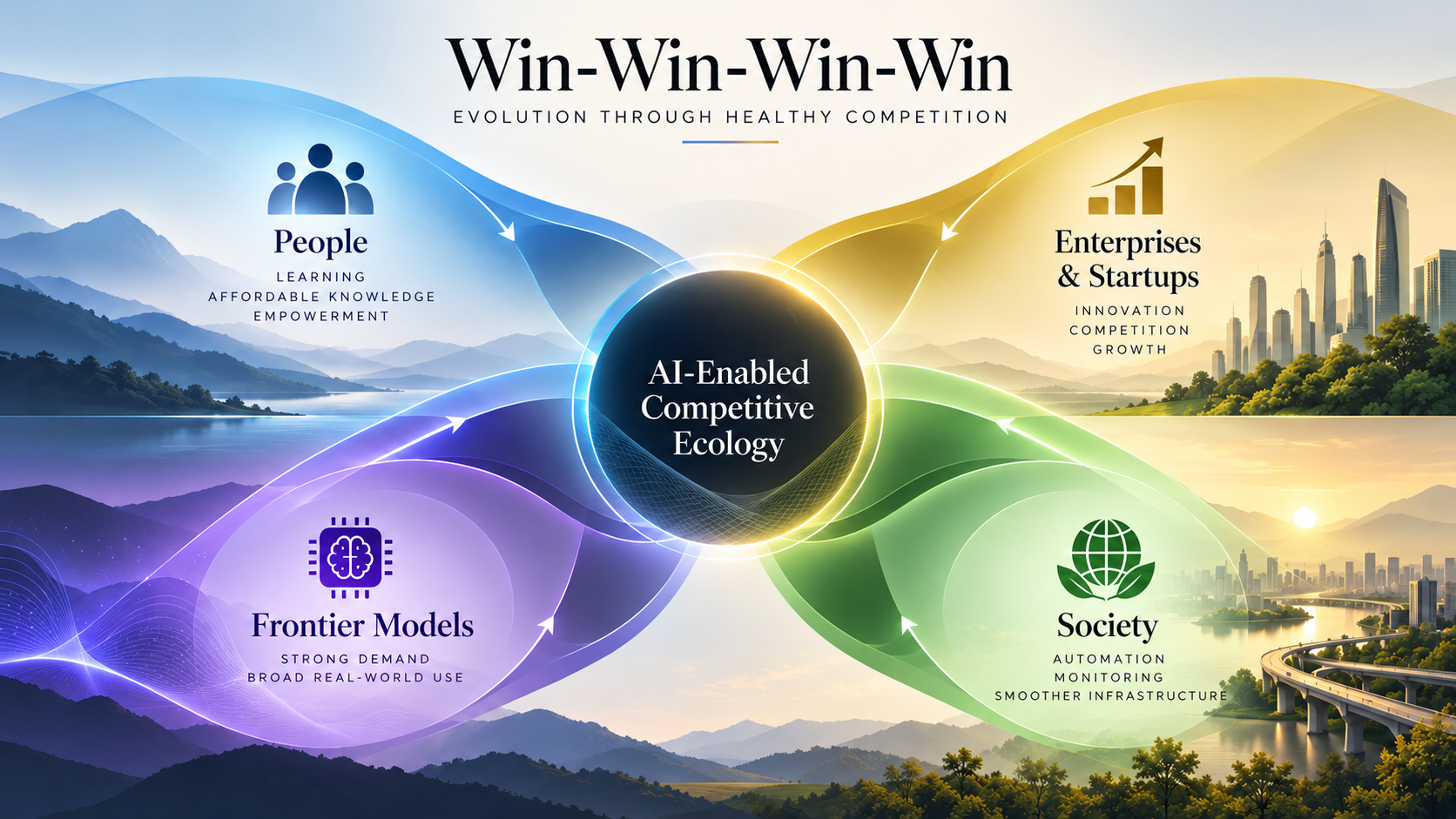
The four wins in the figure are not four isolated systems. People, enterprises, frontier-model companies, and society are all entangled inside a much larger adaptive system, continually changing one another. We try to carve manageable pieces out of that complexity. We build machines to specifications, establish business processes, construct pipelines, define procedures, and automate what we understand well enough to make repeatable. Those structures temporarily reduce uncertainty—and that is enormously valuable. But conditions keep changing. Eventually yesterday’s carefully engineered process can become today’s rigidity, resisting the very changes the larger system is demanding.
Important: I am not proposing a set of controls for steering this system toward the outcome I want. That would contradict much of the point. Complex adaptive systems do not give us a reliable control panel. I am suggesting something more modest. That is, this looks like one promising path for AI, and simply recognizing the path—and some of the ways we could drift away from it—may help us respond more intelligently as events unfold.
When There Is No Answer Key
Most of us spend the first couple decades of life competing in a peculiar way. School generally gives everyone the same questions, and most of those questions have an answer someone already knows:
- What is the capital of France?
- Solve for x.
- What caused the American Civil War?
- Write a program that performs some specified operation.
Even when the work requires reasoning rather than mere memorization, students have generally been taught a process for arriving at an expected answer. Stealing the test helps because knowing the answer ahead of time reduces tests to just a test of memory. The competition is largely over how many questions we can correctly answer from what we have learned and internalized, including our ability to apply learned procedures.
That is a sensible way to learn. But it is not how the most interesting competition among enterprises works. There may be no answer key, not even an assignment. Often there is not even an agreed-upon question.
One enterprise asks how to manufacture something for 8 percent less. Another asks whether the product needs to be manufactured that way at all. Another sees that a capability developed for one industry solves an apparently unrelated problem somewhere else.
The search itself becomes part of the competition. Optimization is one form of this. Reducing a cost might seem mundane, but sometimes the reduction removes a constraint and enables something that was previously impossible.
A new product feature is another. Maybe someone figured out how to make morel flavoring at scale, and so morel-flavored potato chips might be born. It would hardly qualify as mastering fusion, but somebody still had to make the connection between an existing class of product and something that class had not offered before.
Sometimes the connection grows far beyond its starting pieces. The old Reese’s Peanut Butter Cup joke works because chocolate existed and peanut butter existed. The novelty was putting the two together. Once the combination existed, it became its own thing.
The combination of telephone and computer is a far larger example. It did not end with a telephone that could run programs. The connection opened an expanding space of navigation, photography, ride sharing, app stores, banking, social networks, streaming, location-aware services, and businesses that did not fit comfortably inside either of the original categories.
A connection can become a new platform for further connections. That is the kind of ingenuity I mean when I talk about strategy.
It doesn’t have to be world-changing science. It can be a new way to extinguish an oil fire. A new martial technique can provide another path toward the goal the martial art already served. Someone may discover a radically better way to teach a difficult subject. A software architect can connect concepts that had previously lived in separate technology silos.
The innovation can be small or enormous. The common feature is that someone found another path.
Competition as a Distributed Search
Once I look at competition this way, we can see an enormous distributed search. Millions of enterprises are already conducting searches from different starting conditions. Beyond them are millions more individuals and tiny groups that can potentially form something new.
- They do not have the same customers.
- They do not employ the same people.
- They have not experienced the same failures.
- They do not control the same resources.
- They do not have the same history.
- They do not notice the same things.
- And they certainly do not have to imagine the same future.
That variety is part of the engine.
I have worked on enough innovative software over the decades to know how misleading the finished story can become. Once something succeeds, the failed attempts tend to get washed away. The story becomes:
- We had a problem.
- We came up with an idea.
- We built it.
- It worked.
That is rarely what happened. There were bad assumptions. Experiments that went nowhere. Designs that looked elegant and failed under real conditions. Things we built and threw away. Problems we initially misunderstood. Strange results that eventually pointed somewhere more promising.
The mistakes are part of how the solution was found. This is why I don’t necessarily view a failed entrepreneur as damaged goods. Someone who has genuinely tried to build a business and failed may have received an extraordinarily expensive education. Venture capitalists seem to understand this better than most.
The company can disappear while the experience survives in the people. That experience then moves.
People join another startup. They enter an established company. They start something else. They recognize an old failure developing in a new setting. They recombine something learned in one industry with something encountered in another.
A healthy system generates variation, tests it, prunes heavily, preserves some of what was learned, and generates more variation. Pruning belongs in the cycle just as much as experimentation. An economy in which every idea survives would be buried under its own accumulated mistakes.
An economy in which experimentation becomes too difficult eventually stops discovering much that is new. Of course, not every experiment deserves the same tolerance for failure. Creating an artificial pathogen is very different from launching a restaurant concept that nobody wants. Where failure can cause catastrophic or irreversible harm, strong safeguards are warranted. But much of ordinary innovation involves recoverable failure carried out in good faith. We should not make people afraid to conduct those experiments.
I was making a smaller version of this argument back in 2013, when I called Microsoft’s redundant teams attacking similar problems from different directions beautifully Darwinian.
Why I Keep Talking about Life on Earth
Obviously, I don’t want to push the biological analogy (or any analogy) too far, but there is one characteristic of life on Earth that is difficult to ignore. Evolution has no central architect. However, it got us to the point where we could perform impressive, unprecedented tricks.
Most life is not sitting around thinking about evolutionary strategy. Organisms possess phenotypes and behaviors that help them survive and reproduce. Opportunity opens and life tends to move into it. Conditions change. Variation continually creates enormous numbers of failed experiments. Some variants fit the new conditions better. Others disappear.
Meanwhile, every organism encounters resistance from the rest of the system. Competition for resources constrains growth. Predators constrain prey. Prey adaptations constrain predators. Parasites, disease, geography, climate, and resource scarcity add other forms of pressure.
No organism needs to understand the whole web. The web emerges from the interaction. That is the part I find analogous to a healthy economy. Enterprises vigorously pursue their own continuation. Their competitors push back. Customers push back. Suppliers push back. New entrants attack assumptions that incumbents have come to regard as facts.
Other businesses exist partly because somebody needs to inspect, verify, insure, challenge, constrain, or expose the activities of other businesses. Auditors, independent laboratories, security firms, insurers, consumer-testing organizations, due-diligence firms, certification bodies, investigative journalism, and many others form part of that countervailing structure.
They do not all compete for the same sale. They participate in the same ecology. I’ve written about this before using trophic cascades. Robert Paine’s famous starfish experiment showed that removing one participant did much more than remove one predator. Mussels expanded into the opening, other species were displaced, and a diverse tidal ecosystem moved toward a monoculture. The lesson I take from trophic cascades is not that an economy literally operates like a food web. It is that the role of one participant may be visible only through the pressures, opportunities, and indirect effects it creates elsewhere in the system. A competitor, regulator, auditor, startup, supplier, or even a troublesome customer can help shape behavior far beyond its immediate relationship.
We nevertheless tend to manage society as though it were a machine. We even talk about the natural environment that way. Turn this control, adjust that incentive, raise or lower an interest rate, and expect a reasonably predictable output. Machines built to specification can often behave that way. Adaptive systems cannot. Every intervention changes conditions for participants who then change their own behavior in response. To paraphrase Heraclitus, “We never tweak the same economy twice.” That is one reason I am wary of the idea that any central intelligence, however capable, can simply calculate the best answer for everyone. Distributed experimentation gives the larger system many chances to discover what no one actor knew to look for.
The Healthy Churn
I don’t envision a world where giant incumbents simply disappear and everything becomes a chaotic swarm of startups.
Large enterprises provide scale, consistency, accumulated expertise, infrastructure, and the ability to execute things that tiny organizations cannot. This is essentially the David-and-Goliath argument I made in Enterprise Intelligence: the giants provide tremendous scale, while challengers often have to win through ingenuity because they cannot simply match the giants resource for resource (see “David and Goliath” on page 24 in Enterprise Intelligence). But underneath them should be challengers capable of breaking into that top tier. Beneath those challengers should be a huge population of small businesses, startups, individuals, and tiny groups experimenting with possibilities that larger organizations may never have reason to pursue.
I once compared this to an old-growth forest: large established trees, younger contenders capable of eventually reaching the canopy, and an enormous supply of seedlings.
- Some seedlings die.
- Some saplings never reach the top.
- Some established trees eventually fall.
That churn continually opens opportunities and fosters evolution, a good thing in a constantly changing world. We accept this instinctively in sports. A champion deserves to be champion, perhaps for many years. But nobody expects the championship to become permanent property. New competitors appear, old competitors improve, and age itself is the champion’s constant disrupter. The position at the top is earned repeatedly.
I want the same healthy cycle in business. Rising to the top is not the problem. A competitive ecology should produce winners. But their position should never become immune to a better idea arriving from somewhere else.
The human side is very different from biological competition. If a company fails, the people do not have to die with it. Ideally they move elsewhere, carrying what they learned into another part of the economy.
That lets us conduct vigorous competition at a higher organizational level while the humans who composed one failed organization can regroup and try again.
It is one reason I find enterprise-level competition so attractive. One person can certainly create something extraordinary, but in a fast and complicated world it is increasingly difficult for one person to compete across all the capabilities required to turn an idea into something substantial. At the other extreme, nations are far too few to provide the enormous diversity of experimentation I have in mind. Enterprises occupy an interesting middle ground. People can combine complementary skills, compete as groups, fail without the individuals disappearing, regroup, and try again. Millions of enterprises—and an even larger supply of potential ones—give us millions of independent experiments.
Strategic Monoculture
A competitive economy can contain many nominally independent organizations and still lose some of its exploratory power. One route is what I would call strategic monoculture.
- A good idea appears.
- Others recognize that it works.
- Consultants teach it. Analysts describe it. Conferences repeat it. Universities incorporate it into curricula. Vendors package it. Certifications codify it.
None of those people has done anything wrong. The idea may be excellent. But eventually thousands of enterprises may be independently implementing approximately the same excellent idea. The population still contains many organizations, but the searches become less diverse.
AI could accelerate this dramatically. Ask a sufficiently capable model for industry best practices and it may provide a remarkably good answer. That can improve an enterprise.
Now give essentially the same capability to every competitor. If everyone continually asks for the best-known answer, everyone can become better while simultaneously becoming more alike. That is not necessarily premature convergence. Sometimes the prevailing approach genuinely deserves to spread.
But even a very good approach replicated everywhere can leave less of the possibility space under exploration. There is another consequence. Once everybody has learned approximately the same best practices, competitive advantage increasingly shifts toward who can execute those practices at the greatest scale. If everyone is running roughly the same play, the organization able to invest the most in that play has a natural advantage.
Disseminating what works raises the floor (brings more competitors up to the current best-known level). I want that. But raising the floor is not the same thing as moving the frontier. The frontier moves when somebody discovers a different play.
There is another danger: the competitive ecology itself can thin. If customers have few realistic alternatives, if new entrants face barriers high enough that meaningful challenges rarely emerge, or if a small set of participants becomes increasingly insulated from outside pressure, the system loses some of its countervailing force.
I don’t need to assume conspiracy or villainy to worry about this. It is simply a reduction in contestability. The ecosystem has fewer credible ways to push back.
This Is Where AI Can Justify the Trillions in Investment
Most discussions of AI economics naturally begin with productivity: Something used to take ten hours, AI helps complete it in two. Multiply that by millions of workers and the arithmetic quickly becomes enormous.
At this time, there is some proof of that. See My Research Assistant, ChatGPT, page 19, in Enterprise Intelligence (but a lot has happened since 2024).
There is another multiplier. Suppose AI increases the search capability of millions of existing enterprises while also dramatically lowering the barrier for millions more individuals and small teams to attempt something on their own:
- A three-person startup can perform research that once required a department.
- A small company can analyze operational history with techniques once available mainly to large corporations.
- A scientist can explore more hypotheses.
- An architect can investigate combinations that would previously have required several specialized teams.
- An entrepreneur can prototype ideas before raising enough money to hire everyone who would once have been required to test them.
- An experienced worker can preserve expertise that previously vanished at retirement.
- A failed investigation can leave behind clues for the next investigation.
AI can watch well-defined operations, run processes that we understand well, monitor for exceptions, search enormous bodies of information, and help people spend more attention on the things that are not yet routine.
Now AI is doing more than accelerating existing work. It is increasing the number and depth of searches civilization can afford to conduct. That is where I see a much larger economic argument. This does not have to be a zero-sum future. In the simplest terms:
People get cheap intelligence—competitors get greater capacity for ingenuity—Big AI gets a vastly larger market—and society gets more of its mundane operational burden automated, monitored, and maintained.
Those four wins reinforce one another rather than occupying separate boxes:
- Individuals win because extraordinary amounts of knowledge and instruction become available at very low cost.
- Enterprises, entrepreneurs, and the people who work for them win if stronger competition creates new products, services, methods, jobs, and experiences rather than merely reducing the cost of today’s work.
- Frontier-model companies win because their models become part of an enormous amount of ongoing economic activity—not just answering questions, but researching, monitoring, designing, experimenting, operating, and troubleshooting.
- And society wins as more of the well-understood operational substrate can be automated, continuously monitored, and repaired faster. Humans can spend less attention watching machinery we already understand and more attention on the places where somebody still needs to ask a question nobody has asked before.
There Is No One Enterprise Answer
Frontier models possess an extraordinary amount of generalized capability. That is precisely why every enterprise having access to the same model does not by itself create lasting competitive differentiation. Competitors need different answers because they occupy different situations.
- One company has a manufacturing capability another lacks.
- Another has unusual customer loyalty.
- One has suffered a sequence of failures that taught it something its competitors have never encountered.
- Another notices an emerging customer behavior first.
- One organization has a peculiar combination of employees whose experiences allow them to recognize a connection that everyone else misses.
Strategy emerges from those differences. The question isn’t: What should an enterprise do?
It is more like:
Given what we have experienced, what we know, what we can do, what we are trying to become, and what is changing around us, what novel path can we take?
That answer should not be pretty much the same for everyone. In fact, if it becomes similar or even identical for everyone, we have probably squandered part of what AI could have given us.
The Shared Model Problem
Let’s address what looks like a monkey wrench in my argument.
Frontier LLMs cannot simply be trained once and frozen forever. The world changes. New products, technologies, concepts, terminology, events, and relationships appear. Meanings and contexts change. The models—or the larger systems surrounding them—have to keep being updated with the changing public world.
But doesn’t that take me straight back toward homogenization? If millions of enterprises use the same increasingly capable model, they all benefit from the same improving common intelligence. And if the model improved by absorbing every enterprise’s private queries, investigations, discoveries, and responses, then successful searches by one enterprise could eventually raise everybody else to the same answer.
For a moment, that seemed to dead-end the argument.
Having every enterprise run and train its own private frontier LLM is not much of an answer. Most enterprises could not practically train such a model, and an ecosystem in which everyone builds their own model would also undermine the enormous role I have been describing for OpenAI, Anthropic, and the other frontier-model companies.
The better separation is between the shared intelligence of the LLM and the accumulated experience of the enterprise.
That is where the Enterprise Knowledge Graph I described in Enterprise Intelligence and Semantic Webs of Meaning fits. The EKG is an enterprise asset independent of the LLM. It can contain current and proprietary knowledge, relationships, observations, rules, history, and context. A RAG process can retrieve the small part relevant to the problem at hand and temporarily provide that context to a frontier model. The model does not have to be retrained on the enterprise’s knowledge in order to reason with it.
This separation is practical today. OpenAI and Anthropic currently state that, by default, inputs and outputs from their commercial/API offerings are not used to train their general models. That does not mean the providers never process the information—the model obviously must receive the supplied context to answer the request, and data-retention arrangements are a separate consideration—but enterprise knowledge does not have to become training material for the shared model simply because the enterprise used that model to reason over it.
Nor does that make an enterprise an information island. An enterprise exists inside an ecosystem, and to create value it necessarily emits things into that ecosystem: products, prices, documentation, marketing, support information, patents, hiring, partnerships, failures, customer reactions, and countless other observable consequences of what it is doing. We may never see the private chain of investigation and reasoning that produced those emissions, but the emissions themselves become part of the changing public information environment.
That gives us an interesting cycle. Frontier models continue improving their common capability and their understanding of the changing public world. Enterprises privately accumulate different experiences and search different parts of the solution space. Their actions emit new information into the larger ecosystem. Some of that eventually becomes part of the common information environment from which future shared intelligence can learn. The floor rises again, and enterprises begin their next searches from that higher floor.
The shared LLM raises the floor. The enterprise’s private knowledge helps it move its own frontier.
My Search Through This Space
My own work is one attempt. Over the years I’ve been trying to connect Business Intelligence with AI in ways that preserve more of what an enterprise experiences and learns:
- The Enterprise Knowledge Graph from Semantic Webs of Meaning provides a semantic layer of enterprise knowledge that remains independent of the LLM. It can be updated as the enterprise learns and changes, while RAG allows a frontier model to reason temporarily against the relevant private context without requiring that knowledge to become part of the model itself.
- The Insight Space Graph began with a simple observation: analysts continually find small insights while exploring data, but most disappear when the visualization closes. The ISG preserves those observations along with the QueryDefs describing how the data was examined.
- Those queries themselves are events. An investigation has a sequence. An analyst sees something, asks another question, discovers something unexpected, changes direction, and asks the next question.
- That means Time Molecules can potentially model investigative trajectories just as they model other sequences of events. What paths have previously led somewhere? What tends to be investigated next after a certain kind of observation?
- Meanwhile the Tuple Correlation Web can search for relationships with events and conditions outside the analyst’s immediate line of inquiry. Those correlations aren’t answers. They are clues—hints towards causation.
- They can help something like System ⅈ narrow a search space that would otherwise be impossibly large.
- An Expert Reasoning Graph can then preserve more explicit reasoning: observations, possible mechanisms, competing hypotheses, expected evidence, contradictions, investigations, and revisions.
- Formal logic (ex. Prolog) can encode reasoning that deserves deterministic execution.
LLMs can connect these structures, propose possibilities, translate between representations, and help navigate them. This is the direction I have been exploring. I don’t expect it to be the one architecture everyone adopts.
I hope tens of thousands of other architects are pursuing ideas I have never considered, while millions of entrepreneurs, scientists, engineers, artists, musicians, teachers, tradespeople, and other people discover their own combinations from perspectives I don’t possess.
That diversity of creativity—populous searches through the solution space—is the point.
A Cambrian Explosion
AI lowers the cost of capability. Writing software, performing research, analyzing data, designing systems, learning a domain, modeling possibilities, creating media, and planning operations increasingly require fewer resources than they once did. That means:
- The minimum viable size of an ambitious organization can fall.
- A garage startup can attempt something that once required a funded company.
- An individual can explore something that once required a team.
- An established enterprise can afford many more experiments around the edges of its current business.
- Most will not become the next great company.
- Most ideas will not become the next smartphone.
- There should be pruning.
But if AI dramatically increases both the number of independent searches and the sophistication of each search, we should expect more strange combinations, more unexpected paths, more failures that teach somebody something, and occasionally something that opens an entirely new space.
That is the future I hope the AI investment is buying. There are plenty of ways we could end up somewhere else:
- The current investment boom could outrun the economic value it ultimately produces and undergo a severe pruning of its own.
- The benefits of AI could become concentrated rather than widely distributed, leaving fewer credible competitors and fewer independent searches.
- It could accelerate strategic monoculture, making everyone more capable while pushing them toward the same answers.
- Enterprises could use most of the gains simply to cut costs instead of opening new searches.
- AI could succeed so thoroughly that people, businesses, and infrastructure adapt around its constant availability, leaving us surprisingly vulnerable if that capability is suddenly unavailable—even temporarily. I worried about a smaller version of this in Enterprise Intelligence: what happens if the AI plug is pulled after we have assimilated it deeply into society? The more successful the technology becomes, the more consequential even a temporary absence could become. See: “We Think Because We Are”, page 26, Enterprise Intelligence.
I don’t know how to tune all of those risks away, and I would be suspicious of anyone who claimed to. We are part of the system we are trying to influence, and every intervention changes the conditions under which the next decision will be made. What we can do is become better at recognizing these trajectories while they are developing. The path I am advocating is not a centrally designed destination. It is an awareness that a broad, competitive, experimental ecology offers one way for AI’s enormous capabilities to enrich people, enterprises, Big AI, and society at the same time.
Not merely one enormous intelligence producing increasingly good answers for society. Not a world where every enterprise asks the same system for the same best practices and gradually becomes an optimized variation of everyone else.
A much more interesting possibility is a Cambrian explosion of independently evolving enterprises and ideas, assisted by increasingly capable AI but still starting from different experiences and searching in different directions.
That is how the pie grows. The trillions may not come primarily from answering the questions we already know how to ask. They may come from enabling millions more independent searches for answers—and questions—that nobody has discovered yet.
Conclusion
We are already seeing pieces of the extreme AI futures everybody argues about. The point of this essay is not to predict which extreme wins, or to split the difference among them.
It is to keep an attractor that pulls us towards a direction—one that is much more familiar than the futures usually dominating the conversation. Evolution reminds us that large, adaptive systems can support very different participants pursuing their own interests while still producing something larger than any one participant could design. Some become dominant, challengers emerge, failures disappear but leave behind experience, and the system continues to adapt.
AI can accelerate that process, for better or worse. But if the result is a diverse competitive ecology in which large enterprises can exploit scale, challengers retain a credible path upward, people gain access to extraordinary intelligence, frontier-model companies participate in a much larger economy, and society automates more of what it already understands, then the interests of those parties need not be fundamentally opposed.
That is the happy path I mean—not a guaranteed destination, and not a centrally designed compromise, but a direction in which the gains of one part of the system can help create opportunities for the others, for mutual benefit.


